What Does A Cst Dental Cleaning Cost?
When you search for “CST dental cleaning,” you might be looking for information about a specific clinic, a specific type of training program, or a specialized procedure. The acronym “CST” can refer to a few different things in the dental and medical world. However, in the context of dental hygiene and education, it most commonly refers to a Certified Surgical Technologist (who sometimes assists in dental surgeries) or, more likely, a student or facility associated with a Community College or Technical School dental hygiene program.
In many cases, “CST” refers to “Community and Technical Colleges” or specific school districts that offer dental hygiene clinics. Alternatively, you might have seen the term “CST” used for “Certified Specialist in Teeth cleaning” in marketing materials, though this is not a standard medical title.
To give you the most useful answer, we will interpret this query in two ways: the cost of a dental cleaning performed by a dental hygiene student (often at a community or technical college, which fits the “CST” education model) and the cost of a standard professional cleaning at a private dental office. This guide will help you understand the price difference between these two worlds.
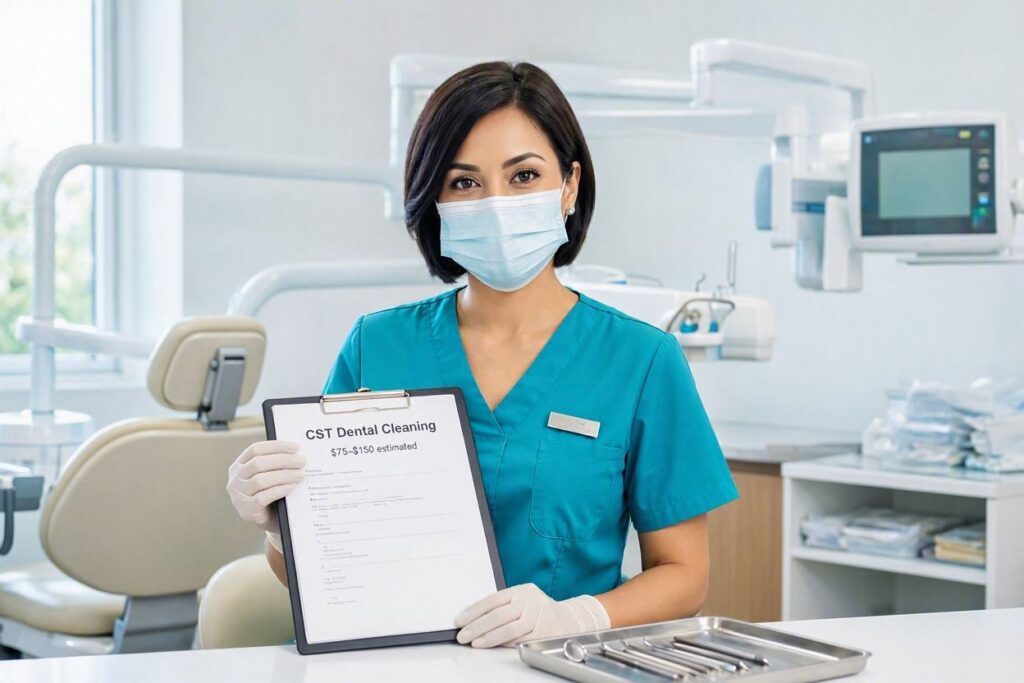
The Cost of a Dental Cleaning at a Dental Hygiene School (CST Model)
Many community colleges, technical schools, and universities have dental hygiene programs. To graduate, students must complete a certain number of hands-on clinical hours. They provide these services to the public at a significantly reduced cost.
This is the most budget-friendly way to get a thorough, professional cleaning.
The Price:
At most dental hygiene schools, a cleaning typically costs between $20 and $50. Some schools offer free cleanings during specific community outreach days or if you volunteer for a board exam patient.
What is Included?
Even though the price is low, the service is extensive. Because it is a learning environment, the process is slower but very thorough.
- Full Medical History Review: The student will review your health history in detail.
- Oral Examination: A supervising dentist or hygienist will examine your mouth.
- X-Rays: If needed, they will take x-rays (often at an additional small fee of $10-$25).
- Scaling and Root Planing: The student will meticulously remove plaque and tartar.
- Polishing: Your teeth will be polished.
- Fluoride Treatment: Usually included.
The Trade-Off: Time
You cannot expect a quick 30-minute visit. At a school, the cleaning is performed step-by-step, with the instructor checking the student’s work at various stages.
- Appointment Length: 2 to 4 hours.
- Number of Visits: You might need to return for 2 or 3 appointments to complete the cleaning, depending on how much tartar you have.
The Cost of a Standard Dental Cleaning at a Private Office
If you are not interested in a school setting, you will go to a standard private dental practice. Here, the cost is determined by the type of cleaning you need. Not all “cleanings” are the same.
1. Prophylaxis (Prophy) – The “Standard” Cleaning
This is what most people think of when they schedule a cleaning. It is for patients with healthy gums (no gum disease).
- What it is: Removal of plaque and tartar from the visible surface of the teeth and just below the gumline.
- Cost (Without Insurance): $75 – $200.
- Cost (With Insurance): Often 100% covered (Free to the patient) as a preventive service.
2. Scaling and Root Planing (SRP) – The “Deep Cleaning”
This is not a routine cleaning. It is a treatment for periodontal disease (gum disease).
- What it is: Removal of tartar from deep below the gumline, down to the roots of the teeth. It usually requires local anesthesia (numbing).
- Cost (Without Insurance): $200 – $400 per quadrant (your mouth is divided into 4 quadrants). A full-mouth deep cleaning can cost $800 – $1,600.
- Cost (With Insurance): Usually covered at 50-80% after your deductible is met.
3. Periodontal Maintenance
If you have had gum disease in the past, you need this specialized cleaning instead of a standard prophy.
- What it is: A cleaning for patients with a history of gum disease. It is done every 3-4 months to keep the disease from returning.
- Cost (Without Insurance): $100 – $250 per visit.
A Cost Comparison Table for Dental Cleanings
| Type of Cleaning | Location | Average Cost (No Insurance) | Time Required | Who Needs It? |
|---|---|---|---|---|
| Student Cleaning (Hygiene School) | Community College/University | $20 – $50 | 2-4 hours (multiple visits) | Budget-conscious patients with time to spare. |
| Standard Prophylaxis | Private Dentist | $75 – $200 | 45-60 minutes | Patients with healthy gums and minimal tartar. |
| Full Mouth Debridement | Private Dentist | $150 – $300 | 60-90 minutes | Patients who haven’t had a cleaning in years (heavy tartar). |
| Scaling & Root Planing (per quadrant) | Private Dentist | $200 – $400 | 1-2 hours (per quadrant) | Patients with active gum disease (periodontitis). |
Why Do You Need X-Rays With a Cleaning?
Many patients ask if they can skip the x-rays to save money. While tempting, this is not recommended. X-rays are the only way to see what is happening between the teeth and under the gums.
- Cavities: You cannot see cavities starting between teeth with the naked eye. An x-ray catches them early.
- Bone Loss: The x-ray shows the health of the bone supporting your teeth. You might have a “cleaning” but still be losing bone silently.
- Cost of X-Rays: 4 bitewing x-rays usually cost $50 – $100.
Why Does a “Deep Cleaning” Cost So Much?
The price of Scaling and Root Planing (SRP) shocks many patients. It seems like “just a cleaning,” but it is a therapeutic procedure.
- Time: It is tedious work. The hygienist must remove calcified deposits from the roots of the teeth, which takes much longer than a standard cleaning.
- Skill: It requires advanced instrumentation and knowledge of root anatomy.
- Anesthesia: You need to be numbed, which adds to the cost.
- Medication: Often, antibiotics are placed under the gums to kill bacteria.
Important Note for Patients: “If a dentist says you need a ‘deep cleaning,’ it is because the health of your mouth is at risk. Gum disease is the leading cause of tooth loss in adults. Spending the money on the SRP now will save you thousands of dollars in dentures and implants later.” – Dr. Maria Lopez-Howell, DDS, spokesperson for the American Dental Association.
How to Save Money on Your Dental Cleaning
If you lack dental insurance, there are still several ways to access affordable care.
- Dental Discount Plans: As mentioned in previous articles, these are membership plans. You pay $80-$200 a year and get access to discounted rates at participating dentists. A cleaning might cost you $50-$100 instead of $150.
- Groupon and “New Patient Specials”: Many private practices offer incredibly cheap cleanings ($59 or $79) to attract new patients. This includes the exam, x-rays, and the cleaning. This is an excellent way to get high-quality care for a low price. Just be wary of “upselling” if the dentist finds other issues.
- Dental Schools (DDS Schools): While we covered hygiene schools above, full dental schools offer cleanings as well. They are usually slightly more expensive than hygiene schools but still very cheap.
- Non-Profit Events: Organizations like “Mission of Mercy” or local health departments often host free dental clinic days. These are first-come, first-served.
The Cost of Neglect
It is important to reframe how you look at the cost of a cleaning. It is not just an “expense”; it is a form of insurance against future bills.
- Cost of a Cleaning: $75 – $200 per year.
- Cost of a Filling: $150 – $400 (caused by not catching decay early).
- Cost of a Root Canal and Crown: $2,000 – $4,000 (caused by ignoring the cavity).
- Cost of an Implant: $3,000 – $6,000 (caused by losing the tooth).
Spending $100 a year on a cleaning is the most effective financial decision you can make regarding your dental health.
Conclusion
A “CST” dental cleaning, typically done at a community or technical college, can cost as little as $20 to $50, though it requires a significant time investment. Standard cleanings at private offices range from $75 to $200, while deep cleanings for gum disease can cost $800 or more. Understanding the type of cleaning you need is crucial to understanding the price.
Frequently Asked Questions (FAQ)
1. Is a dental cleaning painful?
A standard prophy should not be painful if your gums are healthy. If you have heavy tartar or inflamed gums, you might experience some discomfort. A deep cleaning (SRP) always requires numbing to keep you comfortable.
2. How often should I get a dental cleaning?
The standard recommendation is every six months. However, if you have gum disease, are a smoker, or are prone to cavities, your dentist may recommend every 3 to 4 months.
3. Can a hygienist clean my teeth without a dentist present?
In most US states, a hygienist can perform a cleaning under “general supervision” of a dentist, meaning the dentist has examined you recently but does not have to be in the room during the cleaning.
4. What happens if I haven’t been to the dentist in 10 years?
You will likely need a “Full Mouth Debridement” or a deep cleaning. The tartar has likely hardened into a thick layer. This takes longer and costs more than a standard cleaning.
5. Do I need a cleaning before teeth whitening?
Yes. You cannot whiten teeth that are covered in plaque and tartar. The bleach will not penetrate the tartar. A cleaning is always the first step to a brighter smile.
Additional Resource
To find a dental hygiene program near you (often offering low-cost CST-style cleanings), visit the American Dental Hygienists’ Association: https://www.adha.org/