What to Do If the Crown of the Dental Implant Falls Out?
You are eating a piece of bread, something soft and innocent, when you feel a sudden, odd sensation. Your tongue explores the area, and a jolt of panic shoots through you. The crown on your dental implant is loose, or worse, it has come out completely in your hand. Your mind floods with questions. Is the whole implant ruined? Is this an emergency? Did I swallow it? What do I do right now?
First, take a deep breath. A dislodged implant crown is a relatively common mechanical complication, and in the vast majority of cases, it is fully fixable. The implant fixture, the titanium post in your jawbone, is almost certainly still solid and intact. The crown has simply separated from the abutment, or the abutment and crown together have separated from the implant. This is a nuisance, not a catastrophe.
This guide will walk you through exactly what to do in the minutes, hours, and days after your implant crown falls out. We will diagnose the possible causes, explain the treatment for each, and tell you what absolutely not to do.
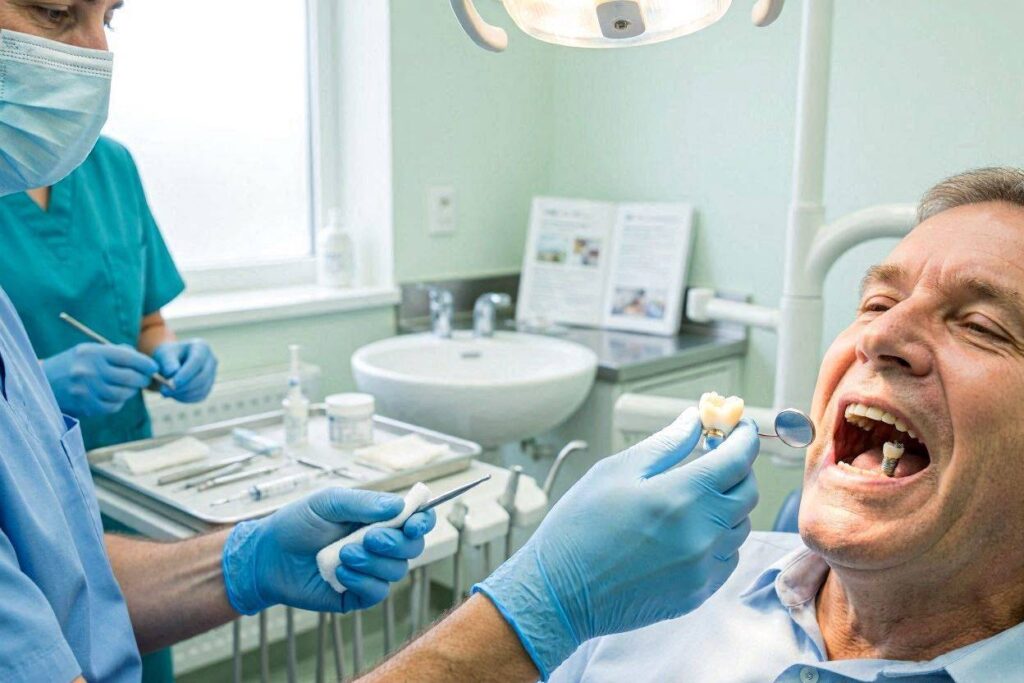
Immediate Action: The First Five Minutes
The moment you realize the crown is out, follow these steps calmly.
1. Retrieve the Crown or Abutment Safely
If the crown has fallen into your mouth, carefully remove it. If you were eating, check the food and your mouth to ensure you have all the pieces. If you suspect you may have swallowed the crown, do not panic. A smooth crown or abutment will usually pass through the digestive system without incident, but you should contact your dentist or physician for guidance. If you think you may have inhaled it (into your airway), which is much rarer and would cause coughing or difficulty breathing, seek emergency medical attention immediately.
Place the retrieved crown or abutment in a safe, clean container, a small plastic bag, a pill bottle, or a small jar. Do not wrap it in a tissue, as it is too easily thrown away accidentally.
2. Inspect the Site
Look in the mirror. What do you see?
- Scenario A: You see a metal or white post (the abutment) still sticking out of the gum. This means the cement between the crown and the abutment has failed. The crown came off, but the abutment is still attached to the implant.
- Scenario B: You see a flat, metallic surface with a small hole in the center, flush with or just below the gum. This means the abutment and crown came out together. The abutment screw has loosened or fractured, and the entire abutment-crown assembly has detached from the implant fixture.
- Scenario C: You see a jagged, broken surface or part of a screw. This indicates a component fracture, likely the abutment screw or, more rarely, the abutment itself.
3. Rinse Gently
Gently rinse your mouth with warm salt water to keep the area clean. Do not scrub the implant site. If the abutment is still in place, clean around it gently.
4. Call Your Dentist Immediately
Call your implant dentist’s office. Explain what happened calmly. This is not a life-threatening emergency, but it is an urgent dental situation that should be addressed promptly, ideally within a day or two. Delaying can lead to damage to the abutment, the implant connection, or the opposing tooth over-erupting. The office will schedule you for a repair appointment.
What NOT to Do
Your actions in the interim can make the difference between a simple, cheap fix and a complex, costly one.
- DO NOT attempt to glue the crown back on yourself. This is the most critical rule. Household glues, superglue, and even over-the-counter dental cements are toxic, can permanently damage the abutment and crown surfaces, and can make proper professional recementation difficult or impossible. You risk creating a situation where the crown and abutment must be replaced entirely.
- DO NOT try to screw the abutment back in yourself. You do not have the correct torque wrench or the sterile technique. You could cross-thread the screw, strip the internal threads of the implant, or fail to achieve proper torque, leading to a loose assembly and potential fracture.
- DO NOT leave the implant abutment or the empty implant well exposed for days. The exposed internal connection can fill with debris and bacteria. The opposing tooth can start to extrude into the space. Call the dentist promptly.
- DO NOT chew on the side of the dislodged crown. Switch entirely to the other side. The exposed abutment or the empty implant platform is vulnerable.
Scenario A: The Crown Fell Off, the Abutment Is Still in Place
This is the most straightforward scenario. The dental cement that held the crown onto the abutment has failed. This is common over time, especially with older cement-retained crowns.
What the Dentist Will Do
The dentist will examine the abutment for any damage or decay. They will clean the inside of the crown and the surface of the abutment thoroughly, removing all old cement. They will check the fit of the crown. If the crown is intact and fits well, they will simply recement it with fresh, high-quality dental cement. If the crown has a defect, a new crown may be needed. This is typically a quick, painless, and relatively inexpensive visit.
Scenario B: The Abutment and Crown Fell Out Together
The abutment screw has loosened completely and backed out, or it has fractured, and the entire assembly has dislodged. You are holding the crown with the abutment still attached inside it.
What the Dentist Will Do
The dentist will inspect the abutment screw. If the screw is intact but simply loose, the entire assembly can often be cleaned, re-seated, and re-torqued to the correct specification. This is a straightforward fix.
If the abutment screw has fractured, with a piece remaining inside the implant fixture, a more complex screw retrieval procedure is needed. The dentist will use a specialized retrieval kit under magnification to carefully back out the broken screw fragment without damaging the internal threads of the implant. If the fragment cannot be retrieved, or if the internal threads are damaged, the implant fixture itself may be at risk, though this is a worst-case scenario.
The dentist will examine the abutment and crown for damage. If they are intact, they are cleaned and re-used. If the abutment is worn or the crown is damaged, new components are fabricated.
Scenario C: The Abutment Screw Is Fractured
The dentist sees a broken screw remnant in the implant. This is a more delicate procedure. The dentist will use a fine probe and magnification to assess the fragment. A dedicated screw retrieval kit is used. This often involves a small, reverse-threaded drill that engages the broken fragment and spins it out. If successful, a new abutment screw is placed, and the abutment and crown are reattached.
If the screw retrieval fails, the implant may need to be removed, which is a significant complication. This is why it is so critical to address a loose abutment screw before it fractures.
Why Do Implant Crowns Fall Off? The Root Causes
Understanding the cause can help you prevent a recurrence.
Cement Failure
Dental cement degrades over time, especially if there was micro-leakage, if the cement margin was open, or if the cement was temporary and not replaced. This is a maintenance issue.
Abutment Screw Loosening
The most common cause of abutment-crown dislodgement. Causes include:
- Insufficient initial torque.
- Bruxism or heavy occlusal forces.
- Poor prosthetic fit causing rocking.
- Metal fatigue over many years.
Abutment Screw Fracture
Usually a consequence of chronic, unresolved screw loosening combined with continued function. The screw fatigues and breaks.
Trauma
A blow to the face or biting down on a hard object unexpectedly can dislodge a crown.
Implant or Abutment Fracture
Rare. A fractured implant is a catastrophic failure. A fractured abutment is less rare but still uncommon.
The Cost of Repair
The cost to fix a fallen implant crown varies dramatically based on the scenario.
- Simple recementation: Relatively inexpensive, often just an office visit fee and a small cement charge.
- Abutment screw retightening: Usually an office visit fee, possibly a charge for a new screw.
- Screw retrieval: More complex, higher fee, depending on the time and difficulty.
- New crown or abutment: If components are damaged, you face the cost of new restorations, which can be significant.
Conclusion
If your implant crown falls out, stay calm, retrieve and safely store the component, and call your dentist immediately for an urgent repair appointment. Do not attempt to glue or screw it back in yourself, as this can cause irreversible damage. The problem is usually a simple cement failure or a loosened abutment screw, both of which are typically manageable in a single visit. Prompt professional attention will restore your implant safely and prevent further complications.
FAQ
1. Can I use denture adhesive to stick my implant crown back on temporarily?
No. Do not use any adhesive. Denture adhesives are not designed for this purpose, are not sterile, and can clog the internal connection of the implant or the abutment interface, making professional treatment more difficult. Wait for your dentist appointment.
2. How long can I wait before seeing the dentist for a fallen crown?
You should ideally be seen within 24 to 48 hours. While it is not an emergency room situation, delaying longer risks the opposing tooth super-erupting into the space, the adjacent teeth shifting, and debris accumulating in the exposed implant connection. Prompt repair is best.
3. Is it painful when the crown falls off?
Usually, no. The exposed abutment or implant platform may be sensitive to temperature and touch, but there is typically no sharp pain. The gum tissue around the site may be slightly tender.
4. Can I eat normally after the crown is re-cemented or re-tightened?
Your dentist will likely advise you to avoid chewing on the repaired side for 24 hours to allow the cement to fully set or to confirm the screw torque is stable. After that, you can resume normal function, but you should be gentle at first.
Additional Resource
For more guidance on managing common dental implant complications, visit the American College of Prosthodontists: https://www.gotoapro.org/