What Is A Dental Implant Definition?
You sit in the dental chair, and the word “implant” lands in the conversation. You nod. You have heard the term before. But if someone asked you to define exactly what a dental implant is, what it is made of, how it works, and why it matters, would you be able to explain it? Most people cannot. Yet understanding the definition of a dental implant is the foundation for making informed decisions about your oral health.
This guide provides a comprehensive definition of dental implants, breaking down every component, every material, every biological principle, and every clinical application. You will finish reading with a complete understanding of what dental implants are and why they represent one of the most significant advances in modern dentistry.
The Core Definition
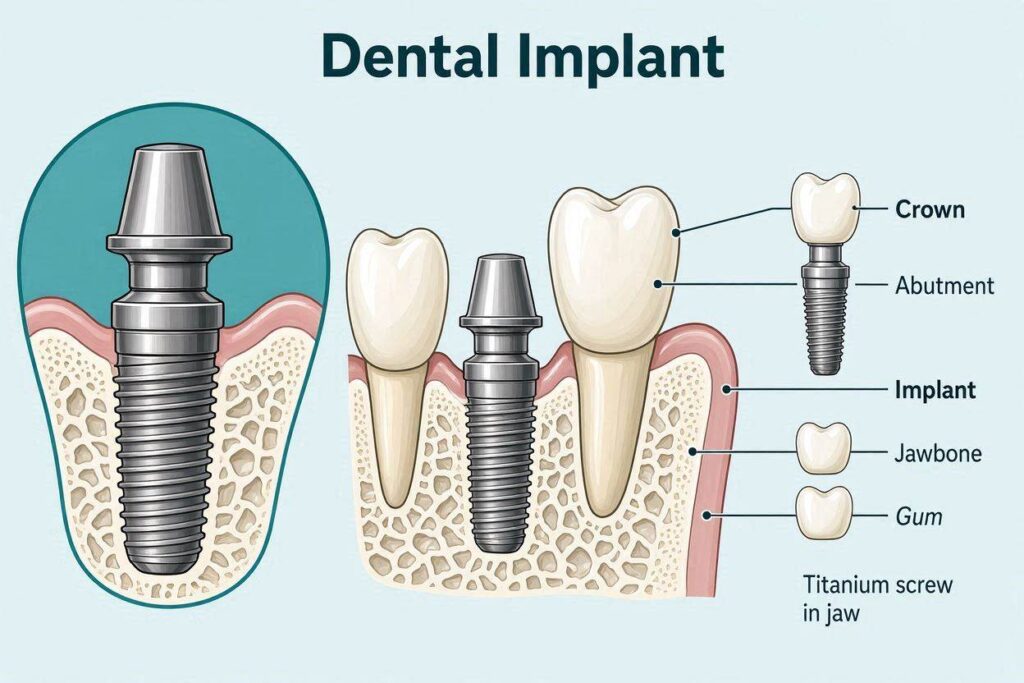
A dental implant is an artificial tooth root, typically made of titanium or zirconia, that is surgically placed into the jawbone to support a replacement tooth, bridge, or denture. Unlike removable dentures that rest on the gums or bridges that rely on adjacent teeth for support, a dental implant integrates directly with living bone, creating a stable, permanent foundation for tooth replacement.
This definition contains several key elements worth unpacking:
- Artificial tooth root: The implant functions as a root replacement, not just a tooth replacement. It sits within the bone as a natural tooth root would.
- Surgically placed: Implant placement is a surgical procedure requiring specific training and sterile technique.
- Integrates with living bone: Through osseointegration, bone cells attach directly to the implant surface.
- Supports replacement teeth: The implant itself is not the visible tooth; it is the foundation upon which a crown, bridge, or denture is attached.
The Historical Context: How Dental Implants Evolved
The definition of dental implants has evolved as technology and understanding have advanced.
Ancient Attempts
Humans have attempted to replace missing teeth for millennia. Archaeological evidence reveals:
- Ancient Egyptian mummies with gold wire-stabilized replacement teeth
- Mayan remains with shells carved into tooth shapes and placed in jawbone
- Ancient Chinese texts describing bamboo pegs used as tooth replacements
- Etruscan and Roman attempts with gold bands and animal teeth
None of these early attempts achieved true integration with bone. They were, at best, temporary solutions that eventually failed.
The Accidental Discovery of Osseointegration
The defining moment in implant dentistry occurred in 1952. Swedish orthopedic surgeon Per-Ingvar Brånemark was studying blood flow in rabbit bone using titanium optical chambers. When he attempted to remove the chambers after the experiment, he discovered that the bone had bonded so tightly to the titanium that the chambers could not be easily removed.
Brånemark named this phenomenon “osseointegration,” from the Latin “os” (bone) and “integration” (to make whole). He recognized the potential for tooth replacement and spent years developing implant systems based on this principle.
The First Modern Dental Implant
In 1965, Brånemark placed the first titanium dental implant in a human patient, Gösta Larsson, who had severe jaw deformities and could not wear conventional dentures. Those implants functioned successfully for the rest of Larsson’s life, more than 40 years.
This case established the foundation for modern implant dentistry and defined what a dental implant could be: a permanent, bone-integrated replacement for missing tooth roots.
The Components of a Dental Implant
A dental implant is not a single piece. It is a system of components, each with a specific function.
The Implant Fixture (The “Root”)
The implant fixture is the component surgically placed into the jawbone. It is the core of what defines a dental implant.
Characteristics:
- Cylindrical or tapered shape, resembling a screw
- Threaded exterior to engage bone and provide initial stability
- Hollow or solid internal connection for abutment attachment
- Surface treated to encourage bone cell attachment
- Available in various lengths and diameters
The fixture is the component that undergoes osseointegration. Once integrated, it is extremely difficult to remove without surgical intervention.
The Abutment (The “Connector”)
The abutment connects the implant fixture to the visible restoration. It screws into the implant fixture and extends through the gum tissue.
Characteristics:
- Made of titanium, zirconia, or gold alloy
- Custom or prefabricated designs
- Connects to the implant via a screw or friction fit
- Emerges through the gum at the optimal angle for the restoration
- Can be angled to correct for implant positioning
The Restoration (The “Tooth”)
The restoration is the visible portion of the dental implant system. This is the part that looks and functions like a tooth.
Types of restorations:
| Restoration Type | Description |
|---|---|
| Single crown | Replaces one missing tooth |
| Implant-supported bridge | Replaces multiple adjacent missing teeth |
| Implant-supported overdenture | Removable denture that snaps onto implants |
| Full arch fixed prosthesis | Permanently fixed replacement for all teeth in an arch |
Restorations are typically made of porcelain, zirconia, or a combination of materials designed to mimic the appearance and function of natural teeth.
Component Summary Table
| Component | Function | Material Options | Lifespan |
|---|---|---|---|
| Implant fixture | Artificial root; integrates with bone | Titanium, titanium alloy, zirconia | Lifetime potential |
| Abutment | Connects fixture to restoration | Titanium, zirconia, gold | 10–20 years typical |
| Restoration | Visible tooth replacement | Porcelain, zirconia, PFM, acrylic | 10–15 years typical |
The Materials: What Dental Implants Are Made Of
The materials used in dental implants are carefully chosen for biocompatibility, strength, and long-term performance.
Titanium and Titanium Alloys
Titanium has been the gold standard implant material since Brånemark’s discovery.
Why titanium works:
- Biocompatibility: Titanium is biologically inert. The body does not recognize it as foreign and does not mount an immune response against it.
- Osseointegration: Bone cells attach directly to the titanium oxide layer that forms naturally on the implant surface.
- Strength: Titanium can withstand the forces of chewing without fracturing.
- Corrosion resistance: Titanium does not rust or corrode in the oral environment.
- Lightweight: Titanium is lighter than many other metals with comparable strength.
Grades of titanium used:
| Grade | Composition | Properties |
|---|---|---|
| Commercially pure (CP) grade 4 | Unalloyed titanium | Good strength, excellent biocompatibility |
| Ti-6Al-4V (grade 5) | Titanium-aluminum-vanadium alloy | Higher strength, commonly used |
| Ti-6Al-4V ELI | Extra-low interstitial alloy | Improved fracture resistance |
| Ti-Zr alloy | Titanium-zirconium | Higher strength, good biocompatibility |
Zirconia
Zirconia (zirconium dioxide) is a ceramic material increasingly used for dental implants, particularly for patients with metal sensitivities or aesthetic concerns.
Advantages of zirconia:
- White color: No dark metal showing through thin gum tissue
- Metal-free: Suitable for patients with metal allergies or sensitivities
- Biocompatibility: Excellent soft tissue response
- Strength: Modern zirconia is extremely strong
- Plaque resistance: Some evidence suggests less plaque accumulation than titanium
Limitations of zirconia:
- Less long-term data than titanium
- Historically higher fracture rates (improving with modern formulations)
- Cannot be modified as easily during surgery
- Typically more expensive
Surface Treatments
Modern implants undergo surface modifications to enhance osseointegration:
| Surface Treatment | How It Works |
|---|---|
| Sandblasting and acid etching (SLA) | Creates microscopic roughness that bone cells grip |
| Anodization | Thickens the oxide layer and creates surface porosity |
| Hydroxyapatite coating | Calcium phosphate coating that stimulates bone formation |
| Hydrophilic treatment | Attracts blood and proteins to accelerate early healing |
| Laser-ablated surfaces | Precisely controlled microtopography |
These surface treatments are part of what defines modern dental implants and distinguish them from earlier, less successful designs.
The Biological Principle: Osseointegration
No definition of dental implants is complete without understanding osseointegration, the biological process that makes implants work.
What Is Osseointegration
Osseointegration is the direct structural and functional connection between living bone and the surface of a load-bearing artificial implant. In simpler terms, it is the process by which bone cells attach directly to the implant surface without intervening soft tissue.
How Osseointegration Happens
The process unfolds in stages:
- Implant placement: The surgeon prepares a precisely sized site in the bone and places the implant.
- Blood clot formation: Blood fills the space between the implant and bone, forming a clot rich in growth factors.
- Inflammatory phase: Immune cells clean the area and release signaling molecules.
- Osteoblast migration: Bone-forming cells migrate to the implant surface.
- Woven bone formation: Osteoblasts deposit new bone matrix directly onto the implant surface.
- Bone remodeling: Woven bone is gradually replaced by stronger lamellar bone.
- Mature interface: The implant becomes firmly anchored in living, remodeling bone.
Why Osseointegration Defines Modern Implants
Before osseointegration was understood, dental implants were essentially foreign bodies that the body tolerated for varying periods. They did not become part of the body. Osseointegration changed that. An osseointegrated implant is not merely tolerated; it is integrated into the living skeletal system.
Types of Dental Implants
The definition of dental implants encompasses several types, each suited to specific clinical situations.
Endosteal Implants
Endosteal implants are placed directly into the jawbone. They are the most common type, representing the vast majority of implants placed today.
Subtypes:
- Root-form implants: Cylindrical or tapered, resembling natural tooth roots
- Blade implants: Flat, blade-shaped implants used in narrow bone (largely historical)
- Ramus frame implants: Used in severely resorbed mandibles (rarely used today)
Subperiosteal Implants
Subperiosteal implants sit on top of the jawbone, under the gum tissue. A metal framework rests on the bone surface with posts extending through the gums to support a prosthesis.
These implants are rarely used today, having been largely replaced by endosteal implants combined with bone grafting. They may still be considered for patients with severe bone loss who cannot undergo grafting.
Zygomatic Implants
Zygomatic implants are much longer than standard implants and anchor into the zygomatic bone (cheekbone) rather than the maxillary jawbone. They are used in patients with severe maxillary bone loss who cannot receive standard implants even with grafting.
Mini Dental Implants
Mini implants have a diameter of less than 3 mm, compared to 3.5–6 mm for standard implants. They are used:
- To stabilize lower dentures
- In areas with insufficient bone width
- For temporary anchorage in orthodontic treatment
- In patients who cannot undergo more extensive surgery
Comparison Table
| Implant Type | Placement Site | Primary Use | Bone Requirement |
|---|---|---|---|
| Endosteal | Within jawbone | All tooth replacement scenarios | Adequate bone height and width |
| Subperiosteal | On top of jawbone | Severe bone atrophy (rare) | Minimal bone height |
| Zygomatic | Zygomatic bone | Severe maxillary atrophy | Insufficient maxillary bone |
| Mini | Within jawbone (narrow) | Denture stabilization, narrow spaces | Minimal bone width |
What Dental Implants Are Used For
The clinical applications of dental implants extend beyond single tooth replacement.
Single Tooth Replacement
A single implant replaces one missing tooth from root to crown. This is the most straightforward application and the one most patients are familiar with.
Advantages over a bridge:
- Adjacent teeth are not reduced or damaged
- The implant preserves bone in the extraction site
- The replacement tooth is cleaned like a natural tooth
- The implant can last a lifetime with proper care
Multiple Tooth Replacement
When several adjacent teeth are missing, implants can support bridges. Instead of one implant per tooth, two or more implants can support a bridge spanning the gap.
Configuration examples:
- Two implants supporting a three-tooth bridge
- Three implants supporting a four-tooth bridge
- Implants placed at strategic positions along the arch
Full Arch Replacement
For patients missing all teeth in an arch, implants provide options ranging from removable to permanently fixed solutions.
All-on-4 concept: Four strategically placed implants support a fixed full-arch prosthesis. This approach often avoids bone grafting even in patients with moderate bone loss.
All-on-6 or All-on-8: More implants provide additional support and may allow for a horseshoe-shaped prosthesis without palatal coverage.
Implant-supported overdenture: Two to four implants retain a removable denture that snaps into place. This provides far more stability than conventional dentures while remaining removable for cleaning.
Implant Applications Table
| Clinical Situation | Implant Solution | Typical Number of Implants |
|---|---|---|
| Single missing tooth | Single implant and crown | 1 |
| Multiple adjacent missing teeth | Implant-supported bridge | 2–4 |
| All teeth missing (lower) | Overdenture or fixed prosthesis | 2–6 |
| All teeth missing (upper) | Overdenture or fixed prosthesis | 4–8 |
| Severely resorbed upper jaw | Zygomatic implants | 2–4 zygomatic plus standard |
| Denture instability | Overdenture with locator attachments | 2–4 |
How Dental Implants Differ from Other Tooth Replacements
Understanding what dental implants are requires understanding what they are not.
Dental Implants vs. Dental Bridges
| Feature | Dental Implant | Dental Bridge |
|---|---|---|
| Support | Integrates with jawbone | Supported by adjacent teeth |
| Impact on adjacent teeth | None | Adjacent teeth must be reduced |
| Bone preservation | Prevents bone loss | Bone continues to resorb under missing tooth |
| Lifespan | 25+ years for implant | 10–15 years |
| Invasiveness | Surgical placement required | No surgery |
| Cost (initial) | Higher | Lower |
| Cost (long-term) | Often lower | Higher due to replacements and adjacent tooth risk |
Dental Implants vs. Removable Partial Dentures
| Feature | Dental Implant | Partial Denture |
|---|---|---|
| Stability | Fixed; does not move | May shift or dislodge |
| Comfort | Like natural teeth | Can cause sore spots |
| Eating | Near-normal function | Reduced chewing efficiency |
| Speech | No interference | May affect speech |
| Maintenance | Routine brushing and flossing | Removal and special cleaning |
| Bone preservation | Preserves bone | May accelerate bone loss |
Dental Implants vs. Complete Dentures
| Feature | Implant-Supported Restoration | Complete Denture |
|---|---|---|
| Retention | Fixed or secure snap-in | Adhesive-dependent |
| Bone preservation | Significantly better | Progressive bone loss |
| Function | 90%+ of natural chewing efficiency | 20–30% of natural chewing efficiency |
| Confidence | No fear of slipping | Constant worry about movement |
| Taste | Normal (no palate coverage in some designs) | Reduced (palate covered) |
The Surgical Procedure: How Dental Implants Are Placed
The definition of dental implants includes the surgical process by which they are placed.
Pre-Surgical Planning
Before surgery, the implant team conducts thorough planning:
- Clinical examination: Assessing the oral cavity, remaining teeth, and soft tissues
- Imaging: Panoramic X-rays, cone beam CT scans to evaluate bone quantity and quality
- Treatment planning software: Virtual implant placement to determine optimal positioning
- Surgical guide fabrication: 3D-printed guides for precise implant placement
The Surgical Procedure
Implant placement typically follows these steps:
- Anesthesia: Local anesthesia ensures patient comfort; sedation may be offered for anxious patients.
- Incision: The gum tissue is opened to expose the underlying bone.
- Site preparation: Progressively larger drills create a precisely sized osteotomy (bone opening) for the implant.
- Implant placement: The implant is threaded or tapped into the prepared site.
- Cover screw or healing abutment placement: Depending on the protocol, the implant may be submerged under the gums or a healing abutment may be placed that extends through the gums.
- Closure: The gum tissue is sutured closed (if submerged) or left to heal around the healing abutment.
Timing Options
| Protocol | Description | Typical Use |
|---|---|---|
| Immediate placement | Implant placed at the same time as tooth extraction | When extraction site is healthy |
| Early placement | Implant placed 4–8 weeks after extraction | Allows soft tissue healing |
| Delayed placement | Implant placed 3–6 months after extraction | Allows complete bone healing |
| Immediate loading | Crown placed on implant same day | Selected cases with excellent primary stability |
| Early loading | Crown placed within weeks to a few months | When adequate stability is achieved |
| Conventional loading | Crown placed 3–6 months after placement | Traditional protocol; most predictable |
Who Is a Candidate for Dental Implants
The definition of dental implants includes understanding who can and cannot receive them.
General Candidacy Requirements
Ideal candidates have:
- One or more missing teeth
- Adequate bone quantity and quality to support implants
- Healthy oral tissues
- Good overall health or well-managed medical conditions
- Commitment to oral hygiene and regular dental visits
- Realistic expectations about the process and outcomes
Factors That May Complicate Candidacy
| Factor | Impact on Candidacy |
|---|---|
| Smoking | Increases failure risk; some surgeons decline heavy smokers |
| Uncontrolled diabetes | Impairs healing and increases infection risk |
| Osteoporosis medications | Certain drugs increase risk of jawbone complications |
| Radiation therapy to jaws | High risk of healing complications |
| Active periodontal disease | Must be treated before implant placement |
| Insufficient bone | May require bone grafting |
| Bruxism | May overload implants; requires management |
Age Considerations
There is no upper age limit for dental implants. Healthy patients in their 80s and 90s successfully receive and maintain implants. The lower age limit is determined by jaw growth completion, typically around age 18 for females and 20–21 for males.
The Benefits That Define Dental Implant Value
The definition of dental implants is ultimately defined by what they provide to patients.
Functional Benefits
- Restored chewing ability to near-natural levels
- Stable, non-moving tooth replacement
- No dietary restrictions beyond those for natural teeth
- Clear speech without denture interference
- No need for adhesives or special cleaning routines beyond normal hygiene
Biological Benefits
- Preservation of jawbone through functional stimulation
- Protection of adjacent natural teeth from damage
- Prevention of teeth shifting into the empty space
- Maintenance of facial structure and prevention of “facial collapse”
- Stimulation of bone remodeling through normal function
Psychological and Social Benefits
- Restored confidence in smiling and speaking
- Elimination of embarrassment about missing teeth or loose dentures
- Ability to eat in social settings without worry
- Improved self-esteem and quality of life
- Sense of permanence and “wholeness”
Conclusion
A dental implant is an artificial tooth root, surgically placed into the jawbone, that integrates with living bone through osseointegration to provide a stable, permanent foundation for replacement teeth. Made primarily of titanium or zirconia, dental implants consist of three components: the fixture that fuses with bone, the abutment that connects through the gum, and the visible restoration that replicates natural tooth appearance and function. Dental implants are distinguished from all other tooth replacement options by their ability to preserve bone, function independently of adjacent teeth, and potentially last a lifetime with proper care.
Frequently Asked Questions
What exactly is a dental implant made of?
Most dental implants are made of titanium or titanium alloy, materials chosen for their biocompatibility and ability to integrate with living bone. Some implants are made of zirconia, a white ceramic material suitable for patients with metal sensitivities or aesthetic concerns.
How is a dental implant different from a dental bridge?
A dental implant replaces the tooth root and integrates with the jawbone, while a bridge relies on adjacent teeth for support and requires those teeth to be reduced. Implants preserve bone and do not damage neighboring teeth, whereas bridges do not prevent bone loss and require modification of healthy adjacent teeth.
What is osseointegration?
Osseointegration is the direct structural and functional connection between living bone and the surface of a dental implant. Bone cells attach directly to the implant surface without any intervening soft tissue, creating a stable, permanent anchor for the replacement tooth.
How long does a dental implant last?
With proper care, the implant fixture can last a lifetime. The attached crown typically lasts 10 to 15 years before replacement. Research shows implant survival rates exceeding 95% at 10 years and 90% or higher at 20 years.
Is dental implant surgery painful?
The surgery itself is performed under local anesthesia and is not painful. Post-operative discomfort is typically mild to moderate and well-managed with prescribed or over-the-counter pain medication. Most patients report that the procedure was less uncomfortable than they anticipated.
Additional Resources
- American Academy of Implant Dentistry: www.aaid.com
- International Congress of Oral Implantologists: www.icoi.org
- American Dental Association: www.ada.org