What Is A Full Mouth Dental Implant?
The phrase “full mouth dental implant” conjures different images for different people. For some, it suggests a complete set of individual implants, one for each missing tooth. For others, it evokes the idea of a permanent, non-removable set of teeth that replaces everything in the upper or lower jaw. The reality is more nuanced, and understanding the terminology is the first step for anyone considering this transformative treatment. A full mouth dental implant restoration is a comprehensive approach to replacing all the teeth in one or both jaws using dental implants as the supporting foundation. This article explains what these restorations are, the different types available, the procedures involved, and who can benefit from them.
The Core Concept: Implants as a Foundation for an Entire Arch
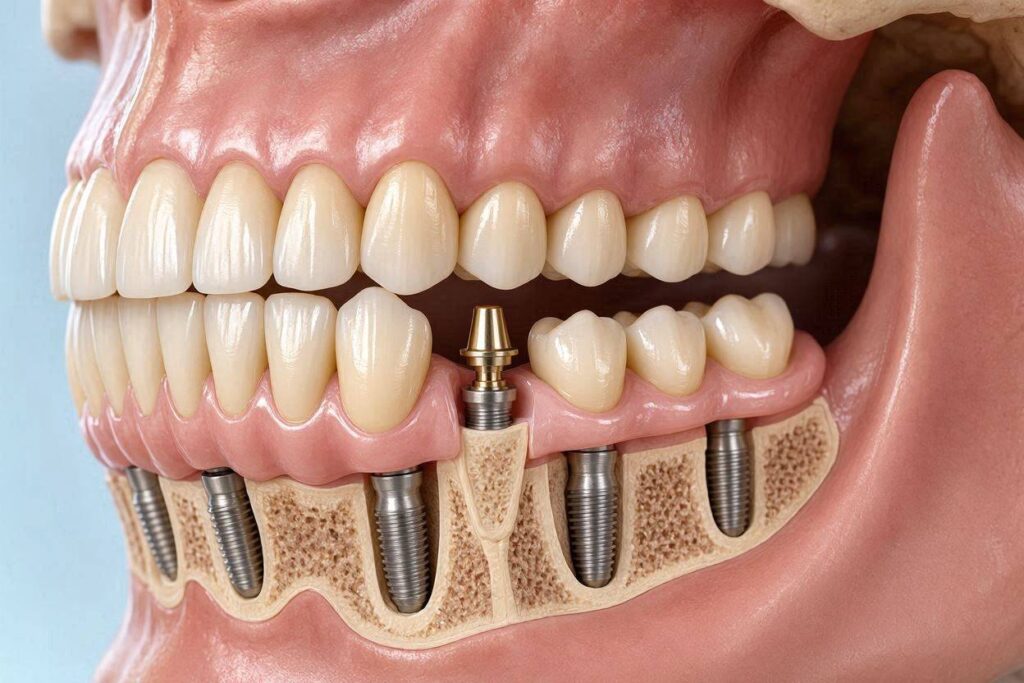
A full mouth dental implant restoration does not mean placing a separate implant for each of the twenty-eight teeth. That would be surgically impractical, prohibitively expensive, and often impossible due to bone limitations. Instead, the concept relies on a strategic number of implants placed in key positions to support a complete arch of prosthetic teeth.
Think of the implants as the pilings of a bridge. A bridge across a river does not require a support under every plank. It requires a sufficient number of deeply anchored supports in the right positions to carry the span. Similarly, a full arch of teeth can be supported by four, six, or eight implants, depending on the specific technique, the bone quality, and the type of prosthesis.
This approach is a radical departure from conventional removable dentures. A complete denture rests on the gums and is held in place by suction, muscle control, and sometimes adhesive. It provides a basic level of function and aesthetics, but it is unstable. It moves during eating and speaking. It does nothing to prevent the bone loss that occurs when teeth are missing. Over time, the jawbone resorbs, the denture fits progressively less well, and the patient faces a cycle of relines and remakes.
An implant-supported full arch restoration solves these problems. It is anchored to the skeleton. It does not move. It transmits chewing forces into the bone, preserving it. It restores a level of function and confidence that a removable denture cannot match.
Types of Full Mouth Implant Restorations
There are two broad categories of full mouth implant restorations: fixed and removable. Each has distinct characteristics, and the right choice depends on the patient’s clinical situation, budget, and personal preferences.
Fixed Full Arch Restoration
A fixed full arch restoration, often called an implant-supported fixed bridge, a fixed hybrid prosthesis, or by the brand-associated term All-on-Four, is a non-removable set of prosthetic teeth anchored by implants. The patient cannot take it out. It is cleaned in the mouth, similarly to natural teeth, with brushing, flossing under the prosthesis, and water flossing.
The prosthesis typically consists of a metal framework, usually titanium or cobalt-chromium, supporting acrylic or porcelain teeth and gum-colored acrylic to replace lost soft tissue contours. The framework is screwed directly into the implants and torqued to specification. The access holes are filled with composite resin. The result is a permanent restoration that looks and functions like natural teeth.
Fixed full arch restorations are typically supported by four to eight implants per arch. The All-on-Four concept, developed by Nobel Biocare, uses four implants: two placed vertically in the anterior region and two placed at an angle in the posterior region to avoid the sinus in the upper jaw or the nerve canal in the lower jaw and to maximize bone contact. The All-on-Six concept adds two additional implants for increased support, particularly in cases with good bone volume.
The fixed full arch restoration is widely considered the gold standard for full mouth rehabilitation with implants. It provides the highest level of function, stability, and patient satisfaction. It also requires adequate bone volume, a significant financial investment, and a commitment to meticulous daily cleaning.
Removable Implant Overdenture
A removable implant overdenture is a conventional-looking denture that snaps onto implants using specialized attachments. The patient removes the denture for cleaning but wears it during the day. The implants provide stability and retention that a conventional denture cannot match, but the prosthesis is still removable.
The most common attachment system is the Locator abutment. A metal abutment with a male attachment is screwed into each implant. The denture has corresponding female housings with nylon inserts that snap onto the abutments. The patient can insert and remove the denture with a deliberate pull, but it stays securely in place during function.
An overdenture is typically supported by two to four implants in the lower jaw and four or more in the upper jaw. The lower jaw requires fewer implants because the mandibular denture is the one that patients find most unstable. The upper denture gains some retention from suction against the palate.
The overdenture is less expensive than a fixed restoration. It requires fewer implants. The denture itself is less costly to fabricate. It is easier to clean because the patient removes it. It can replace lost lip and cheek support more easily than a fixed prosthesis because the denture flange can be contoured to fill out the face.
The trade-offs are that it is still removable, which some patients find psychologically undesirable. It requires periodic replacement of the nylon retention inserts, which wear over time. It does not provide quite the same chewing efficiency as a fixed prosthesis. But for many patients, a removable implant overdenture represents a dramatic improvement over a conventional denture at a more accessible price point.
The Surgical Procedure: What Happens
Full mouth implant treatment is a significant surgical undertaking. The process generally unfolds in phases over several months.
Pre-Surgical Phase
The patient undergoes a comprehensive evaluation. This includes a medical and dental history review, clinical examination, photographs, and advanced imaging. A Cone Beam CT scan is essential. It provides three-dimensional data on bone volume, nerve positions, sinus anatomy, and any pathology. Digital planning software is used to virtually place the implants and design the surgical guide.
If teeth are still present, they are evaluated. Hopeless teeth are slated for extraction. The decision to extract all remaining teeth is not made lightly. Teeth with a reasonable prognosis may be retained and incorporated into the restoration, but in many full arch cases, the remaining teeth are so compromised that extraction and full arch implant rehabilitation is the most predictable long-term solution.
Surgical Phase
The surgery is typically performed under local anesthesia with intravenous sedation or general anesthesia. Any remaining teeth are extracted. The surgical sites are thoroughly debrided. Bone grafting may be performed if needed, either at this surgery or in a prior surgery.
The implants are placed according to the surgical plan. A surgical guide, fabricated from the digital plan, ensures precise positioning. The implants are inserted and torqued to achieve primary stability. Healing abutments or multi-unit abutments are attached.
In many protocols, a temporary fixed prosthesis is attached to the implants on the same day. This is called immediate loading. The patient leaves the surgery with a full set of functional, aesthetic teeth. The temporary prosthesis is made of acrylic and is designed to protect the implants during healing. It is slightly softer in the bite and must be treated gently with a soft diet.
Healing Phase
The implants undergo osseointegration over the next three to six months. The patient follows a soft diet and avoids chewing hard or crunchy foods with the temporary prosthesis. Good oral hygiene is essential to prevent infection and inflammation around the healing implants.
Final Restoration Phase
Once osseointegration is confirmed, the temporary prosthesis is removed. Impressions are taken, either traditional or digital. The final prosthesis is fabricated in a dental laboratory. This is a custom, high-precision process that takes several weeks.
The final prosthesis is tried in. The fit, aesthetics, bite, and speech are verified. Adjustments are made. When everything is correct, the prosthesis is secured to the implants with screws. The access holes are filled. The patient receives instructions for home care and maintenance.
Who Is a Candidate?
Full mouth implant treatment is indicated for patients who are missing all teeth in one or both arches, or whose remaining teeth have a hopeless prognosis and are facing complete edentulism. The ideal candidate has adequate bone volume or is willing to undergo grafting to achieve it, is in good general health, is willing to commit to meticulous oral hygiene and regular professional maintenance, and is a non-smoker or is willing to quit.
Specific medical conditions increase risk and must be carefully evaluated. Uncontrolled diabetes impairs healing and increases infection risk. High-dose antiresorptive medications are a strong contraindication. A history of radiation therapy to the jaws elevates the risk of osteoradionecrosis. The patient’s psychological readiness and expectations must also be assessed. Full mouth implant treatment is a major commitment, and realistic expectations are essential.
The Cost of Full Mouth Dental Implants
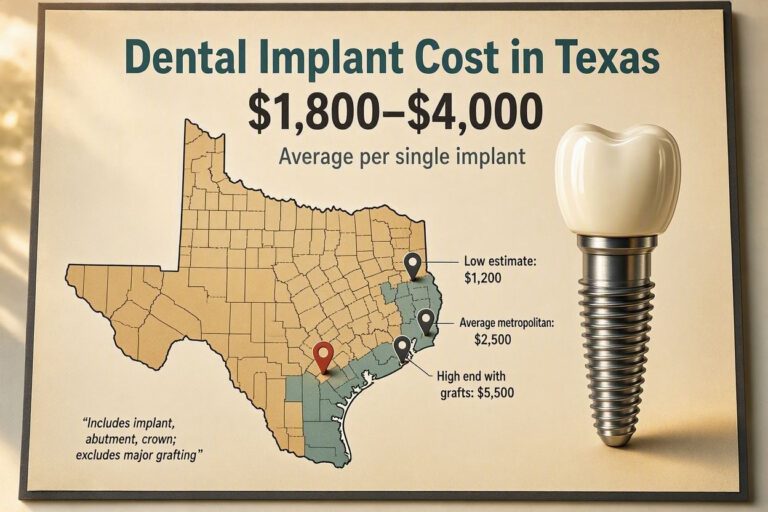
Full mouth implant treatment is a significant financial investment. In the United States, a single arch typically costs between $20,000 and $35,000. A full mouth, both upper and lower, can range from $40,000 to $70,000. These figures include all surgery, the temporary prosthesis, the final prosthesis, and follow-up care within a defined period.
Costs vary by geographic location, the number of implants, the materials used, the need for grafting, and the experience of the clinician. Dental schools and residency programs offer reduced fees. Dental tourism offers lower costs but carries the risks of distant follow-up and variable quality.
Conclusion
A full mouth dental implant restoration is a comprehensive solution for patients who have lost all their teeth or face the loss of all their teeth. It uses four to eight strategically placed implants per arch to support a complete set of prosthetic teeth. Fixed restorations are non-removable and provide the highest level of function and patient satisfaction. Removable overdentures snap onto implants, offering greatly improved stability over conventional dentures at a lower cost. The treatment involves a significant surgical procedure, a healing period of several months, and a commitment to lifelong maintenance. For the right candidate, full mouth dental implants are a life-changing investment that restores the ability to eat, speak, and smile with confidence.
Frequently Asked Questions
How many implants are needed for a full mouth restoration?
A fixed full arch typically uses four to eight implants per arch. An overdenture typically uses two to four in the lower jaw and four or more in the upper jaw.
How long does full mouth implant treatment take?
The surgical and healing phase takes approximately three to six months. The entire process, including final prosthesis fabrication, can take six to twelve months from start to finish.
Is the All-on-Four procedure different from full mouth implants?
All-on-Four is a specific technique within the category of full mouth implant restorations. It uses four implants per arch, with the posterior implants angled to maximize bone contact and avoid anatomical structures.
Can I have all my teeth extracted and implants placed on the same day?
Yes. In many cases, failing teeth are extracted, implants are placed, and a temporary fixed prosthesis is attached on the same day. This is called immediate loading.
How do I clean a fixed full arch implant restoration?
Brush the prosthesis with a soft toothbrush. Use a water flosser with a non-metal tip to clean under the prosthesis. Use super floss or implant-specific floss to clean around the implants. Professional maintenance visits every three to six months are essential.
How long do full mouth dental implants last?
With proper care and maintenance, the implants can last a lifetime. The prosthesis may need replacement or significant refurbishment after ten to twenty years due to normal wear.
Additional Resource:
American College of Prosthodontists – Full Mouth Rehabilitation Information
https://www.gotoapro.org/