What Is Silver Nitrate In Dentistry?
Silver nitrate is a chemical compound with a long and fascinating history in medicine and dentistry. It is an inorganic salt formed by the reaction of silver with nitric acid, appearing as a white crystalline solid that dissolves readily in water. In dentistry, its primary role has been as a potent antimicrobial and cauterizing agent, particularly useful for arresting dental caries and managing oral soft tissue lesions. While modern dentistry has evolved, silver nitrate’s unique mechanism of action has led to a significant resurgence of interest in specific, evidence-based applications.
The Chemical and Biological Mechanism
Silver nitrate’s therapeutic power stems from the free silver ions it releases upon dissolution. These ions are highly reactive and exert a profound oligodynamic effect, meaning they are toxic to microorganisms at extremely low concentrations. The silver ion attacks bacterial cells in multiple ways. It binds to and disables sulfur-containing proteins and enzymes essential for the bacterial metabolism. It disrupts the bacterial cell membrane, causing leakage of cytoplasmic contents. It also intercalates with bacterial DNA, preventing replication.
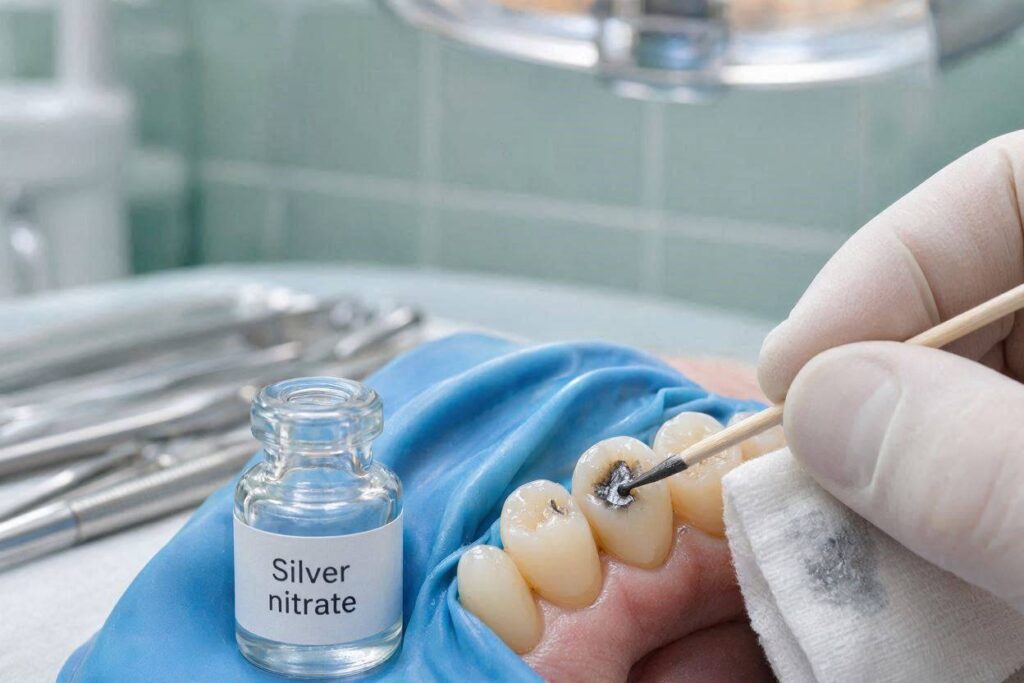
For dental decay, this translates into an immediate sterilization of the carious lesion. The silver nitrate solution penetrates the porous, demineralized dentin and kills the acid-producing bacteria driving the cavity. Simultaneously, the silver ions react with the organic components of the decayed tooth structure, forming a hardened, dark-stained protein-silver complex. This black staining is the most characteristic and visible effect of silver nitrate application; it is the chemical signature of an arrested, sterilized cavity.
The Historical Context of Silver Nitrate Use
Silver nitrate was a mainstay of dental medicine in the 19th and early 20th centuries, long before the advent of modern local anesthetics and high-speed rotary instruments. Dentists applied it to carious lesions in children, with the goal of stopping the decay process without drilling. The procedure was simple and painless, a crucial advantage in an era when caries management was often primitive. A dentist would excavate the gross debris from a large cavity and then apply a strong silver nitrate solution directly to the affected dentin. The tissue would turn black instantly as the chemical cauterization occurred.
The application was often followed by a eugenol-based dressing or a conventional filling. Over time, the profession moved toward a purely surgical model of caries management that demanded complete removal of all infected tooth structure. Silver nitrate, which chemically arrests decay but leaves the tooth discolored, fell out of favor as aesthetic white fillings and the drill-and-fill philosophy became the dominant standard of care.
Silver Nitrate in Caries Arrest
The modern revival of silver nitrate in dentistry is not driven by nostalgia; it is driven by a paradigm shift in caries management toward minimal intervention dentistry. The current understanding of the carious process recognizes that a tooth does not always need to be drilled. If the biofilm is inactivated, the lesion can be arrested. Silver nitrate is an exquisitely effective chemical agent for achieving this bacterial inactivation, particularly in deep, active dentin lesions.
This application is most common in pediatric and geriatric dentistry, as well as in community outreach settings. Very young children with severe early childhood caries, who cannot cooperate for conventional restorative treatment, can have their teeth treated with silver nitrate as a temporary or definitive measure to buy time until they mature. Frail, elderly, or medically compromised patients who cannot tolerate lengthy dental procedures benefit from the simplicity and speed of the technique. In global health contexts, where access to electricity, running water, and rotary instruments is limited, silver nitrate has emerged as a critical public health tool. The atraumatic nature of the application makes it ideal for school-based and field-based dental programs.
The Silver Nitrate and Fluoride Varnish Protocol
Silver nitrate is rarely used alone for caries arrest in modern protocols. It is most powerful when combined sequentially with a fluoride varnish. The standard procedure begins with cleaning the tooth surface as much as possible, removing loose debris from the cavity with a small excavator. The dentist or therapist then isolates the tooth with cotton rolls and applies a small amount of 25% silver nitrate solution directly to the carious lesion with a microbrush. The solution is left in place for a prescribed time, often one to two minutes, allowing the silver ions to penetrate and sterilize the lesion.
The tooth is then dried, and a sodium fluoride varnish, typically 5% sodium fluoride, is painted over the silver nitrate-treated surface and surrounding enamel. The fluoride varnish serves a dual purpose. It provides a concentrated dose of fluoride to remineralize the enamel at the lesion margins and adjacent tooth structure. It also seals the silver nitrate in place, preventing it from washing away in saliva and prolonging its contact with the diseased tissue. This two-step silver nitrate and fluoride varnish protocol is a well-documented, non-invasive caries arrest method with a growing body of clinical evidence.
Silver Nitrate for Soft Tissue Management
Beyond its use on hard tooth structure, silver nitrate has a specific application in the management of certain oral soft tissue conditions. Its caustic, protein-coagulating action allows it to function as a chemical cauterant. This is useful for treating superficial lesions where controlled tissue destruction promotes healing.
Treating Aphthous Ulcers and Oral Wounds
Recurrent aphthous stomatitis, the common canker sore, can be intensely painful. A dentist can apply a very small, precisely controlled amount of silver nitrate solution directly to the ulcerated mucosa using a fine-tipped applicator stick. The silver nitrate chemically cauterizes the exposed nerve endings in the ulcer bed, effectively deadening them. It also coagulates the superficial tissue, creating a chemical seal over the wound that protects the underlying tissue from oral fluids and mechanical irritation. The application causes a brief, sharp stinging sensation, but the lesion often becomes painless within minutes, and the pain relief can last for days, allowing the ulcer to heal naturally.
This same cautery principle applies to the management of hyperplastic or overgrown gum tissue, small pyogenic granulomas, and persistent bleeding points. A silver nitrate stick can be rubbed gently over a small bleeding capillary bed to achieve chemical hemostasis. The use requires significant clinical skill to confine the burn to the intended target area and avoid damaging adjacent healthy tissue or tooth structures. Silver nitrate will stain everything it touches, including skin, clothes, and dental instruments.
Safety, Staining, and Material Compatibility
The dark, permanent black staining is the most significant and obvious side effect of silver nitrate use. This is not an external surface stain but a chemical transformation of the tooth structure itself. The silver ions react with the sulfide ions in the decayed collagen, creating a black silver sulfide precipitate. This staining is a biomarker of success; a black lesion is an arrested lesion. However, the aesthetic impact on anterior teeth is unacceptable to many patients and parents, making this a treatment primarily suited for posterior teeth or for patients where aesthetics are a secondary concern.
Silver nitrate is caustic to gingival and mucosal tissues. The dentist must take great care to protect the gums with a protective barrier, such as petroleum jelly, before applying the solution to a near-gingival cavity. Accidental spillage onto the cheeks, lips, or tongue causes a chemical burn that appears as a white, coagulated patch that eventually sloughs off. While these burns are typically superficial and heal without scarring, they are painful and alarming to the patient. The clinician must wear gloves and protective eyewear, as the solution will permanently stain clothing and can cause a brownish-black stain on skin that exfoliates over several days.
Pulpal and Restorative Considerations
Silver nitrate has a long history of safe use on deep carious lesions. Studies have shown that it does not cause irreversible pulp damage when used on lesions that are deep but not yet into the living pulp tissue. Its protein-coagulating action can actually form a protective barrier of coagulated dentin matrix over the pulp. However, its application on a tooth with irreversible pulpitis or a necrotic pulp will not resolve the pulpal infection. A proper diagnosis is essential.
If a tooth treated with silver nitrate later requires a conventional filling, the black-stained dentin can pose a challenge for adhesive bonding. Composite resin may not bond as reliably to the silver-protein complex. Modern protocols often plan for a final restoration of a glass ionomer cement or a stainless steel crown, which do not rely on adhesive bonding to the stained dentin. The arrested lesion remains chemically sealed under the final restoration.
Conclusion
Silver nitrate is a potent antimicrobial and cauterizing agent in dentistry, historically used to chemically arrest caries and currently revived as a key component in minimal intervention protocols, particularly when combined with fluoride varnish. Its mechanism of action sterilizes a carious lesion by killing bacteria and forming a hardened, black-stained, arrested complex of silver and tooth protein. While the permanent staining confines its use primarily to posterior teeth and specific patient populations, its simplicity, low cost, and non-invasive nature make it an invaluable public health tool and a valid clinical option for patients who cannot access or tolerate conventional restorative dental care.
Frequently Asked Questions
Q: Is the black stain from silver nitrate permanent?
A: Yes. The black stain is a permanent chemical change to the arrested carious tooth structure. It is not a surface stain that can be polished off. It can be covered by a tooth-colored filling or a crown later if aesthetics are a concern.
Q: Does applying silver nitrate to a cavity hurt?
A: The application to the tooth itself is painless, as the tooth is not being drilled or vibrated. If the solution contacts the gums or a very deep, inflamed pulp, it will cause a brief, sharp stinging sensation.
Q: Is silver nitrate the same as silver diamine fluoride?
A: No, but they are related. Silver diamine fluoride (SDF) is a different compound that combines silver ions and fluoride ions in an ammonia complex. SDF is also used to arrest caries, and it also stains the lesion black. The two agents have a similar visual outcome but different chemical formulations and regulatory approvals.
Additional Resource
For the latest evidence-based guidelines on non-invasive caries management and the use of silver compounds, the leading global dental federation provides authoritative resources.
- FDI World Dental Federation Caries Resources: fdiworlddental.org/oral-health/caries