What Is The Cost Of A Partial Denture On The NHS?
A partial denture on the NHS in England costs £326.70. This is the Band 3 charge for 2025. If you need extractions or other treatments as part of the same course of treatment, you still only pay the Band 3 charge. Some patients get free NHS dental treatment, including children, pregnant women, and those on certain benefits. In Scotland, Wales, and Northern Ireland, the charges are different or have been abolished. This guide explains the real costs, who qualifies for free care, and what to expect from the NHS.
What Is A Partial Denture?
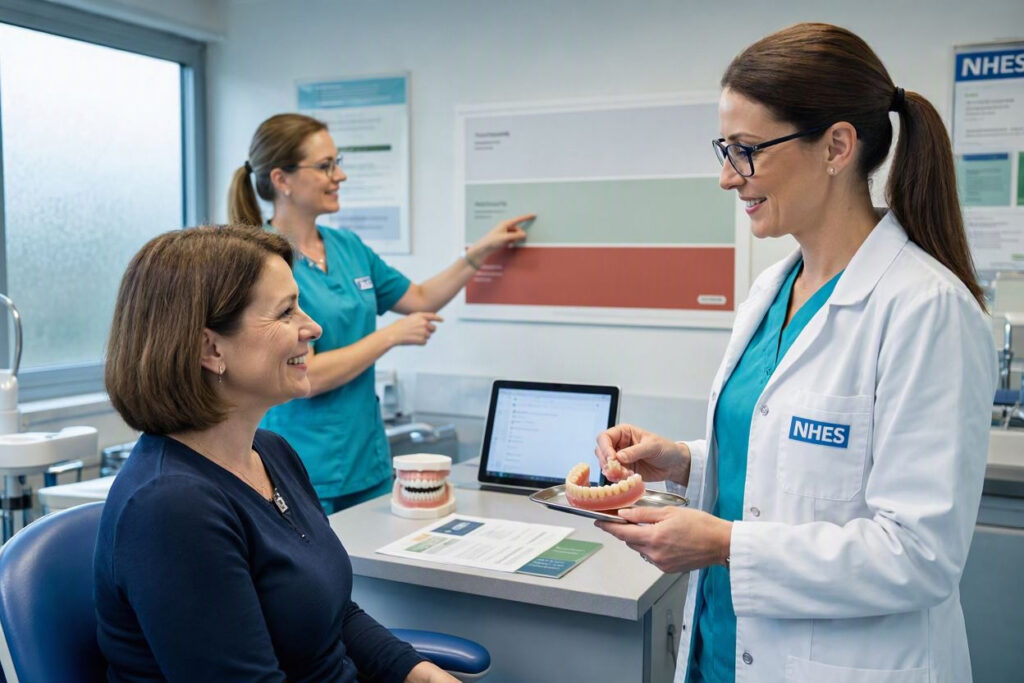
A partial denture is a removable appliance that replaces one or more missing teeth. It fills the gap and rests on the remaining teeth for support. It can be made of metal, acrylic, or a combination of both. A partial denture helps you chew, speak, and smile with confidence. It also prevents your remaining teeth from shifting out of position.
On the NHS, a partial denture is considered a prosthetic appliance. It falls under Band 3 of the NHS dental charge system. This is the highest band and covers the most complex treatments.
NHS Dental Charge Bands
NHS dental charges in England are divided into three bands. The band you pay depends on the most complex treatment you need in a single course of treatment.
| Band | What It Covers | Cost (2025) |
|---|---|---|
| Band 1 | Examination, diagnosis, advice, scale and polish, fluoride varnish, fissure sealants | £27.40 |
| Band 2 | Fillings, root canal treatment, extractions, periodontal treatment | £75.30 |
| Band 3 | Crowns, bridges, dentures (including partial dentures), inlays, onlays | £326.70 |
If you need treatments from more than one band, you only pay the highest band. For example, if you need an extraction (Band 2) and a partial denture (Band 3), you pay only the Band 3 charge of £326.70. This covers the entire course of treatment.
Important note: NHS charges usually increase in April each year. Always check the NHS website or ask your dentist for the current charges before treatment.
What Does The Band 3 Charge Cover?
The Band 3 charge of £326.70 covers a partial denture and any other treatments needed in the same course of treatment. This may include:
- The initial examination and diagnosis.
- X-rays if needed.
- Extractions required to prepare your mouth for the denture.
- Impressions and fittings for the denture.
- The partial denture itself.
- Adjustments after the denture is fitted.
- Any necessary follow-up visits within the course of treatment.
The charge is per course of treatment, not per denture. If you need both an upper and a lower partial denture, you still pay only £326.70, as long as they are part of the same treatment plan.
Who Gets Free NHS Dental Treatment?
Not everyone pays for NHS dental treatment. You may be entitled to free care if you meet certain criteria. You do not pay if you are:
- Under 18 years old.
- Under 19 and in full-time education.
- Pregnant or have given birth in the last 12 months.
- Receiving Income Support, Income-based Jobseeker’s Allowance, or Income-related Employment and Support Allowance.
- Receiving Pension Credit Guarantee Credit.
- Receiving Universal Credit and your earnings are below a certain threshold.
- Named on a valid HC2 certificate (for low-income patients).
- A prisoner or on remand.
If you are not sure whether you qualify, ask your dentist or check the NHS website. You may need to show proof of your exemption, such as a maternity exemption certificate or a benefit award letter.
What If You Do Not Qualify For Free Care?
If you do not qualify for free care, you must pay the NHS charge. The Band 3 charge of £326.70 is still much lower than private denture costs. Private partial dentures can cost £500 to £1,500 or more per denture. The NHS offers excellent value for money.
However, the NHS does not cover cosmetic upgrades. You cannot choose premium materials or a specific shade. The denture is functional and designed to match your natural teeth as closely as possible, but it may not be a perfect aesthetic match. If you want a more natural look or a lighter, more comfortable material, you may need to pay privately.
What Affects The Cost Of An NHS Partial Denture?
The cost of an NHS partial denture is fixed at the Band 3 charge. However, a few factors can affect what you pay.
Course Of Treatment
The charge is per course of treatment. If you need multiple treatments, such as extractions, fillings, and a partial denture, you pay only the highest band. This is good value. But if you need a new course of treatment later, you pay again.
NHS Vs. Private
You can choose to have a partial denture made privately. Private costs vary widely. A private partial denture may cost £500 to £2,000 depending on the material, the dentist, and the complexity. Private treatment offers more choice, faster appointments, and often a better aesthetic result. But it is not covered by the NHS charge.
Complexity Of The Case
A simple partial denture replacing one or two teeth is straightforward. A complex case involving multiple missing teeth, a metal framework, or a difficult bite may take more time and skill. The NHS charge remains the same, but your dentist may need to refer you to a specialist. Waiting times may be longer.
Dental Practice
Not all dental practices offer NHS treatment. Some practices are fully private. Others offer a mix of NHS and private care. You may have to call several practices to find one that accepts NHS patients. Waiting lists can be long in some areas.
Urgent Treatment
If you need urgent treatment, such as a repair to a broken denture, you may pay a Band 1 urgent charge of £27.40. This covers an urgent examination and any necessary treatment to relieve pain or repair the denture. It is not the same as a full course of treatment for a new denture.
How The Process Works On The NHS
Knowing the steps helps you understand what to expect.
- Find an NHS dentist. Call practices in your area and ask if they accept NHS patients. You can also use the NHS website to find a dentist.
- Book an examination. The dentist will check your teeth and gums. They will discuss your options for replacing missing teeth.
- Agree on a treatment plan. If a partial denture is recommended, the dentist will explain the NHS charge and what it covers.
- Prepare your mouth. You may need extractions or other treatments before the denture is made. These are included in the Band 3 charge if they are part of the same course of treatment.
- Take impressions. The dentist will take a mold of your mouth. This is sent to a dental lab.
- Try-in. You may have a try-in appointment to check the fit and appearance of the denture before it is finished.
- Fit the denture. The dentist will place the finished denture and make any necessary adjustments.
- Follow-up. You may need a follow-up visit to check for sore spots or fit problems.
The process may take several weeks. Waiting times depend on the practice and the complexity of your case.
How To Save Money On An NHS Partial Denture
The NHS charge is already heavily subsidized. But there are ways to reduce your costs further.
- Check if you qualify for free care. Many people do not realize they are exempt from charges.
- Apply for an HC2 certificate. If you are on a low income, you may get help with costs.
- Combine treatments. If you need multiple treatments, try to have them in one course of treatment to pay only the highest band.
- Ask about payment plans. Some practices offer installment plans for NHS charges.
- Consider a dental school. Dental schools may offer treatment at reduced costs or free for certain patients.
- Look for community dental services. These services provide care for vulnerable patients and may charge less.
- Avoid private upgrades. The NHS denture is functional and affordable. Private upgrades add to the cost.
- Repair rather than replace. If your denture breaks, a repair may be cheaper than a new denture. Ask your dentist.
Important note: Do not delay treatment for a missing tooth. A partial denture can prevent more serious problems, such as shifting teeth and bite issues. The NHS charge is a small price to pay for your oral health.
Real-World Examples
Example 1: Adult on Income Support.
Sarah is on Income Support and receives free NHS dental treatment. She needs a partial denture after losing three teeth. She pays nothing. The NHS covers the full cost of the denture and extractions.
Example 2: Adult paying full NHS charges.
David works full-time and does not qualify for free care. He needs a partial denture and two extractions. He pays the Band 3 charge of £326.70. This covers everything in the course of treatment.
Example 3: Patient choosing private treatment.
Emma wants a more natural-looking partial denture. She chooses private treatment. The cost is £1,200 for a metal framework partial denture. She pays the full amount. The NHS option would have cost £326.70, but she preferred the private option.
Quotations From Dental Professionals
“The NHS partial denture is a functional appliance. It does the job. If patients want a more aesthetic result, they can choose private treatment. But the NHS option is excellent value.” — NHS dentist in Manchester.
“I always tell my patients to check if they are exempt from charges. Many people pay when they do not have to. It is worth asking.” — Dental receptionist in Birmingham.
Frequently Asked Questions
How much does a partial denture cost on the NHS?
The NHS charge for a partial denture in England is £326.70 (Band 3) as of 2025. This covers the denture and any other treatments needed in the same course of treatment.
Is the NHS partial denture free for everyone?
No. You only get free NHS dental treatment if you meet certain criteria, such as being under 18, pregnant, or on certain benefits.
Can I get a partial denture on the NHS if I am an adult?
Yes, adults can get NHS partial dentures. You will need to pay the Band 3 charge unless you are exempt.
How long does it take to get an NHS partial denture?
It usually takes several weeks from the initial examination to the fitting. Waiting times vary by practice and region.
Can I choose the material for my NHS partial denture?
No. The NHS provides a standard acrylic or metal partial denture. You cannot choose premium materials or specific shades.
What if I need extractions before the denture?
Extractions are covered under Band 2. But if they are part of the same course of treatment as the denture, you only pay the Band 3 charge.
What if my NHS partial denture breaks?
You can get a repair on the NHS. You may pay a Band 1 urgent charge of £27.40. If the denture is beyond repair, you may need a new one, which is a new course of treatment and a new Band 3 charge.
Can I get an NHS partial denture if I have not seen a dentist in years?
Yes. You can register with an NHS dentist and start treatment. You do not need to have seen a dentist recently.
Are NHS partial dentures comfortable?
They can be comfortable, but they may take some getting used to. Your dentist will make adjustments to improve the fit.
What is the difference between an NHS and a private partial denture?
NHS dentures are functional and affordable. Private dentures offer more choice in materials, aesthetics, and comfort. Private dentures cost more.
Additional Resources
For more information on NHS dental charges and partial dentures, visit the NHS website at nhs.uk. You can also check with the Oral Health Foundation at dentalhealth.org for advice on denture care.
Conclusion
A partial denture on the NHS in England costs £326.70 (Band 3) as of 2025. This covers the denture and any other treatments needed in the same course of treatment. Many patients get free NHS dental care, including children, pregnant women, and those on certain benefits. The NHS offers excellent value, though private treatment provides more choices. Always check if you are exempt from charges and speak to your dentist about the best option for your needs.