Which Dentist In My Area Performs Implants?
You have done your research. You know you want a dental implant to replace your missing tooth. You understand the cost, the timeline, and the amazing benefits. Now, you are faced with a new challenge: finding the right person to do the job. You type into your search bar: “Which dentist in my area performs implants?”
The results are overwhelming. Every general dentist, cosmetic dentist, and specialist seems to advertise “Dental Implants!” in bright letters. How do you know who is actually qualified? How do you choose between a general dentist and an oral surgeon?
This guide will walk you through the different types of dental professionals who place implants, explain the red flags to watch out for, and give you a step-by-step strategy to find a skilled, trustworthy provider in your neighborhood.
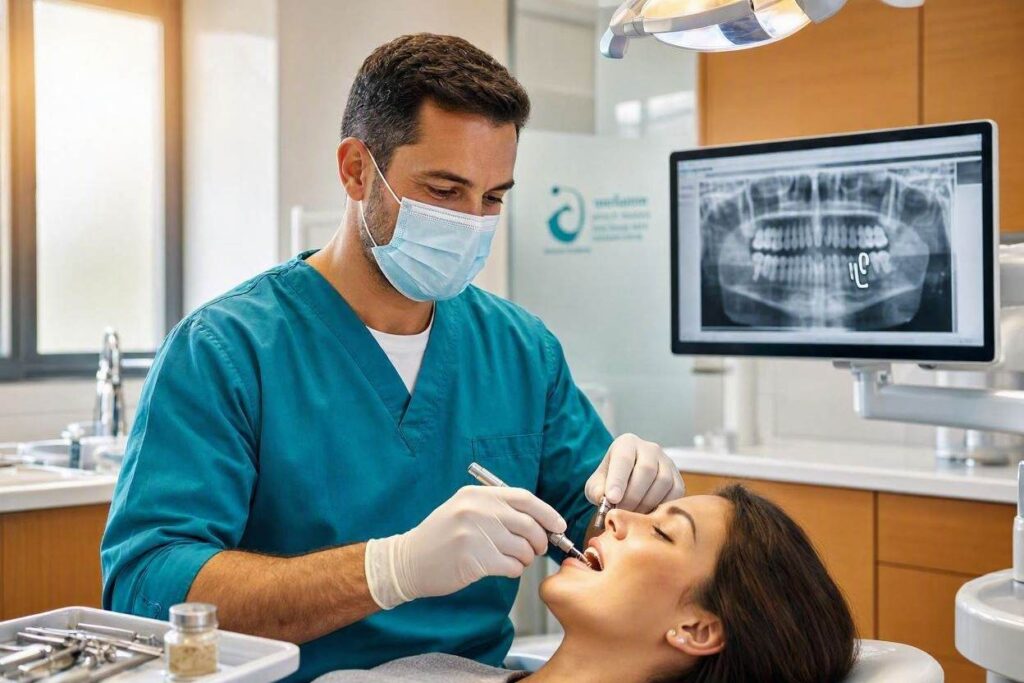
The Cast of Characters: Who Can Legally Place an Implant?
In the United States, dental implants can be placed by several different types of dental professionals. The training and experience levels vary widely among them.
1. The General Dentist
A general dentist is your primary care provider for your teeth. They do fillings, crowns, and cleanings. Many general dentists now also place implants.
- Training: Some general dentists have taken extensive continuing education courses, completed residencies, or achieved Fellowship status in organizations like the International Congress of Oral Implantologists (ICOI). Others may have only taken a weekend course at a hotel.
- Best for: Straightforward cases. If you have good bone density and a healthy mouth, a well-trained general dentist can often place an implant and restore it (put the crown on) all in one office. This can be cheaper and more convenient.
- The Risk: If a complication arises (like hitting a nerve or a sinus issue), a general dentist might not have the surgical experience to fix it.
2. The Oral Surgeon (Oral and Maxillofacial Surgeon)
This is a specialist. After dental school, they complete a 4 to 6-year hospital-based surgical residency. They perform complex extractions, jaw surgery, and treat facial trauma.
- Training: They are the undisputed experts in surgery. They handle difficult cases daily.
- Best for: Complex cases. If you need bone grafting, a sinus lift, multiple implants, or if you have medical conditions that complicate surgery, an oral surgeon is the safest choice.
- The Hand-Off: The oral surgeon places the implant post, but they usually do not make the crown. You will go back to your general dentist (or a prosthodontist) for the visible tooth.
3. The Periodontist
This is a specialist in the gums and bone that support the teeth. They treat gum disease and place bone grafts.
- Training: They complete a 3-year residency focusing on the supporting structures of the teeth.
- Best for: Patients with a history of gum disease or significant bone loss. If your “foundation” is weak, a periodontist is an excellent choice to place the implant because they understand how to manage the soft tissue and bone.
4. The Prosthodontist
This is a specialist in restoring and replacing teeth (crowns, bridges, dentures). They are the architects of the smile.
- Training: They complete a 3-year residency focusing on complex restoration.
- Best for: Full-mouth reconstructions. While some prosthodontists do place implants, they usually focus on the restorative phase (the crown). If you are doing a complex case like “All-on-4” or full mouth implants, a prosthodontist often leads the team, working with an oral surgeon.
5. The “Implantologist”
Be careful with this title. “Implantologist” is not a recognized specialty by the American Dental Association. Any dentist can call themselves an “implantologist.” While it sounds impressive, it does not guarantee they have formal surgical training. Always check their actual credentials.
The “Team” Approach vs. The “One-Stop Shop”
You will generally encounter two models of care when searching for an implant dentist.
The Team Approach (Specialist + General Dentist)
This is the traditional model. You see an oral surgeon or periodontist for the surgery. Once you are healed, you go back to your general dentist for the crown. This ensures each phase is done by an expert in that specific field. The downside is more travel and coordination between two offices.
The One-Stop Shop (General Dentist)
Many modern dental offices offer “implant dentistry” where one doctor does everything. This is convenient and often cheaper. The key is to ensure the general dentist has the proper training and, more importantly, that they know their limits. A good general dentist will refer you to a specialist if they see something on your X-ray that is out of their comfort zone.
How to Find Implant Dentists in Your Area
Now that you know who does what, let’s find them.
1. The Specialist Search (Best for Complex Cases)
If you want a surgeon, search for their specific credentials:
- Search terms: “Oral surgeon near me,” “Periodontist near me,” “Prosthodontist near me.”
- You can also use the “Find a Surgeon” tool on the website of the American Association of Oral and Maxillofacial Surgeons (AAOMS).
2. The Credential Search (Best for General Dentists)
If you want a one-stop shop, look for general dentists with advanced implant credentials.
- Fellowships: Look for dentists who are “Fellows” or “Diplomates” of the International Congress of Oral Implantologists (ICOI) or the American Academy of Implant Dentistry (AAID) . These titles mean they have passed rigorous testing and submitted case studies proving their skill. They are not just “weekend warriors.”
- Search terms: “AAID credentialed implant dentist near me” or “ICOI Fellow near me.”
3. The Referral Route
Ask your current general dentist. Even if they don’t place implants, they likely refer to a local surgeon they trust. A recommendation from a dental professional you already trust is gold.
4. The “Before and After” Hunt
Once you find a few names, visit their websites and social media. Look for photo galleries of their actual implant cases. Do not trust stock photos. You want to see real cases of single implants and complex cases. If the photos look good, that is a great sign.
The Red Flags: How to Spot a Bad Provider
Finding a dentist is easy; finding a good one is the challenge. Watch out for these warning signs:
The “Too Good to Be True” Price
You see an ad: “Implants $999!” This is a classic “bait and switch” tactic. The $999 usually covers only the implant post, not the abutment or the crown. Or, it might be for a “mini” implant, which is not suitable for most cases. Once you are in the chair, the price doubles. Quality implant surgery costs money.
The High-Pressure Sales Pitch
If you go for a consultation and they pressure you to sign a contract today with a “limited time offer,” walk away. A medical decision should not feel like buying a used car.
The Lack of 3D Imaging
Modern implant placement relies on 3D CBCT scans. This allows the dentist to see your nerves, sinuses, and bone density. If a dentist says they can place an implant using only a standard 2D X-ray, they are taking unnecessary risks. Run.
The “No Limits” Doctor
If a general dentist claims they can do anything—complex bone grafts, full arch restorations, sinus lifts—and they never refer out to specialists, be skeptical. The best doctors know their limitations.
Questions to Ask During Your Consultation
You should interview your potential implant dentist. Here are the questions that separate the pros from the amateurs:
- “How many implants have you placed in the last year?” (You want someone who does this regularly, not once a month).
- “Do you use 3D imaging (CBCT) for planning?” (The answer must be yes).
- “What is your success rate, and how do you handle failures?” (They should be transparent).
- “Will you be placing the implant, or will you refer me to a surgeon?” (Clarify the team).
- “What brand of implant do you use?” (Stick with major, reputable brands like Straumann, Nobel Biocare, or BioHorizons. Avoid cheap, unknown brands that might not have replacement parts available in 20 years).
- “Can you show me photos of your actual cases?” (Proof of skill).
- “What is the total cost, including the crown, the abutment, and any necessary extractions or bone grafts?” (Get it in writing).
The Cost Factor: Who is More Expensive?
Generally, specialists (oral surgeons and periodontists) charge more for the surgical phase than a general dentist. However, the total cost of the entire treatment (implant + crown) might be similar, or even cheaper, if a general dentist does everything in one office.
Do not choose a dentist based solely on price. An implant is a permanent medical device. A cheap implant placed by an inexperienced doctor can lead to nerve damage, chronic infection, or a failed implant that requires removal and a more expensive redo. You get what you pay for.
Conclusion
Finding the right dentist for your implant requires a little detective work. While many general dentists now offer the service, complex cases are best handled by oral surgeons or periodontists. Look for advanced credentials (like AAID or ICOI Fellowships), insist on 3D imaging, and ask to see real photos of their work. By choosing a skilled provider, you are protecting your health and ensuring your new tooth lasts a lifetime.
Frequently Asked Questions (FAQ)
1. Can my regular dentist put the crown on after a surgeon places the implant?
Yes. This is the standard “team approach.” The oral surgeon places the post. You return to your general dentist (or a prosthodontist) after the healing phase to have the abutment and crown placed. Coordination between the two offices is key.
2. What is a “mini” implant, and is it cheaper?
Mini implants are much narrower than standard implants. They are sometimes used to stabilize lower dentures. They are generally not recommended for replacing a single missing tooth in the back of the mouth because they are not strong enough to withstand the forces of chewing. Be wary of ads for “cheap mini implants.”
3. How do I know if I need a bone graft before I see a dentist?
You won’t know for sure until you have a 3D X-ray. If you have been missing a tooth for a long time, the bone has likely shrunk. A good implant dentist will identify this on the scan and include the bone graft in your treatment plan and cost estimate.
4. Is it better to go to a dental school for an implant?
Dental schools offer implant placement at a significantly reduced cost (often 40-60% less). The work is performed by residents under the direct supervision of experienced faculty members. The trade-off is time—appointments take much longer, and the process may have more steps. If you are on a budget and have patience, it is an excellent option.
5. What is a “Diplomate” of the American Board of Oral and Maxillofacial Surgery?
This is the highest level of certification for an oral surgeon. It means the surgeon has completed rigorous training, passed comprehensive written and oral exams, and demonstrated a commitment to excellence. If you want the most qualified surgeon possible, look for “Board Certified” oral surgeons.