4 on 1 Dental Implants Cost: A Complete Honest Guide for 2026
Losing most or all of your teeth in one jaw can feel overwhelming. You might feel self-conscious when smiling. You might struggle to eat the foods you love. And you may have heard about dental implants but assumed they were out of your budget.
That is where the 4 on 1 dental implants concept comes into play.
This treatment offers a middle ground. It is not as expensive as placing eight or ten individual implants. But it is far more stable and permanent than traditional dentures.
Still, one question sits at the front of everyone’s mind: What does 4 on 1 dental implants cost in real life?
This guide gives you a realistic, detailed breakdown. No hidden agendas. No fake discounts. Just honest information to help you make a confident decision.
What Exactly Are 4 on 1 Dental Implants?
Before we talk about money, let us quickly define what 4 on 1 dental implants actually are.
The name says a lot. Four titanium posts are surgically placed into your jawbone. These four posts support a full bridge of prosthetic teeth. That bridge replaces an entire arch—either your upper teeth, your lower teeth, or both.
Important note: Some clinics use the term “All-on-4,” which is a specific brand name. “4 on 1” is a more general description of the same concept. Always ask your dentist which system they use.
The key advantage is that you do not need one implant per missing tooth. Four well-positioned implants can hold a full set of twelve to fourteen teeth.
This approach works especially well for people who have some bone loss. The two back implants are placed at an angle. That angled placement often avoids the need for bone grafting.
Who Is a Good Candidate for 4 on 1?
You might be a good fit if:
- You are missing most or all teeth in one jaw
- Your remaining teeth are failing or loose
- Traditional dentures are uncomfortable or slip
- You have enough bone to support four implants
- You are a non-smoker or willing to quit temporarily
Even if you have been told you lack bone density, many patients still qualify. The angled placement technique often makes bone grafting unnecessary.
The Real 4 on 1 Dental Implants Cost (No Nonsense)
Let us get straight to the numbers.
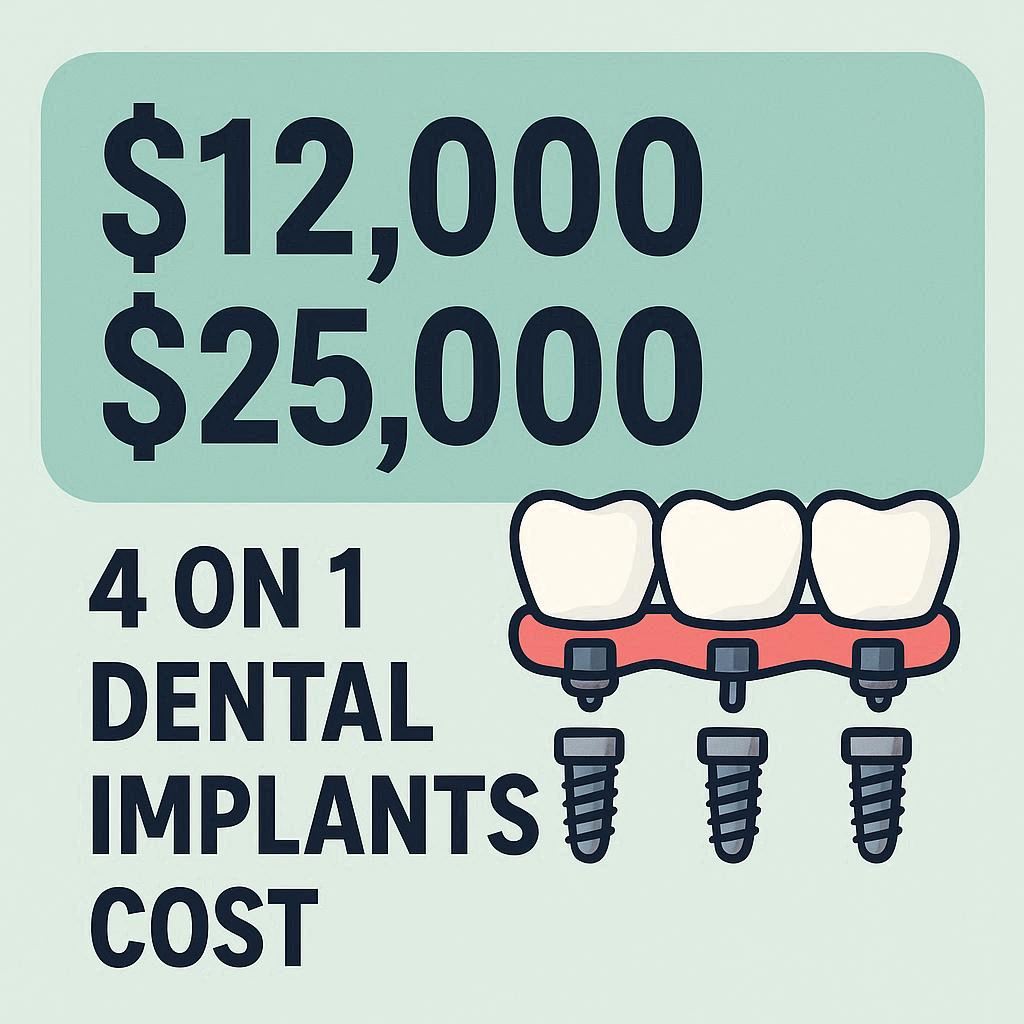
The total cost for 4 on 1 dental implants for a single arch typically falls between $12,000 and $25,000 in the United States.
For both upper and lower jaws (full mouth), the price ranges from $24,000 to $50,000 or more.
These numbers include the surgery, the abutments, the temporary teeth, and the final zirconia or acrylic bridge. But not always. And that is where many patients get surprised.
| Treatment Scope | Average Cost Range (USA, 2026) |
|---|---|
| Single arch (upper or lower) | $12,000 – $25,000 |
| Full mouth (both arches) | $24,000 – $50,000+ |
| Single arch at a dental school | $7,000 – $12,000 |
| Single arch overseas (Mexico, Costa Rica, Turkey) | $6,000 – $12,000 (plus travel) |
Important note: These prices are averages. Your exact cost depends on your location, your dentist’s experience, the materials used, and any additional procedures you might need.
Why Such a Wide Price Range?
You will see huge price differences between clinics. That does not always mean the expensive option is a rip-off. And the cheap option is not always a bargain.
Here is what moves the price up or down:
1. Your geographic location
A clinic in Manhattan or Los Angeles pays higher rent and staff salaries. That cost transfers to you. The same procedure in a smaller Midwestern city might cost 30% less.
2. The dentist’s expertise
An implant specialist (prosthodontist or oral surgeon) with twenty years of experience charges more than a general dentist who places implants part-time. You want experience here. Failed implants cost far more to fix.
3. Materials used for the final teeth
Acrylic (plastic) teeth cost less but stain faster and break more easily. Zirconia teeth look more natural, resist chipping, and last longer. They also cost significantly more.
4. Type of implant brand
Premium brands like Nobel Biocare or Straumann cost more. Off-brand implants cost less. Both can work well. But premium brands have more research behind them and offer better warranties.
5. Included services
Some clinics quote a low price but then add fees for:
- CT scans
- Temporary dentures during healing
- Pain medication
- Follow-up visits
- The final bridge adjustments
Always ask for an “all-in” quote.
Breaking Down the 4 on 1 Dental Implants Cost by Component
To understand where your money goes, let us split the total cost into smaller pieces.
1. Initial Consultation and Imaging ($150 – $500)
You will need a CBCT scan (3D X-ray). This scan shows your bone density, nerve locations, and sinus positions. The dentist uses this information to plan your implant placement.
Some clinics include this in the total package. Others charge separately.
2. Extractions (If Needed) ($75 – $300 per tooth)
If you still have failing teeth, they must come out. Simple extractions cost less. Surgical extractions (for broken or curved roots) cost more.
For a full arch, extraction fees can add $500 to $2,000 to your bill.
3. Bone Grafting or Sinus Lift ($500 – $3,000 per site)
Here is an honest truth. Many clinics advertise “no bone grafting needed with 4 on 1.” That is often true. But not always.
If your jawbone is severely resorbed (worn away), you might still need a small graft. A sinus lift (for the upper back teeth area) adds even more.
Ask your dentist directly: “Does my quote include any possible bone grafting?”
4. Implant Placement Surgery ($1,500 – $3,000 per implant)
This covers the surgeon’s time, the anesthesia, and the operating room setup. Four implants means four surgical fees.
5. The Implant Posts Themselves ($500 – $1,200 each)
The titanium screw that goes into your bone. Premium brands cost more. Some clinics bundle this with the surgical fee.
6. Abutments ($300 – $600 each)
These are small connectors that attach the implant to the prosthetic teeth. You need one per implant.
7. Temporary Prosthesis ($700 – $2,000)
While your implants heal (typically 3 to 6 months), you wear a temporary set of teeth. These are not as strong as the final set, but they allow you to eat soft foods and smile normally.
8. Final Prosthesis (The Teeth You Keep) ($4,000 – $12,000)
This is the big one. The final bridge attaches permanently to your implants.
- Acrylic (lower cost, less durable): $4,000 – $7,000
- Zirconia (higher cost, very durable, natural look): $8,000 – $12,000
9. Sedation or Anesthesia ($300 – $1,000)
Most patients choose IV sedation for comfort. You will remember nothing of the surgery. Local anesthesia alone costs less but can be stressful for anxious patients.
10. Follow-up Appointments and Adjustments ($200 – $800)
After your final bridge is placed, you may need small adjustments. Your bite might feel uneven. A spot might rub your gum. These visits are often included in better clinics but not always.
4 on 1 vs. Other Tooth Replacement Options: A Cost Comparison
How does 4 on 1 compare to other ways of replacing teeth? Let us look at the numbers.
| Treatment | Average Cost (Single Arch) | Lifespan | Pros | Cons |
|---|---|---|---|---|
| Traditional removable denture | $1,500 – $3,000 | 5 – 10 years | Low upfront cost | Slippage, bone loss, discomfort |
| Implant-supported overdenture (2 implants) | $6,000 – $10,000 | 10 – 15 years | More stable than dentures | Still removes for cleaning; less biting force |
| 4 on 1 dental implants | $12,000 – $25,000 | 20 – 30+ years | Fixed, natural feel, preserves bone | Higher upfront cost |
| Individual implants (8 to 10 implants) | $24,000 – $45,000 | Lifetime (with care) | Most natural option | Most expensive; more surgery time |
Reader note: A cheap denture might seem appealing today. But over twenty years, you could buy three or four dentures. You also lose jawbone over time, which changes your face shape. 4 on 1 stops that bone loss.
A Personal Perspective
Think of 4 on 1 as buying a reliable car instead of renting a different cheap car every few years. The upfront payment is higher. The long-term comfort and value are much better.
Hidden Costs That Catch Patients Off Guard
Even honest dentists sometimes forget to mention certain fees. Here are the most common “surprise” costs.
The Temporary Teeth Breakage Fee
Your temporary teeth are not indestructible. If you bite into a hard piece of bread or a nut, you could crack them. Some clinics charge $200 to $500 to repair or replace a broken temporary.
The “Final Try-In” Appointment
Before your permanent bridge is made, you try a wax or plastic version. One or two try-ins are often included. A third or fourth try-in (if you want changes) may cost extra.
The Warranty Fine Print
Many clinics offer a warranty. But read it carefully. Some warranties only cover the implants themselves, not the teeth. Others require you to return for cleaning every three months to keep the warranty active.
Travel and Time Off Work
You will need multiple appointments:
- Consultation and CT scan
- Surgery day (plan to take 2–3 days off)
- Follow-up at 2 weeks
- Follow-up at 3 months
- Final bridge placement (another day off)
If you live far from the clinic, factor in gas, hotels, or flights.
How to Get an Accurate 4 on 1 Dental Implants Cost Quote
Do not rely on website prices. Do not call and ask for “a ballpark.” Here is a better system.
Step 1: Find Three Clinics
Look for:
- One implant specialist (prosthodontist or oral surgeon)
- One general dentist with advanced implant training
- One dental school or teaching hospital
Step 2: Request a Written “All-In” Treatment Plan
Ask specifically for a document that includes:
- All imaging and diagnostics
- All extractions
- Any possible bone grafting (and what happens if you need it)
- The temporary prosthesis
- The final prosthesis material (acrylic or zirconia)
- All follow-up visits for one year
- Sedation fees
Step 3: Ask the Warranty Questions
- “Does the warranty cover the implants, the abutments, and the final teeth?”
- “What voids the warranty?”
- “How long does the warranty last?”
- “If an implant fails, who pays for the replacement surgery?”
Step 4: Compare Apples to Apples
Clinic A: $15,000 for acrylic teeth, no warranty, no sedation included.
Clinic B: $18,000 for zirconia teeth, 10-year warranty, sedation included.
Clinic B is actually the better value despite the higher price.
Does Insurance Cover 4 on 1 Dental Implants?
This is a frustrating answer, but an honest one.
Most traditional dental insurance plans do not cover implants. They were designed for fillings, crowns, and cleanings, not major restorative surgery.
However, you may have some coverage for:
- Extractions (if your plan covers oral surgery)
- The final prosthesis (sometimes called a “bridge” or “dentures”)
- The diagnostic imaging
Some plans cover 10% to 50% of certain components. But the total out-of-pocket remains high.
Medical Insurance Possibilities
If your tooth loss is due to an accident, injury, or a congenital condition, your medical insurance might contribute. This is rare but worth investigating.
The Best Alternative: Dental Savings Plans
Discount dental plans (not insurance) offer 15% to 50% off implant procedures at participating dentists. You pay an annual fee of $100 to $200 and then receive reduced rates.
Financing Options for 4 on 1 Dental Implants
Most patients do not pay $15,000 in cash. Here is how real people afford this treatment.
1. In-House Payment Plans
Some clinics offer no-interest or low-interest payment plans directly. You pay a down payment (often 25% to 50%) and then monthly installments over 6 to 24 months.
Always ask: “Do you offer in-house financing with no credit check?”
2. Medical Credit Cards (CareCredit, Alphaeon)
These are revolving credit lines for healthcare. Many offer 6, 12, or 18 months with no interest if paid in full by the deadline. The catch? If you miss a payment or go beyond the term, deferred interest hits hard.
3. Personal Loans
Sites like SoFi, LightStream, and Upgrade offer fixed-rate personal loans for medical procedures. Rates range from 7% to 20% depending on your credit. No collateral needed.
4. Health Savings Account (HSA) or Flexible Spending Account (FSA)
If you have an HSA or FSA through your employer, you can use pre-tax dollars for dental implants. This saves you 20% to 40% compared to using after-tax income.
5. Crowdfunding
Sites like GoFundMe have a “medical” category. Some patients raise a portion of their implant costs from family, friends, and even strangers. It is not guaranteed, but it costs nothing to try.
4 on 1 Dental Implants Cost Abroad: Is It Worth It?
Traveling for dental care has become common. But it comes with real risks and rewards.
| Country | Average Single Arch Cost | Travel + Lodging (Estimate) | Total Estimated Cost |
|---|---|---|---|
| Mexico (Los Algodones, Cancun) | $7,000 – $10,000 | $1,000 – $2,000 | $8,000 – $12,000 |
| Costa Rica | $8,000 – $11,000 | $1,500 – $2,500 | $9,500 – $13,500 |
| Turkey (Istanbul, Antalya) | $6,000 – $9,000 | $2,000 – $3,000 | $8,000 – $12,000 |
| Colombia (Bogota, Medellin) | $7,000 – $10,000 | $1,200 – $2,000 | $8,200 – $12,000 |
| Thailand (Bangkok) | $8,000 – $11,000 | $2,500 – $3,500 | $10,500 – $14,500 |
The Pros of Dental Tourism
- You can save 40% to 60% compared to the US
- Many foreign clinics are modern and use the same implant brands
- You combine dental work with a vacation
The Cons of Dental Tourism
- No easy follow-up care if something goes wrong
- Different infection control standards (research carefully)
- Language barriers can cause misunderstandings
- If an implant fails, you pay full price again back home
- Flying soon after surgery increases the risk of blood clots
Important note: If you choose dental tourism, stay for at least 10 to 14 days. You need to be there for the initial healing and any immediate adjustments. Do not fly home the day after surgery.
How to Vet an Overseas Clinic
- Ask for before-and-after photos of 4 on 1 cases
- Request a video call with the dentist
- Read Google reviews and Dental Departures reviews
- Ask what happens if you need a repair within one year
- Confirm they use a reputable implant brand (Nobel, Straumann, Zimmer)
The Long-Term Value: Why Cost Per Year Matters
Let us do a simple calculation.
Assume you pay $18,000 for 4 on 1 on your lower arch. The restoration lasts 25 years with normal care.
$18,000 ÷ 25 years = $720 per year.
That is about $60 per month.
Compare that to a denture. A good denture costs $2,500 and lasts 8 years. That is $312 per year or $26 per month. Cheaper, yes. But you also lose bone. Your face collapses. You need adhesive. You cannot bite into an apple.
Many patients say the extra $34 per month is worth feeling like yourself again.
What Affects the Lifespan of Your 4 on 1 Implants?
You want your investment to last as long as possible. These factors determine longevity.
Daily Hygiene (The #1 Factor)
Implants do not get cavities. But they can get peri-implantitis—an infection around the implant that destroys bone. This happens when you do not clean properly.
You will need:
- A water flosser (Waterpik)
- Super floss or implant-specific floss
- Interdental brushes
- Regular toothbrush (soft bristles)
Professional Maintenance
Plan on dental cleanings every 6 months. The hygienist uses special instruments that will not scratch your implant surfaces. Skipping cleanings shortens implant life.
Parafunctional Habits
Grinding or clenching your teeth (bruxism) puts extreme force on implants. Unlike natural teeth, implants have no ligament to absorb shock. You may need a nightguard.
Medical Conditions
Uncontrolled diabetes, osteoporosis medications (bisphosphonates), and autoimmune diseases can affect implant success. Always tell your dentist your full medical history.
Smoking
Smokers have significantly higher implant failure rates. Nicotine reduces blood flow to the bone. If you smoke, your 4 on 1 implants may last half as long.
Real Patient Scenarios: What Different People Pay
Let us look at three realistic examples.
Scenario 1: Sarah, Age 58, Lower Arch Only
Sarah has worn a lower denture for ten years. She hates how it moves. She has moderate bone loss but no need for grafting.
- Location: Suburban Ohio
- Clinic: General dentist with implant training
- Final teeth: Acrylic
- Total cost: $13,500
- Financing: $3,500 down, $500/month for 20 months (0% in-house plan)
Scenario 2: David, Age 65, Full Mouth (Both Arches)
David has failing teeth due to decades of grinding. He needs extractions of 18 remaining teeth. He chooses zirconia for both arches.
- Location: Austin, Texas
- Clinic: Prosthodontist (specialist)
- Final teeth: Zirconia
- Total cost: $44,000
- Financing: $10,000 from HSA, $34,000 personal loan at 9% over 5 years
Scenario 3: Maria, Age 49, Single Arch with Bone Graft
Maria lost bone after an infection. She needs a small graft on one implant site. She chooses dental tourism in Costa Rica.
- Location: San Jose, Costa Rica
- Clinic: Implant center (US-trained dentist)
- Final teeth: Zirconia
- Total cost (including travel and 12-day stay): $11,800
- Risk: No local warranty, but the clinic offers remote consultations
How to Avoid 4 on 1 Dental Implants Scams
Unfortunately, cheap implant deals sometimes hide problems. Watch for these red flags.
Red Flag #1: “Half Price if You Book Today”
High-pressure sales tactics have no place in healthcare. A trustworthy dentist gives you time to decide.
Red Flag #2: No CT Scan Performed
Placing 4 on 1 implants without a 3D CT scan is malpractice. If a clinic offers to “save you money” by skipping it, run.
Red Flag #3: Vague Materials
“High-quality dental grade materials” means nothing. Ask for the brand name of the implants and the specific type of final teeth.
Red Flag #4: No Written Warranty
If the warranty is only verbal, it does not exist. Get it in writing before you pay.
Red Flag #5: Unusually Low Price
Be very skeptical of any clinic offering 4 on 1 for less than $9,000 per arch in the US. The math does not work. Something is being cut—materials, sterility, or follow-up care.
Preparing for Your 4 on 1 Surgery: What to Expect
Understanding the process helps you budget for time and recovery.
Before Surgery (2 to 4 weeks)
- CT scan and records taken
- Treatment plan finalized
- Payment and financing arranged
- Pre-surgical blood work if medically indicated
- Antibiotics prescribed (usually taken one hour before surgery)
Surgery Day (3 to 5 hours)
You arrive, sign consent forms, and receive sedation. The dentist extracts remaining teeth, places four implants, attaches temporary teeth, and gives you post-op instructions. You go home with pain medication and a follow-up appointment scheduled.
The First Week
Swelling and bruising peak at day 2 or 3. You eat only soft, cool foods. No spitting, no straws, no vigorous rinsing. Most patients return to desk jobs by day 4 or 5.
Months 1 to 6 (Osseointegration)
Your bone grows tightly around the implants. You wear your temporary teeth. You return for periodic checks. During this time, your dentist may ask you to eat only softer foods to protect the healing implants.
Final Restoration (Month 6 to 8)
Your dentist removes the temporary teeth, takes new impressions, and sends them to the lab. A few weeks later, you return for your final bridge placement. The bridge is screwed or cemented into place. You leave with a full, fixed smile.
Frequently Asked Questions (FAQ)
How painful is the 4 on 1 procedure?
Most patients report mild to moderate discomfort after the anesthesia wears off. This usually peaks at day 2 and improves quickly. Most say it hurts less than a difficult tooth extraction.
Can I get 4 on 1 if I have gum disease?
Active gum disease must be treated first. Once your gums are healthy, you can proceed. Placing implants into infected gums leads to failure.
How long does the final bridge last?
With excellent home care and regular dental visits, a zirconia bridge can last 20 to 30 years or more. Acrylic bridges may need replacement after 8 to 12 years.
Do 4 on 1 implants feel like natural teeth?
Yes, more than dentures. You cannot remove them. They do not click. You can eat almost anything. The main difference is that you feel less temperature sensitivity and no nerve sensation.
Can I get 4 on 1 on both jaws at once?
Yes. This is called full-mouth restoration. The surgery takes longer (6 to 8 hours), and recovery is more intense. Many patients prefer to do one arch, wait 4 to 6 months, and then do the second.
What happens if one implant fails?
The dentist removes the failed implant, lets the area heal, and usually places a new implant. During this time, your bridge can often be modified to work with three implants temporarily.
Is 4 on 1 better than 6 on 1?
For most patients, 4 on 1 is sufficient. Six implants provide more even force distribution and may last longer, but they cost more. Your dentist will recommend based on your bone and bite force.
Additional Resource
For a current list of verified implant dentists, patient reviews, and cost comparison tools, visit the American Academy of Implant Dentistry (AAID) patient resource page:
🔗 aaid.com/patient-resources (external link, open in new tab)
This site helps you locate accredited implant specialists in your area.
Conclusion
4 on 1 dental implants cost ranges from $12,000 to $25,000 per arch in the US. The price depends on your location, the dentist’s expertise, the materials chosen, and whether you need extractions or grafting. While the upfront cost is significant, the long-term value—in comfort, function, and bone preservation—often outweighs cheaper alternatives like dentures. Always get a written all-in quote, verify warranty terms, and explore financing or dental tourism only after careful research.