Dental Implants Pensacola: The Patient’s Complete Roadmap to a Lasting Smile
Losing a tooth changes everything. It alters the way you smile in photographs. It makes you hesitate before biting into a crisp apple. It can even make you mumble words you once spoke with clarity. You are not alone in this experience. Millions of adults face tooth loss, and many of them discover a solution that feels and functions like a natural part of their body. That solution is a dental implant.
Pensacola has become a hub for exceptional restorative dentistry. The combination of coastal living and advanced medical care draws skilled professionals to the area. If you live in Pensacola, Pace, Gulf Breeze, or Milton, you have access to life-changing treatment right in your backyard.
This guide exists for one reason. We want to give you honest, detailed, and clear information about getting dental implants in Pensacola. No confusing jargon. No empty promises. Just the knowledge you need to make a confident decision about your health.
We will walk through the entire process. We will discuss real costs. We will look at the different types of implants. We will help you understand what to expect before, during, and after surgery. Grab a cup of coffee, sit back, and let us explore your path to a complete, healthy smile.
What Exactly Is a Dental Implant?
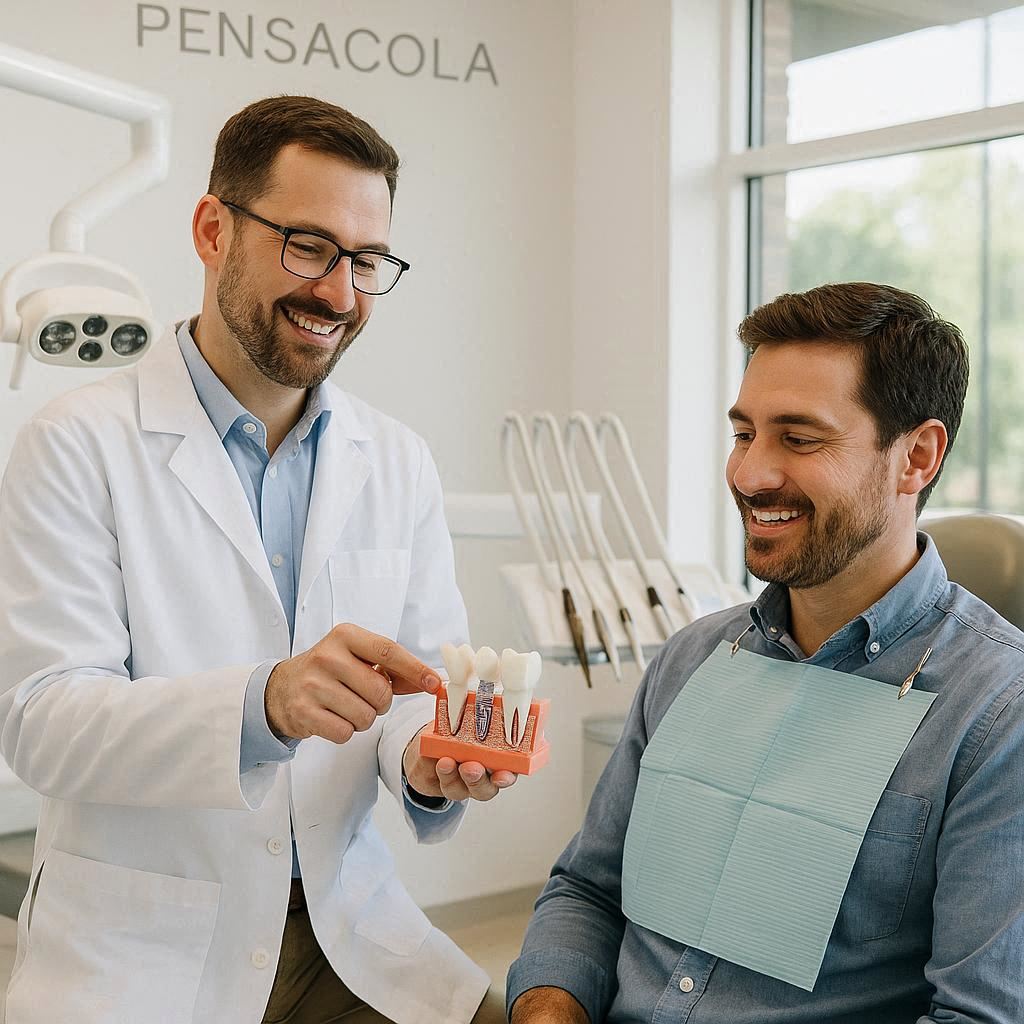
We should start with a simple definition. A dental implant is a small, biocompatible post that an oral surgeon places into your jawbone. Think of it as a replacement for the root of your missing tooth. Once the post bonds with your bone, your dentist attaches a custom-made crown on top. The result looks, feels, and chews like a natural tooth.
A dental implant consists of three distinct parts. The implant post itself, usually made of titanium or zirconia, acts as the artificial root. The abutment is a tiny connector piece that sits on top of the post. The crown is the visible, tooth-shaped part that you see above the gum line. Together, these three components create a restoration that stands independently. It does not rely on neighboring teeth for support. It does not slip or click when you speak.
Why Titanium and Zirconia Dominate Modern Implants
Most implant posts use a medical-grade titanium alloy. The human body accepts titanium remarkably well. Bone cells actually grow right up against the titanium surface and lock it in place. This biological process is called osseointegration. A Swedish orthopedic surgeon discovered it by accident in the 1950s, and it revolutionized dentistry forever.
Zirconia implants offer a metal-free alternative. Patients with metal sensitivities or those who simply prefer a ceramic option find zirconia appealing. Zirconia is also white, which can be advantageous if you have thin gum tissue that might show a grayish titanium shadow. Both materials have excellent track records. Your implant dentist in Pensacola will help you decide which option suits your unique situation.
“The day I understood that an implant actually fuses with the bone, I stopped thinking of it as a fake tooth. It becomes part of you. That is a powerful concept.” — A long-time dental implant patient
Why Pensacola Residents Choose Dental Implants
People in Pensacola live active, social lives. We spend weekends on the sugar-white sands of Pensacola Beach. We enjoy fresh seafood downtown. We talk, laugh, and eat together. Missing teeth can steal the joy from those simple pleasures. Here is why so many local residents are turning to dental implants.
Preservation of Jawbone and Facial Structure
Your teeth do more than chew food. They stimulate the jawbone every time you bite down. When you lose a tooth, that stimulation stops. The body begins to resorb the bone in that area, essentially breaking it down because it thinks the bone is no longer needed. Over time, this bone loss can cause your face to sag and look prematurely aged. Dental implants replace the stimulation because the post transfers chewing forces into the bone, just like a natural tooth root. This helps preserve your facial structure and bone density.
No Impact on Healthy Neighboring Teeth
A traditional dental bridge requires the dentist to file down the two adjacent healthy teeth. Those teeth become anchors for the bridge. With an implant, you leave your healthy teeth completely untouched. The implant stands on its own. This is a more conservative and long-term-healthy approach.
Unmatched Stability and Comfort
Patients who wear removable dentures often struggle with slipping, clicking, and sore spots. Adhesives are messy. Embarrassing moments happen. An implant-supported restoration stays firmly in place. You speak clearly. You chew steak, corn on the cob, and crunchy vegetables. You forget you even have a replacement tooth.
Long-Term Value and Durability
While a dental implant costs more upfront than a bridge or denture, its longevity often makes it the most cost-effective choice over a lifetime. Bridges may need replacement every 10 to 15 years. Dentures require relining and periodic replacement. A well-maintained implant can last a lifetime. When you consider cost per year, implants frequently come out ahead.
Comparative Table: Dental Implants vs. Bridges vs. Dentures
| Feature | Dental Implants | Fixed Bridge | Removable Partial/Full Denture |
|---|---|---|---|
| Impact on Adjacent Teeth | None | Requires filing down healthy teeth | May clasp onto teeth (partial) or rest on gums (full) |
| Bone Preservation | Yes, stimulates bone | No, bone loss continues under pontic | No, underlying bone continues to resorb |
| Stability | Excellent, like natural teeth | Good, fixed in place | Fair to poor, may slip or move |
| Longevity | Lifetime with proper care | 10-15 years on average | 5-8 years, may need relining/replacement |
| Oral Hygiene | Brush and floss like natural teeth | Flossing under bridge requires special tools | Must remove and clean daily |
| Initial Cost (Single Tooth) | $$$$ | $$$ | $$ |
| Long-Term Value | Often best due to longevity | Moderate | Lower initial cost, higher maintenance |
Exploring the Types of Dental Implants Available in Pensacola
Not every dental implant procedure looks the same. Your specific needs determine the approach your dental team will take. Let us look at the most common types of implant solutions practiced by Pensacola dentists.
Single Tooth Implants
This is the most straightforward implant procedure. You have one missing tooth. The oral surgeon places one implant post. After healing, one custom crown connects to the post. Single tooth implants are incredibly common and have a success rate of over 95 percent in healthy individuals. The procedure protects your bone and restores full function to the gap.
Multiple Tooth Implants with Individual Crowns
Suppose you have three missing teeth in different areas of your mouth. You do not have to join them together. A dentist can place individual implants for each missing tooth. Each crown functions independently. You floss between them just like natural teeth.
Implant-Supported Bridges
What if you are missing two or more teeth in a row? Placing an individual implant for each missing tooth might be unnecessary or too costly. An implant-supported bridge uses just two implants to support a span of three or four teeth. The implants serve as anchors on either end. The crowns in the middle (called pontics) connect to the anchor crowns. This is a fixed, non-removable solution that feels very stable. It also avoids involving natural teeth on either side of the gap.
Full-Arch Implant Restoration Options
People who have lost all or most of their teeth in an arch have several implant solutions available. These options have transformed the lives of denture-wearers across Pensacola.
Implant-Retained Overdentures
An implant-retained overdenture uses two to four implants to secure a removable denture. The denture snaps onto special attachments on the implants. It stays put during eating and speaking, but you can still remove it for cleaning. This is an excellent upgrade from a traditional loose denture. Patients with some bone loss who still want a removable option often choose this route.
Fixed Full-Arch Restoration (Often Called All-on-4®)
This technique uses four to six strategically placed implants to support a full arch of fixed, non-removable teeth. The back implants are angled to maximize contact with available bone, often eliminating the need for bone grafting. You leave the dental office with a temporary set of teeth on the same day as the implant surgery in many cases. After healing, you receive a final, permanent bridge. The All-on-4® protocol has given thousands of patients a new lease on life. Pensacola has several skilled providers who perform this advanced procedure.
“I walked in with a denture that made me gag. I walked out with teeth that don’t come out. I cried happy tears eating a chicken wing for the first time in ten years.” — A Pensacola patient who received a full-arch restoration
Zygomatic Implants for Severe Bone Loss
Some patients have suffered such extensive bone loss in the upper jaw that even angled implants cannot find adequate anchorage. Traditional implants in these cases would require massive bone grafting procedures. Zygomatic implants offer an alternative. Instead of anchoring in the deficient upper jawbone, these extra-long implants anchor into the zygomatic bone, which is your cheekbone. The zygomatic bone is dense and does not resorb like jawbone. This highly specialized technique avoids complex grafting and greatly reduces treatment time. Only select surgeons in the Pensacola region perform this procedure.
The Dental Implant Procedure: A Step-by-Step Timeline
Uncertainty causes anxiety. The more you know about what happens and when it happens, the calmer you will feel. Let us walk through the entire dental implant journey in Pensacola, from your very first phone call to the day you smile with your final restoration.
Phase 1: Initial Consultation and Comprehensive Examination
Your journey starts with a consultation. You sit down with an implant dentist or oral surgeon who listens to your concerns, goals, and medical history. This is not a rushed appointment. The doctor asks about your tooth loss history, your general health, medications you take, and any anxieties you have about dental treatment. You get to ask every question on your mind.
After the conversation, the clinical examination begins. The dentist examines your entire mouth. They check the health of your gums, remaining teeth, and bite alignment. Special attention goes to the area where the implant will go. The doctor evaluates the amount of bone width and height through palpation and visual inspection.
Advanced Diagnostic Imaging
Almost every implant case in modern Pensacola practices involves a 3D Cone Beam Computed Tomography scan. A CBCT scan takes a three-dimensional X-ray of your jaws, teeth, sinuses, and nerves. This is a critical safety tool. The scan allows the surgeon to precisely measure the available bone. It reveals the exact location of the inferior alveolar nerve in the lower jaw, which must be avoided during surgery. It shows the position of the sinus cavities in the upper jaw. With this 3D data, the dentist can virtually place your implant on a computer before ever touching a surgical instrument. This digital planning dramatically increases safety and precision.
Phase 2: Personalized Treatment Plan and Preparatory Procedures
With the diagnostic information gathered, your dental team creates a written treatment plan. The plan clearly outlines the proposed procedure, the number of appointments, the type of sedation available, the timeline, and the fees. You should receive this plan in writing. You should understand it fully before you consent to treatment.
For some patients, preparatory procedures are needed before implant placement. If the CBCT scan shows insufficient bone volume, your surgeon will recommend a bone graft. A bone graft adds bone material to the deficient area and allows it to heal and integrate over several months. If the sinuses in the upper jaw droop too low, the surgeon may recommend a sinus lift, which gently raises the sinus floor and places bone graft underneath. If you have gum disease, you must complete periodontal therapy to ensure a healthy, infection-free environment for the implant. Healthy foundation, successful outcome.
Important Note for Patients: Do not be discouraged if your dentist recommends a bone graft. It is a very common and routine procedure. It simply means your team is committed to the long-term success of your implant. Rushing into surgery without adequate bone invites failure.
Phase 3: The Surgical Placement of the Implant
Surgery day arrives. Do not let the word “surgery” intimidate you. Dental implant placement is a very controlled, delicate procedure. Most patients are surprised by how straightforward it feels.
Your chosen sedation takes effect. Options typically range from local anesthesia only, to nitrous oxide (laughing gas), to oral conscious sedation, to IV sedation. Your comfort level and the complexity of the case dictate the best choice.
Once you are comfortable and numb, the surgeon makes a small incision in the gum to expose the underlying bone. Using a series of precisely sized drills, the surgeon creates a channel in the bone that exactly matches the dimensions of your implant. The implant is then gently threaded into place. The surgeon checks the position and stability. The gum tissue is then sutured back down over the implant or around a small healing cap, depending on the specific technique.
Placing a single implant often takes less than an hour. Even full-arch cases can frequently be completed in one surgical session.
Phase 4: Osseointegration and the Healing Period
This phase requires patience. No active work happens. Your body takes over. Over the next three to six months, the jawbone cells grow and attach themselves firmly to the implant surface. This process, osseointegration, creates a biological lock. The implant becomes a stable part of your anatomy. During this phase, you must protect the implant. Your surgeon provides a soft diet protocol. Avoid chewing directly on the implant site. Maintain excellent oral hygiene to prevent infection. If you wear a temporary tooth or denture, it will be designed to place no pressure on the healing implant.
Phase 5: Uncovering the Implant and Placing the Abutment
After osseointegration is confirmed, the surgeon performs a brief second procedure to uncover the implant if it was buried beneath the gum. They attach a small healing abutment that sticks out through the gum. This abutment shapes the gum tissue to create a natural emergence profile for the future crown. This step is minor and heals quickly.
Phase 6: Creating and Placing Your Final Restoration
Once the gums heal around the abutment, you return to the restorative dentist. Impressions are taken, either with traditional putty or, more commonly now, with a digital intraoral scanner. The dental laboratory fabricates your custom crown, bridge, or full-arch restoration. The dentist selects a shade that perfectly matches your natural teeth.
When the restoration returns from the lab, you sit for the final delivery appointment. The dentist removes the healing abutment, places the final abutment, and seats the crown. They check the bite carefully, ensuring your new tooth does not hit too hard or too light. They check the contacts between teeth to make sure you can floss comfortably. You look in the mirror. You smile. The missing tooth is gone, and a new, permanent, beautiful tooth stands in its place.
Cost Analysis of Dental Implants in Pensacola
Money matters. We believe in transparent, honest discussion about the financial investment required for dental implants. The cost of dental implants in Pensacola varies widely based on individual needs, but we can give you realistic ranges that reflect what you can expect to encounter.
Single Tooth Implant Costs
A single tooth implant from start to finish in the Pensacola area typically ranges from $3,500 to $6,500. This total fee generally includes the surgical placement of the implant, the abutment, and the final crown. Factors influencing this range include the implant brand, the material of the crown (porcelain-fused-to-metal vs. full ceramic like zirconia), and whether any additional sedation was used.
Note that this estimate assumes you do not need a bone graft or a sinus lift. If you need one of those procedures, you can add $400 to $3,000 depending on the size and type of graft.
Full-Arch Restoration Costs
A full-arch restoration using the All-on-4® concept on one jaw can range from $20,000 to $30,000 per arch in Pensacola. This fee typically covers the surgical placement of all four to six implants, the immediate temporary denture or bridge, and the final, permanent zirconia or acrylic hybrid bridge. This is a significant investment that replaces an entire arch of failing or missing teeth with a permanent solution.
Premier full-arch options using premium materials like a monolithic zirconia prosthesis with titanium substructures can exceed $35,000 per arch. Less expensive options using denture teeth set in acrylic on a titanium bar may come in at the lower end of the range.
Implant-Retained Overdenture Costs
An implant-retained lower overdenture supported by two implants with locator attachments typically costs between $8,000 and $14,000. This includes the implant surgery, the attachments, and the fabrication of a new, custom-fitted denture. This is a highly popular, life-changing option for patients struggling with a loose lower denture.
Important Note for Readers: The fees quoted above are estimates for the Pensacola market. Every case is unique. Get a detailed, written treatment plan from your specific provider with all codes and fees before making a decision.
Why This Investment Makes Financial Sense
We understand that these numbers can feel intimidating. Let us put them in long-term perspective. A three-unit dental bridge to replace one missing tooth might cost $3,000 to $4,500. It will likely need replacement in 10-15 years. Over 30 years, you might pay for that bridge two or three times. The bridge also puts the adjacent teeth at risk of decay and root canal problems. The implant, while more initially, rarely needs replacement if cared for properly. Over decades, the implant often proves less expensive and less troublesome.
Cost Comparison Table: Different Implant Solutions in Pensacola
| Treatment Type | Estimated Fee Range (per arch/unit) | Key Inclusions | Considerations |
|---|---|---|---|
| Single Implant + Crown | $3,500 – $6,500 | Implant post, abutment, crown | Does not include bone graft if needed |
| Implant Bridge (3-unit) | $7,000 – $12,000 | 2 implants, 3-unit bridge | Replaces 3 consecutive missing teeth |
| Snap-On Overdenture (Lower) | $8,000 – $14,000 | 2 implants, attachments, new denture | Removable for cleaning, much more stable |
| All-on-4® Full Arch (per jaw) | $20,000 – $30,000 | 4-6 implants, temporary and final fixed bridge | Fixed, non-removable solution |
| Zygomatic Full Arch | $35,000+ | Specialized extra-long implants, final bridge | For severe upper jaw bone loss |
Dental Implant Materials: A Closer Look
The materials used in your implant restoration affect aesthetics, durability, and cost. Understanding your options empowers you to ask the right questions during your Pensacola consultation.
Implant Post Materials
Titanium alloy is the gold standard. Decades of research support its safety and effectiveness. The success rate is extremely well-documented. Some patients express concern about metal sensitivity, though true titanium allergy is extraordinarily rare.
Zirconia, specifically yttria-stabilized zirconia, offers a white, ceramic, metal-free implant. It is an excellent option for patients with confirmed metal allergies or for those who simply desire the most holistic material possible. Studies show zirconia implants have comparable success rates to titanium, though the technology is newer. Not every office offers zirconia implants, so ask if this interests you.
Crown Materials
Most single implant crowns in Pensacola are crafted from ceramic materials. Porcelain-fused-to-metal (PFM) crowns have a metal base covered with tooth-colored porcelain. They are strong and proven, but the metal margin can sometimes show a dark line at the gum if the gum recedes slightly.
Full ceramic crowns, often made of layered porcelain or solid zirconia, eliminate any metal display. Solid zirconia (often called “monolithic zirconia”) is the strongest tooth-colored material available in dentistry. It is virtually unbreakable and highly aesthetic. For back teeth, solid zirconia is a superb choice. For front teeth, layered porcelain offers the most lifelike translucency. Your dentist will guide this decision based on the position in your mouth and your bite forces.
Full-Arch Bridge Materials
For full-arch cases, you often choose between a high-impact acrylic bridge reinforced with a titanium framework, or a final monolithic zirconia bridge. Acrylic is lighter, more affordable, and easier to repair if a tooth chips. Zirconia is heavier, extraordinarily strong, more resistant to wear, and more expensive. It looks stunning and lasts a very long time.
The Technology Advantage in Modern Pensacola Implant Practices
The best implant dentists in Pensacola invest in technology that makes your treatment safer, faster, and more comfortable. When you research providers, look for the following technologies.
Cone Beam Computed Tomography (CBCT) has become a standard of care. Surgeons use it to plan implant placement virtually, avoiding nerves and sinuses. It transforms implant surgery from a “best guess” based on two-dimensional X-rays to a precise, measurable, predictable procedure.
Intraoral Scanners eliminate the need for goopy, uncomfortable traditional impressions. A small wand scans your teeth and implant positions digitally. The data is sent electronically to the dental laboratory. Digital impressions are faster and more accurate.
3D Printing and In-Office Milling allow some advanced practices to fabricate surgical guides, temporary crowns, and even final restorations right in the office. This can dramatically reduce turnaround times.
Computer-Guided Implant Surgery combines CBCT data with digital impressions. The dentist plans the exact position, depth, and angulation of each implant on a computer. A surgical guide is then 3D-printed. During surgery, the guide directs the drills precisely according to the plan. This is minimally invasive, often flapless, and extremely precise.
Sedation and Comfort Options for Dental Implant Surgery
Fear of pain is one of the biggest barriers preventing people from seeking implant treatment. Modern sedation dentistry has changed everything. Pensacola implant practices offer a spectrum of comfort options.
Local Anesthesia alone numbs only the surgical site. You remain completely awake and alert. You feel pressure and vibration but no sharp pain. This is sufficient for many straightforward, single-implant cases in cooperative, low-anxiety patients.
Nitrous Oxide (Laughing Gas) adds a layer of mild sedation. You breathe the gas through a small mask. You feel relaxed, warm, and somewhat detached. The effects wear off within minutes of stopping the gas. You can drive yourself home. It is an excellent option for mild to moderate anxiety.
Oral Conscious Sedation involves taking a prescribed pill, often a medication from the Valium family, before your appointment. By the time you arrive, you are very drowsy and relaxed. You remain conscious and able to respond to commands but likely will not remember much of the procedure. You must have someone drive you home.
IV Sedation (Twilight Sedation) delivers sedation medication directly into your bloodstream through a small IV line. The level of sedation is deeper and more precisely controllable. You drift into a dream-like state. You feel completely comfortable and unaware. This is very popular for complex cases, multiple implant placements, and patients with significant dental anxiety. You need a driver, and you will feel groggy for the rest of the day.
Talk openly with your Pensacola implant surgeon about your level of anxiety. There is no shame. They want to make this experience as easy as possible for you.
Choosing the Right Provider for Dental Implants Pensacola
The single most important decision you make in this journey is who you trust to perform your surgery and restore your teeth. Credentials, experience, and personal connection all matter. Use this checklist as a guide when evaluating practices.
Credentials and Training
Look for a surgeon who is a board-certified oral and maxillofacial surgeon or a periodontist with advanced surgical training. General dentists can place implants, and many do so excellently, but they should have pursued extensive continuing education and demonstrate significant experience. Ask directly: “How many implant procedures do you perform each year?” and “What advanced training do you hold in implant dentistry?” A Fellowship or Diplomate status in organizations like the International Congress of Oral Implantologists (ICOI) or the American Academy of Implant Dentistry (AAID) indicates a serious commitment to this field.
Technology and Facility
Ask about CBCT technology. Does the doctor perform surgery using computer-guided templates? Do they have an in-house dental laboratory for faster turnaround on temporaries? The quality of the facility speaks to the overall commitment to excellence.
Communication Style
Do you feel heard? Does the dentist take time to answer your questions without making you feel rushed? Are the treatment coordinator and office staff friendly and transparent about costs? Dental implant treatment is a relationship. You will be seeing this team for many months, and for follow-up care for years.
Reviews and Testimonials
Read Google reviews and Healthgrades. Do not just look at the star rating. Read what patients actually say. Look for themes. Mentions of compassionate care, good pain management, excellent communication, and beautiful results are good signs. Pay attention to how the practice responds to any negative reviews. It reveals their character.
The Consultation Experience
Most reputable Pensacola implant practices offer a paid or free consultation. Use this appointment to interview the doctor. Bring a list of questions. A good provider will be happy to answer them all.
Step-by-Step Timeline: What Your Weeks and Months Will Look Like
To give you a very clear picture, here is a sample timeline for an uncomplicated single tooth implant without bone grafting.
- Week 1: Initial consultation, CBCT scan, and treatment planning.
- Week 2-3: Surgical placement of the implant under local anesthesia or sedation. Sutures placed. Post-operative instructions given.
- Week 4: Follow-up visit to check healing and remove any sutures if not dissolvable.
- Week 5-16: Healing and osseointegration period. Implant fuses with the bone. You wear a temporary tooth if needed.
- Week 17: Uncovering the implant and placing a healing abutment (minor in-office procedure).
- Week 19: Digital impression taken for the final crown.
- Week 21: Final abutment and crown delivery. Bite and aesthetic evaluation.
- Week 22: First post-delivery checkup.
Actual timelines can be shorter or longer based on individual healing and the doctor’s specific protocol.
Before the Surgery: A Practical Preparation Checklist
Proper preparation makes surgery day smooth.
- Arrange for a responsible adult to drive you home if you choose sedation beyond nitrous oxide.
- Fill any prescriptions (antibiotics, pain medication, anti-anxiety medication) ahead of time, as instructed.
- Shop for soft foods: yogurt, smoothies, protein shakes, mashed potatoes, soup, applesauce, scrambled eggs.
- Pick up a few ice packs or a bag of frozen peas to help reduce swelling.
- Wear comfortable, loose-fitting clothing with short sleeves if you are having IV sedation.
- Do not eat or drink after midnight if your surgeon tells you to fast before sedation.
- Go to bed early and try to rest well.
After the Surgery: A Realistic Recovery Guide
Your recovery instructions will be very specific from your surgeon. Here is what a typical first week looks like.
The First 24-48 Hours
Swelling is normal. Apply ice packs to the cheek over the surgical area in 20-minute on, 20-minute off cycles. Some minor oozing of blood is expected. Bite gently on gauze placed over the site. Take prescribed pain medication or over-the-counter ibuprofen as directed. Rest. Do not exercise. Prop your head up on pillows when you sleep. Eat only cold liquids and very soft cold foods. No straws. The sucking motion can dislodge the protective blood clot.
Days 3 to 7
Swelling should peak around day three and then begin to subside. You may have some bruising on the cheek or under the eye. This resolves on its own. You can transition to warm, soft foods. Gently rinse with warm salt water several times a day, but do not swish vigorously. You can usually return to a non-physical job after a couple of days, but listen to your body.
The Healing Weeks
The gum tissue closes over the implant. The implant is doing its work below the gum, bonding with the bone. Follow strict oral hygiene around the area without disturbing the implant. Use the soft toothbrush and gentle technique your team shows you. Avoid chewing directly on the site.
“The day after, I thought, what did I do? By day five, I felt basically normal. The wait for the final tooth is the hardest part—but so worth it.” — A patient reflecting on their single implant journey
Dental Implants and Smoking: An Honest Conversation
Smoking and vaping significantly compromise dental implant success. The chemicals in tobacco constrict blood vessels and reduce oxygen delivery to the healing surgical site. Smokers have a much higher rate of implant failure, particularly due to poor osseointegration and a drastically increased risk of a post-operative infection known as peri-implantitis.
If you smoke, your dentist will have a frank conversation with you. Many surgeons require a smoking cessation period before and after surgery. They want your investment to last. Quitting smoking is the single best thing you can do not just for your implant, but for your overall health. If quitting is not possible, your dentist may modify the treatment plan or set realistic expectations about the increased risk profile.
Medical Conditions That Influence Implant Candidacy
Dental implants are a safe elective surgery for most people, but certain medical conditions demand careful consideration.
Uncontrolled Diabetes: Diabetic patients with poorly controlled blood sugar heal slower and are more prone to infection. With HbA1c levels in a healthy range, many diabetic patients enjoy successful implant outcomes. Good collaboration between your physician and your dentist is vital.
Autoimmune Diseases: Conditions like rheumatoid arthritis or lupus can affect healing. Medications like steroids or immunosuppressants can also play a role. It does not automatically disqualify you, but your team will need a full picture of your health.
History of Bisphosphonate Use: Patients who have taken intravenous bisphosphonates for cancer treatment or oral bisphosphonates for osteoporosis are at risk for medication-related osteonecrosis of the jaw (MRONJ). Elective jaw surgery, including implants, must be approached with extreme caution and full disclosure of your drug history.
Pregnancy: Elective dental surgery is typically postponed until after delivery.
Full disclosure of your complete medical history, including all medications and supplements, is absolutely non-negotiable. It keeps you safe.
Protecting Your Investment: Maintenance and Long-Term Care
Dental implants cannot get cavities, but that does not mean they are maintenance-free. The enemy of a long-lasting implant is peri-implantitis—an inflammatory condition affecting the soft and hard tissues around an implant, similar to gum disease around natural teeth. It is caused by bacterial plaque and can lead to bone loss and eventual implant failure.
Your Daily Routine
- Brush twice a day with a soft-bristled toothbrush.
- Floss daily. Use specialized implant floss, floss threaders, or a water flosser with a non-metal tip to clean around the implant.
- Consider an antimicrobial mouth rinse if recommended by your dentist.
Professional Maintenance
You must see your dentist or periodontist for professional maintenance visits, usually every six months but sometimes every three to four months for complex full-arch cases. The hygienist uses special instruments that do not scratch the titanium abutment or ceramic crown. They also evaluate the health of the tissues, check the integrity of the abutment screw, and take periodic X-rays to monitor bone levels around the implant.
Full-Arch Transformations: Living with Your New Smile
The day you receive your final fixed full-arch bridge is life-changing. You walk into the office feeling incomplete. You leave feeling whole. There is an adaptation period. Your tongue needs time to get used to the new contours of the bridge. Speaking feels slightly different for a few days. Reading aloud to yourself at home helps speed up the adaptation.
Eating is a rediscovery. Start with softer foods to gain confidence. Gradually introduce more challenging textures. Take small bites. The bite force sensation through implant-supported teeth is different from natural teeth; you will quickly learn. The psychological impact cannot be overstated. Patients report renewed confidence, improved social engagement, and better nutrition. They no longer choose restaurants based on what they can eat. They eat what they want.
The Emotional Journey No One Talks About
We have to address the emotional side of tooth loss and restoration. Losing teeth hurts. It causes grief, embarrassment, and social withdrawal. Many people feel shame, as if they somehow failed. Please hear this: tooth loss is a medical condition, not a moral failing. Accidents, genetics, disease, and time all play roles. Getting dental implants is an act of self-care and courage. It is okay to feel nervous. It is okay to feel emotional when you see your new smile. These feelings are valid. The Pensacola dental professionals we know treat this journey with the compassion it deserves.
Dental Implants Pensacola: Beyond the City Limits
This information applies regardless of whether you live in the heart of downtown Pensacola, out near Perdido Key, across the bay in Gulf Breeze, or up in Pace. Patients routinely travel short distances to see top-tier implant providers in the Pensacola metro area. The quality of care available here is exceptional. Do not let a 20-minute drive prevent you from choosing the right doctor.
A Word on Dental Tourism and Seeking Out-of-Area Care
Some patients consider traveling out of state or even out of the country for cheaper implants. We understand the appeal of a lower advertised price. We urge extreme caution. Dental implant therapy requires multiple visits over months. If complications arise, having your surgeon nearby and accessible is invaluable. The true cost includes appropriate follow-up care. Verify the materials being used. Ensure the provider meets U.S. standards of sterilization and training. The horror stories of cut-rate implant dentistry gone wrong are real. We recommend you find a trusted, local Pensacola provider with strong credentials and a visible presence in the community.
A Helpful Checklist for Your First Consultation
Print this out or save it on your phone. Bring it with you.
- Can you explain what the CBCT scan shows me?
- Am I a candidate for a bone graft or sinus lift?
- How many similar cases have you completed in the last year?
- What is your personal success rate with implants?
- What brand of implant do you use, and why?
- Will a specialist place the implant and my general dentist make the crown, or do you do both in your practice?
- Can I see before-and-after photos of your own patients?
- What sedation options do you offer?
- Can you provide a detailed, written treatment plan and fee breakdown today?
- What is your policy if an implant fails?
Real Patient Experiences in Pensacola (Anonymous Narratives)
To protect privacy, we have compiled composite narratives drawn from common patient experiences.
James, 54, Lost a Lower Molar: “I ignored a cracked tooth for too long. Eventually it had to come out. The gap was far back and nobody could see it, but chewing was annoying and my dentist warned me the tooth above was starting to drift down. I was terrified of the surgery. My oral surgeon used IV sedation. I remember nothing from the procedure. Recovery was a few days of soft food and ibuprofen. The implant took about four months to heal. The crown went on and I honestly forget it is not my real tooth. It just works.”
Sarah, 68, Longtime Denture Wearer: “I had an upper denture for 15 years. It never fit right. I used so much adhesive. I was always worried it would drop when I laughed. My daughter found out about the All-on-4 procedure. I got four implants placed and a temporary fixed bridge the same day. The first time I bit into an apple without worrying? I cried. I absolutely cried. My final zirconia bridge is beautiful. I smile as wide as I want. It gave me my life back.”
David, 47, Front Tooth Lost to Sports Injury: “An elbow in a basketball game knocked out my front tooth. The emergency dentist could not save it. I wore a flipper temporary for a while and it was awful. I went for a single implant with a custom ceramic crown. The color matching was incredible. My coworkers never knew it was fake. It feels exactly like my original tooth. Worth every penny to not have a missing front tooth at my age.”
Common Mistakes to Avoid on Your Implant Journey
- Choosing a provider based solely on price. This is a surgical procedure. Skill and quality matter more than a bargain.
- Skipping the bone graft because it adds time and cost. The long-term result depends on adequate bone. Trust your surgeon.
- Smoking during the healing phase. Do not risk it. You are actively undermining your own investment.
- Neglecting oral hygiene after the crown is delivered. Implants need cleaning. No exceptions.
- Not asking enough questions. You are the patient. You have every right to full understanding.
The Future of Dental Implants: What’s on the Horizon
The field moves fast. Researchers are exploring ways to speed up osseointegration with growth factors and specialized implant coatings. 3D-printed custom implants tailored exactly to a patient’s extraction socket are becoming more common. Digital workflows from start to finish continue to reduce treatment time. Bioprinting, the concept of printing living tissue and even teeth, is a long-term research goal. Pensacola providers who invest in continuing education stay at the forefront of these advances, passing the benefits on to their patients.
Additional Resources for Your Journey
We believe in connecting you with accurate, authoritative information. Here is a respected resource where you can continue your research.
- The American Academy of Implant Dentistry (AAID): Patient education section available at www.aaid.com
This site offers reliable, peer-reviewed information about implant types, procedures, and finding a credentialed implant dentist.
Frequently Asked Questions About Dental Implants Pensacola
How painful is dental implant surgery?
Most patients report that the actual surgery is comfortable with modern anesthesia. Post-operative discomfort for a single implant is often compared to a tooth extraction. It is manageable with over-the-counter or prescribed pain medication for a few days.
How long does a dental implant procedure take from start to finish?
For an uncomplicated single implant, you can expect the process to take about three to six months. Complex cases involving bone grafts or full-arch restorations can extend the timeline.
Does dental insurance cover implants in Pensacola?
Coverage varies widely. Many plans now offer some implant coverage, but often with a waiting period or an annual maximum. Your dental office can help you understand and maximize your specific benefits.
What is the difference between a periodontist and an oral surgeon for implants?
Both are surgical specialists. A periodontist specializes in the gums and bone supporting the teeth. An oral and maxillofacial surgeon has a broader surgical scope that includes the entire facial complex. Both can place implants excellently. Choose a provider with significant implant experience and the credentials to match.
Can I get an implant years after losing a tooth?
Yes, absolutely. However, bone loss occurs over time in the missing space. You will likely need a bone graft to rebuild the foundation before an implant can be placed. A CBCT scan will tell you exactly what is needed.
How long do dental implants last?
Dental implants themselves, the post in the bone, can last a lifetime with proper care. The crown on top may need replacement after 15 to 20 years due to normal wear.
Are dental implants safe for older adults?
Age alone is not a disqualifier. Health status and adequate bone volume are the determining factors. Many patients in their 80s and 90s receive implants successfully and safely.
What happens if an implant fails?
Implant failure is uncommon but possible. It often occurs within the first year if the implant fails to integrate. The surgeon can remove the failed implant, allow the site to heal, and place a new implant, often with success.
Conclusion
Your journey toward dental implants in Pensacola represents a profound investment in your health, confidence, and quality of life. We have guided you through the honest, detailed reality—from the initial consultation and 3D imaging, through the surgical placement and healing period, to the moment you see your final, permanent restoration. By choosing a skilled, compassionate provider and committing to proper care, you gain a solution that looks, feels, and functions beautifully for decades. A complete smile in Pensacola is not just a dream; it is a very achievable reality.
Disclaimer: This article is for informational purposes only and does not constitute medical or dental advice. Every individual’s oral health situation is unique. Consult directly with a licensed dental professional in Pensacola for a thorough examination and personalized treatment recommendations.