What Is PVP Ingredient for Teeth Whitening?
You flip over a whitening gel syringe or read the ingredients on a strip package. Among the peroxide, glycerin, and flavorings, you spot an unfamiliar acronym: PVP. It sounds like something from a chemistry lab. You wonder what it does, whether it is safe, and why manufacturers include it in products you put in your mouth.
PVP stands for polyvinylpyrrolidone, a synthetic polymer with remarkable properties that make it exceptionally useful in teeth whitening formulations. This ingredient plays several critical roles that directly affect how well your whitening treatment works and how comfortable it feels.
We will explore PVP comprehensively. You will learn what it is chemically, why it appears in whitening products, how it benefits the whitening process, and what safety data says about its use in oral care.
What PVP Actually Is
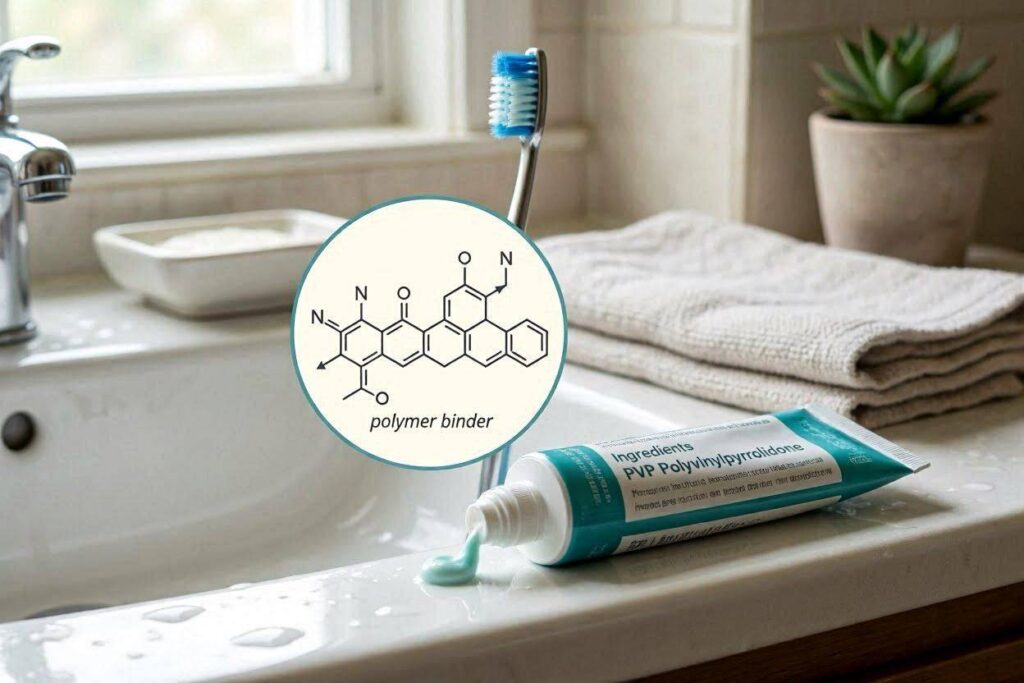
PVP, or polyvinylpyrrolidone, is a water-soluble polymer made from repeating units of N-vinylpyrrolidone. The name sounds intimidating. The reality is more approachable.
The Chemistry in Simple Terms
Imagine a chain made of identical links. Each link is a single molecule of N-vinylpyrrolidone. Connect hundreds or thousands of these links together, and you have polyvinylpyrrolidone. The “poly” prefix simply means many units joined in a chain.
This chain structure gives PVP its useful properties. The polymer can be manufactured in different chain lengths, called molecular weights. Short chains produce low-viscosity solutions. Long chains create thick, sticky gels. Whitening formulators select the molecular weight that produces the consistency they need.
Physical Form
Pure PVP is a white to off-white powder that dissolves readily in water and many organic solvents. It is hygroscopic, meaning it attracts and holds water molecules from the surrounding environment. This moisture-attracting property proves valuable in whitening applications.
Where Else PVP Appears
PVP is not unique to teeth whitening. You encounter it regularly in products throughout your daily life:
- Pharmaceutical tablets use PVP as a binder that holds ingredients together
- Liquid medicines include PVP as a suspending agent
- Eye drops and contact lens solutions contain PVP as a lubricant
- Hair sprays and styling gels rely on PVP for film-forming properties
- Food products use PVP as a stabilizer and clarifying agent
- Wound dressings incorporate PVP-iodine complex as an antiseptic
The presence of PVP in so many regulated products, including injectable pharmaceuticals and ophthalmic solutions, speaks to its established safety profile.
Why PVP Is Used in Teeth Whitening Products
PVP serves multiple functions in whitening gel. It is not filler. It actively contributes to product performance.
Adhesion and Gel Retention
The most important role of PVP in whitening is keeping gel where it belongs: on your teeth and off your gums. PVP forms a sticky, adherent film when it dries. This film helps whitening gel stay in contact with enamel throughout the treatment period.
Without PVP or similar polymers, whitening gel would flow under gravity, dilute rapidly with saliva, and migrate onto soft tissues. The treatment would be messy, less effective, and more irritating to gums.
Viscosity Control
PVP thickens whitening gel to a consistency that can be dispensed precisely and that stays in place after application. The polymer chains entangle with each other in solution, creating resistance to flow. This viscosity can be tuned by selecting the appropriate molecular weight and concentration.
A gel that is too thin runs off teeth. A gel that is too thick is difficult to dispense and spread evenly. PVP allows formulators to hit the sweet spot between these extremes.
Film Formation
As whitening gel sits on teeth, water and other volatile components slowly evaporate or are diluted by saliva. PVP remains behind, forming a thin, transparent film. This film serves as a matrix that holds peroxide against the enamel surface.
The film is semi-permeable. It allows oxygen released from peroxide decomposition to reach the tooth surface while slowing the rate at which saliva washes away the active ingredient. This controlled release extends the effective whitening window.
Stabilization of Peroxide
PVP can form weak complexes with hydrogen peroxide. This complexation provides a degree of stabilization, slowing the decomposition of peroxide in the gel before application. More stable gel means more active peroxide reaches your teeth rather than breaking down prematurely in the syringe.
This stabilizing effect is particularly valuable for products that must maintain potency during shelf storage. PVP helps ensure the gel you apply at the end of a treatment course is nearly as active as the first application.
Lubrication and Mouth Feel
PVP contributes a smooth, non-gritty texture to whitening gel. It reduces the perception of grittiness that other ingredients might create. The polymer also provides a degree of lubricity that makes tray insertion and removal more comfortable.
Reduced Sensitivity Contribution
Some evidence suggests PVP may help reduce whitening sensitivity. The polymer film can partially occlude open dentin tubules, reducing the hydrodynamic fluid flow that triggers nerve responses. This effect is secondary to dedicated desensitizing ingredients but contributes to overall comfort.
| Function | How PVP Achieves It | Why It Matters |
|---|---|---|
| Adhesion | Forms sticky film when partially dried | Keeps gel on teeth, off gums |
| Viscosity Control | Polymer chain entanglement | Easy dispensing, stays in place |
| Film Formation | Dries to transparent matrix | Holds peroxide against enamel |
| Peroxide Stabilization | Weak complex formation | Maintains potency in storage |
| Lubrication | Smooth polymer texture | Comfortable tray insertion |
| Tubule Occlusion (partial) | Film deposits over pores | May reduce sensitivity slightly |
Important Note: PVP contributes to, but does not replace, dedicated desensitizing agents like potassium nitrate or fluoride. Products marketed for sensitive teeth typically contain both PVP and specific desensitizing compounds.
The Relationship Between PVP and Carbamide Peroxide
PVP is especially common in whitening gels that use carbamide peroxide as the active ingredient. The interaction between these two compounds enhances whitening performance.
Carbamide Peroxide Breakdown
Carbamide peroxide breaks down into hydrogen peroxide and urea when it contacts water. This breakdown occurs gradually, providing a sustained release of active whitening agent over several hours. The extended action makes carbamide peroxide suitable for overnight whitening protocols.
PVP Extends Action Further
PVP forms a gel matrix that slows water access to carbamide peroxide molecules. This slowing further extends the breakdown rate, creating an even more gradual peroxide release. The combination of carbamide peroxide chemistry and PVP film formation produces the sustained, long-duration whitening action that tray-based systems rely on.
Urea Management
The urea released from carbamide peroxide breakdown is basic and can raise the pH of the gel environment. PVP helps maintain gel structure despite this pH shift. Without a stabilizing polymer, the gel might thin or separate as urea accumulates during extended wear.
PVP in Whitening Strips
Whitening strips use PVP somewhat differently than tray gels, but the fundamental functions remain similar.
The Dry Film on Strips
Whitening strip gel is applied to the plastic substrate and partially dried during manufacturing. PVP is a primary film-former in this dried layer. When you place the strip on your teeth, moisture from your mouth rehydrates the PVP film, creating a sticky gel that adheres the strip to enamel.
Adhesion Without Additional Adhesives
PVP provides the adhesion that keeps strips in place. No separate glue or adhesive is needed. The rehydrated PVP layer grips teeth directly. This mechanism explains why strips adhere better to dry teeth than wet teeth; excess moisture before application interferes with the rehydration and adhesion process.
Strip Removal
When the recommended wear time ends, the strip peels away cleanly. The PVP gel remains somewhat hydrated and does not bond permanently to enamel. The adhesion is sufficient for the wear period but reversible, which is precisely what the application requires.
Safety of PVP in Oral Products
Any ingredient placed in the mouth for extended periods deserves safety scrutiny. PVP has undergone extensive evaluation.
Regulatory Status
The FDA lists PVP as Generally Recognized as Safe for use in food and pharmaceuticals. It is approved for use in oral care products, including those that contact mucosal tissues for extended periods. The European Medicines Agency and other international regulatory bodies have similarly approved PVP for pharmaceutical and cosmetic applications.
Absorption and Metabolism
PVP is not absorbed through intact oral mucosa in significant amounts. The polymer molecules are too large to pass through mucous membranes efficiently. Any small amount that is swallowed passes through the digestive system without being absorbed and is excreted in feces.
This lack of systemic absorption is a key safety feature. The PVP stays where it is applied and is eliminated without entering the bloodstream.
Allergy and Sensitivity Potential
True allergic reactions to PVP are extremely rare. The polymer is considered non-allergenic and non-sensitizing. Most people who react to whitening products are reacting to the peroxide, flavorings, or other ingredients, not to PVP.
Patch testing in dermatological studies consistently shows PVP to be non-irritating and non-sensitizing even at high concentrations.
Oral Tissue Compatibility
PVP does not irritate oral mucosa under normal use conditions. Its film-forming properties may actually provide a mild protective effect, coating tissues with a thin, inert layer. This is the same property that makes PVP useful in oral moisturizers and dry mouth products.
Environmental Considerations
PVP is not considered environmentally hazardous. It is not bioaccumulative and does not persist indefinitely in the environment. The polymer eventually degrades through physical and biological processes. Proper disposal of whitening products minimizes environmental release.
PVP vs. Other Thickening Agents in Whitening
PVP is not the only polymer used in whitening gels. Understanding how it compares to alternatives clarifies why formulators choose it.
Carbomer (Carbopol)
Carbomer is another common thickener in whitening gels. It creates very clear, high-viscosity gels at low concentrations. However, carbomer requires neutralization to achieve its thickening effect, which can complicate formulation. Carbomer gels may also be more sensitive to the ionic environment in the mouth.
PVP provides thickening without requiring neutralization and maintains viscosity more consistently in the variable oral environment.
Cellulose Derivatives
Hydroxyethyl cellulose, carboxymethyl cellulose, and similar cellulose-based thickeners are used in some whitening products. They are inexpensive and have long safety histories. However, they generally provide less adhesion than PVP and may not form films that are as durable in the presence of saliva.
Poloxamers
These block copolymers have interesting temperature-sensitive properties. Some poloxamer gels are liquid at room temperature but gel at body temperature. While clever, these systems can be more expensive and more sensitive to formulation variables than PVP-based systems.
Silica and Mineral Thickeners
Fumed silica and similar inorganic thickeners create viscosity through particle networks rather than polymer chains. They do not provide the film-forming adhesion that PVP offers. They are more commonly found in whitening toothpastes than in leave-on whitening gels.
Why PVP Often Wins
PVP combines thickening, adhesion, film formation, and peroxide compatibility in a single ingredient. It simplifies formulation while delivering multiple performance benefits. This versatility explains its widespread use across brands and product types.
Common Whitening Products Containing PVP
PVP appears in products across the whitening spectrum, from professional to over-the-counter.
Professional Dispensed Gels
Many dentist-dispensed whitening gels list PVP among their ingredients. These professional formulations use pharmaceutical-grade PVP at concentrations optimized for use with custom trays. The PVP helps the higher-concentration professional gels stay precisely where the dentist intends.
Over-the-Counter Tray Gels
PVP is standard in OTC tray-based whitening kits. It provides the consistency that allows users to dispense gel into trays without it running everywhere. The film-forming properties are especially important for the boil-and-bite and one-size-fits-all trays that have less precise fit than custom trays.
Whitening Strips
Nearly all major whitening strip brands incorporate PVP. The polymer is essential to the strip format, providing the adhesion that keeps strips in place and the matrix that holds peroxide against teeth during wear.
Whitening Pens
Some pen formulations use PVP to create the quick-drying film that adheres to teeth. The polymer allows the gel to flow through the pen tip during application and then set up rapidly once placed on teeth.
Combination Whitening-Desensitizing Products
Products that combine whitening with sensitivity relief often use PVP alongside potassium nitrate or fluoride. The PVP film may help retain desensitizing agents on teeth, enhancing their effectiveness.
Potential Downsides of PVP
No ingredient is perfect. PVP has some characteristics worth noting.
Residue Sensation
Some users report a filmy sensation on teeth after treatment. This is the PVP film that remains after the gel matrix breaks down. The film is harmless and rinses away or is removed by brushing, but some people find the sensation unpleasant during the period between treatment and brushing.
Interaction with Very Dry Mouth
PVP’s hygroscopic nature means it attracts water. In people with severe dry mouth, the polymer may not hydrate adequately, reducing its adhesion and film-forming performance. Adequate saliva flow supports PVP function. Those with xerostomia may find PVP-based products less effective.
Build-Up on Trays
Over many uses, PVP can build up as a thin film on whitening trays. This buildup is easily removed with gentle brushing and does not affect tray function, but it requires attention to tray cleaning that some users neglect.
Not a Natural Ingredient
PVP is synthetic, not plant-derived or naturally occurring. For consumers seeking all-natural oral care products, PVP may not align with their preferences. However, synthetic does not equal unsafe, and PVP’s safety record is well-established.
How to Identify PVP on Ingredient Labels
Reading whitening product labels helps you understand exactly what you are applying to your teeth.
Common Label Names
PVP appears on ingredient lists under several names:
- PVP
- Polyvinylpyrrolidone
- Povidone (the pharmaceutical grade name)
- Polyvidone
- 1-Ethenyl-2-pyrrolidinone homopolymer
The most common listing is simply “PVP” or “Polyvinylpyrrolidone.”
Position on the Ingredient List
Ingredients are listed in descending order of concentration. In whitening gels, PVP typically appears in the middle of the list, after water, peroxide, and humectants like glycerin, but before flavorings and preservatives. Its position reflects its role as a functional but not primary ingredient.
Grades and Quality
Pharmaceutical-grade PVP is highly purified and meets strict specifications for molecular weight distribution, residual monomers, and contaminants. Cosmetic-grade PVP is also purified but to slightly less stringent standards. Both grades are appropriate for oral care products. Reputable manufacturers use pharmaceutical or high-purity cosmetic grade PVP.
Frequently Asked Questions
Is PVP safe to put in my mouth?
Yes. PVP has decades of safe use in oral care products, pharmaceuticals, and foods. It is not absorbed through the oral mucosa and passes harmlessly through the digestive system if swallowed in the small amounts present in whitening gel.
Does PVP cause teeth sensitivity?
No. PVP does not cause sensitivity. It may actually help reduce sensitivity slightly by forming a film over exposed dentin tubules. Sensitivity during whitening is caused by peroxide penetrating to the pulp, not by PVP.
Is PVP the same as the PVP in hair products?
Chemically, yes, though the molecular weight and purity specifications may differ between applications. The PVP in whitening gel is pharmaceutical or high-purity cosmetic grade suitable for oral use.
Can I be allergic to PVP in whitening gel?
True PVP allergy is extremely rare. The polymer is widely used in medical and pharmaceutical applications specifically because of its low allergenic potential. Reactions to whitening products are almost always due to peroxide, flavorings, or other ingredients.
Does PVP whiten teeth itself?
No. PVP has no whitening activity. It is a functional ingredient that holds the active whitening agent, peroxide, against teeth. The whitening effect comes entirely from the peroxide.
Why do some whitening gels not contain PVP?
Alternative thickeners and film-formers exist, including carbomer, cellulose derivatives, and poloxamers. Some formulators prefer these alternatives for cost, supply chain, or specific performance reasons. The absence of PVP does not indicate an inferior product, simply a different formulation approach.
Does PVP build up on teeth?
PVP forms a temporary film that rinses away with water or is removed by normal brushing. It does not permanently accumulate on enamel. Any residual film sensation disappears after brushing.
Is PVP vegan?
PVP is synthetic and contains no animal-derived ingredients. The manufacturing process does not use animal products. It is suitable for vegan consumers. Some manufacturers may hold vegan certifications for their PVP-containing products.
Additional Resource
For more information about ingredients used in oral care products and their safety evaluation, visit the Cosmetic Ingredient Review resource:
https://www.cir-safety.org/ingredients
Conclusion
PVP (polyvinylpyrrolidone) is a versatile synthetic polymer that plays essential supporting roles in teeth whitening products: it thickens gel for precise application, creates an adherent film that holds peroxide against enamel, stabilizes the active ingredient during storage, and contributes to a smooth, comfortable texture during treatment. Decades of safe use in pharmaceuticals, foods, and oral care products confirm its suitability for whitening applications, and it remains one of the most important functional ingredients enabling effective, comfortable at-home whitening.
Frequently Asked Questions (FAQ)
Q: What does PVP do in teeth whitening gel?
A: PVP serves multiple functions: it thickens the gel for controlled dispensing, helps the gel adhere to teeth rather than running onto gums, forms a film that holds peroxide against enamel during treatment, and contributes to peroxide stability during storage.
Q: Is PVP safe to swallow?
A: The small amounts of PVP that may be incidentally swallowed during whitening are harmless. PVP passes through the digestive system without absorption and is excreted. It is classified as Generally Recognized as Safe by the FDA for food and pharmaceutical use.
Q: Why does whitening gel contain PVP instead of natural thickeners?
A: PVP provides a combination of thickening, adhesion, film formation, and peroxide compatibility that natural alternatives cannot match in a single ingredient. Its performance characteristics are specifically suited to the requirements of leave-on whitening products.
Q: Does PVP cause the burning sensation during whitening?
A: No. Burning or stinging during whitening is caused by peroxide contacting gum tissue or penetrating to sensitive dentin. PVP helps prevent this by keeping gel on teeth, but it does not cause the sensation itself.
Q: Can PVP stain teeth or dental work?
A: No. PVP forms clear, colorless films that do not stain natural teeth or restorations. It rinses away cleanly without leaving discoloration.
Disclaimer: This article provides general information about the ingredient PVP in teeth whitening products. It does not constitute dental or medical advice. Specific product formulations vary. Always read the ingredient label on your specific product and consult your dentist with questions about ingredients, allergies, or sensitivities.