Why Cant You Get Dental Implants?
You have made the decision. You have researched the costs, understood the procedure, and mentally prepared yourself for the journey. A dental implant feels like the right solution for your missing tooth. You sit in the consultation chair, and the implant surgeon reviews your medical history, examines your mouth, and studies your 3D scan. Then, they deliver news that lands like a physical blow: “You are not a good candidate for dental implants right now.” The question erupts in your mind, a mix of frustration and confusion. Why? Why can’t you get the gold standard of tooth replacement?
This article is a direct, honest explanation of the medical, anatomical, and behavioral reasons that can temporarily or permanently disqualify a patient from receiving dental implants. This is not a list of punishments. It is a catalog of biological realities that a responsible surgeon must respect to protect you from a predictable failure, a catastrophic nerve injury, or a life-threatening medical complication. Understanding these reasons is the first step toward addressing them, if possible, or accepting a safer alternative.
The Absolute Contraindications: When the Risk Outweighs the Benefit
There are a small number of medical conditions and circumstances where the risk of placing a dental implant is simply too high. These are not flexible guidelines. They are hard stops.
Recent Intravenous Bisphosphonate Therapy
Bisphosphonates are a class of drugs, often given intravenously (Zometa, Aredia), used to treat bone metastases from cancers like breast or prostate cancer, and to manage multiple myeloma. They powerfully suppress the normal bone turnover and remodeling cycle. An oral surgery like implant placement creates a wound in the bone that must heal. In a patient on IV bisphosphonates, that healing can be catastrophically disrupted, leading to Medication-Related Osteonecrosis of the Jaw (MRONJ). This is a condition where a portion of the jawbone dies, becomes exposed to the oral environment, and resists all treatment. It is a devastating, disfiguring complication. A patient actively receiving or with a history of IV bisphosphonate therapy is generally considered an absolute contraindication for elective implant surgery. Oral bisphosphonates (like Fosamax for osteoporosis) carry a much lower risk, but still require a careful, informed discussion and a drug holiday protocol.
Active, Uncontrolled Cancer Therapy
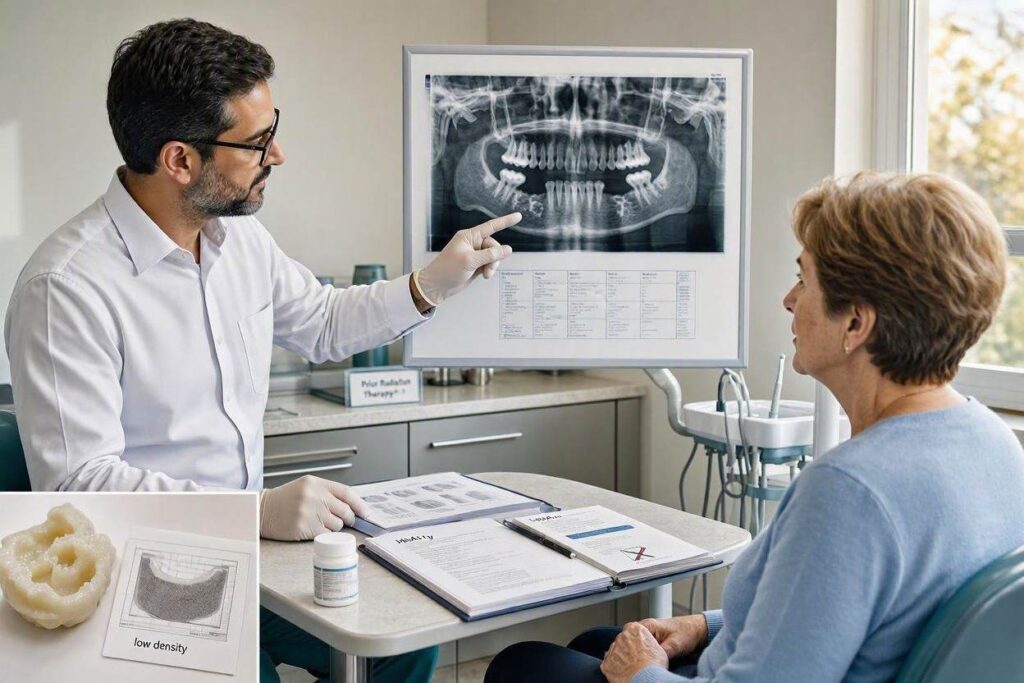
A patient actively undergoing radiation therapy to the head and neck region, or chemotherapy that suppresses the immune system, cannot receive dental implants. Radiation damages the delicate blood vessels within the bone, a condition called osteoradionecrosis risk, severely impairing the bone’s ability to heal. Chemotherapy neutropenia exposes the patient to a high risk of a catastrophic post-operative infection. Implants are deferred until cancer treatment is complete, the patient is in remission, and a sufficient healing window has passed, often with a consultation from the oncologist and the use of hyperbaric oxygen therapy to revive the irradiated bone.
Severe, Uncontrolled Systemic Disease
Uncontrolled diabetes mellitus is the most common relative-to-absolute contraindication. A patient with a hemoglobin A1c consistently above 8.0 or 9.0 has impaired wound healing. Their small blood vessels are diseased. Their immune function is compromised. An implant placed in such a patient has a significantly higher risk of failing to osseointegrate or developing aggressive peri-implantitis. The condition is often controllable. The patient must first work with their physician to get their blood sugar under tight control. The implant is deferred until the A1c is at a safe, stable level. The implant is a reward for systemic health stability.
Recent Myocardial Infarction or Cerebrovascular Accident
A patient who has suffered a heart attack or a stroke within the last six months is not a candidate for an elective surgical procedure like a dental implant. The stress of surgery, the anesthesia, and the discontinuation of certain anti-coagulant medications pose an unacceptable risk of another life-threatening vascular event. Time must pass. The patient must receive medical clearance from their cardiologist or neurologist.
The Anatomical Deficit: When the Bone is Insufficient
A dental implant requires bone to survive, just as a tree requires soil. The most common anatomical reason a patient cannot immediately receive an implant is a simple, brutal deficit of the necessary foundation.
Vertical Bone Deficiency and the Inferior Alveolar Nerve
In the lower posterior jaw, the inferior alveolar nerve runs through a bony canal. When a lower molar is lost and not immediately replaced, the bone above the nerve canal resorbs, or melts away. Over years, the available vertical height of bone above the nerve can diminish to nothing. There is literally not enough bone to place an implant of even the shortest standard size without drilling directly into or compressing the nerve. This would cause permanent numbness, pain, and tingling of the lower lip, chin, and tongue. A paresthesia is a devastating, often permanent, injury that the surgeon must avoid at all costs.
The solution, if possible, is a nerve lateralization or transposition procedure, a highly delicate, risky surgery in itself. The alternative is a shorter, wider implant, or the avoidance of the site altogether, opting for a bridge or a partial denture. The surgeon’s declaration that you cannot get an implant in this location is an act of ethical protection, not a failure of skill.
Pneumatization of the Maxillary Sinus
In the upper posterior jaw, the maxillary sinus is an air-filled cavity that, like a balloon, expands into the space where tooth roots once were. After upper molar extraction, the sinus floor drops down, leaving a paper-thin shelf of bone between the mouth and the sinus. Placing an implant of any meaningful length would penetrate the sinus membrane, creating a communication between the mouth and the sinus cavity that can lead to chronic sinusitis and implant failure.
The solution is a sinus lift or sinus augmentation surgery, a graft that adds bone to the sinus floor. But if the available bone is so minimal that even a graft cannot predictably establish a stable foundation, the implant may not be possible. The surgeon is not being difficult. The anatomy has been permanently altered by time and biology.
Inadequate Bone Width
A narrow, knife-edge ridge of bone is often the legacy of a long-healed extraction site where the facial plate of bone resorbed. To place a standard implant, the ridge must be at least 6-7 millimeters wide. A narrow ridge requires a bone augmentation procedure, a block graft or a guided bone regeneration, to rebuild the width. If the bone deficit is too severe, a graft may not be predictable. The site may be permanently unsuitable.
The Behavioral Contraindications: The Patient Factor
A patient’s actions can make an implant a doomed enterprise. The surgeon can place a perfect implant, but they cannot control what happens in the patient’s mouth after the surgery.
Heavy, Active Smoking
Smoking is the single most significant modifiable behavioral risk factor for implant failure. The vasoconstrictive effect of nicotine starves the healing surgical site of oxygen-rich blood. The heat and chemicals of cigarette smoke directly damage the delicate healing cells. The chronic smoker’s mouth is a hotbed of pathogenic bacteria. The statistics are stark and unignorable. A heavy smoker (more than 10 cigarettes per day) has a dental implant failure rate that is two to three times higher than a non-smoker. The risk of peri-implantitis, the destructive infection of the bone around an implant, is dramatically elevated.
A responsible surgeon may refuse to place an implant in a heavy, active smoker. This is not moral judgment. It is a clinical risk calculation. The patient is being asked to invest thousands of dollars and months of healing into a procedure that their habit actively sabotages. The surgeon will often require the patient to quit smoking for a period before the surgery and commit to not smoking during the critical osseointegration window. A patient unwilling to stop smoking may be a permanent no-go for implant therapy.
Uncontrolled Parafunctional Habits (Bruxism)
Severe, untreated tooth grinding and clenching exert forces far exceeding normal chewing loads. These lateral, destructive forces are the enemy of the delicate bone-implant interface. An implant, lacking the shock-absorbing periodontal ligament of a natural tooth, is rigid and intolerant of overload. A patient who grinds their teeth into flat nubs every night will likely do the same to an implant crown, fracturing the porcelain, loosening the abutment screw, or causing the implant itself to fracture or lose osseointegration.
The solution is not a refusal of the implant, but a mandatory precondition. The patient must be fitted with a properly adjusted, full-coverage occlusal night guard before the implant restoration is finalized. The guard protects the implant from the patient’s own muscles. If a patient refuses to wear the guard, the long-term prognosis for the implant is poor.
Poor Oral Hygiene and Inability to Commit to Maintenance
A dental implant is a precision medical device placed into a living, bacterial environment. It requires meticulous, daily hygiene and regular professional maintenance for life. A patient with a history of severe neglect, who lost their natural teeth to rampant decay and gum disease, who will not brush, floss, or use a water flosser, is a poor candidate for implants. Placing an expensive implant into a mouth that will not be cleaned is an act of financial and biological waste. The implant will develop peri-implantitis, the bone will melt away, and the implant will fail, just as the natural teeth did. The surgeon may require a patient to demonstrate a sustained period of improved hygiene and completed periodontal therapy before agreeing to implant placement. The patient must prove they can care for their investment.
The Alternatives: When an Implant is Not the Path
The finality of being told you cannot have an implant is softened by the reality that excellent, predictable alternatives exist. A fixed dental bridge, anchored on prepared adjacent teeth, is a time-tested, stable, and aesthetic solution. It does not require bone grafting or sinus lifts. It is completed in a fraction of the time. A removable partial denture, while less desirable to many, is an affordable, non-surgical option that restores function. The implant is the gold standard, but it is not the only standard. Your surgeon’s refusal to place one is an ethical act that directs you toward a safer, more predictable path.
Conclusion
A patient can be denied a dental implant for a constellation of firm biological, anatomical, and behavioral reasons. Systemic disease, bone deficits, active smoking, and poor hygiene are not judgments; they are clinical realities that predictably lead to implant failure or catastrophic complication. A responsible surgeon’s “no” is a shield, protecting you from a failed procedure and steering you toward a safer, more appropriate tooth replacement solution.
Frequently Asked Questions
Can I get dental implants if I have osteoporosis?
Osteoporosis itself is not an absolute contraindication. However, if you are taking oral bisphosphonates, a careful risk assessment and discussion with your prescribing physician are mandatory. The risk of MRONJ is low with oral bisphosphonates but is real. A drug holiday protocol may be advised. The bone quality may also be less dense, requiring a longer healing time.
Is age a reason I cannot get dental implants?
No. Chronological age is not a contraindication. A healthy 90-year-old with good bone density is a better candidate than a 40-year-old heavy smoker with uncontrolled diabetes. The decision is based on biological and medical status, not the calendar.
If I quit smoking, how long before I can get an implant?
Most surgeons require a patient to have completely stopped smoking for at least two to four weeks before implant surgery and to remain smoke-free throughout the entire osseointegration period of three to six months. A blood test for cotinine, a nicotine metabolite, may be used to confirm cessation. The former smoker’s failure rate returns close to that of a never-smoker after a prolonged period of abstinence.
Additional Resource:
For a detailed, evidence-based overview of the risk factors and contraindications for dental implant therapy, visit the American Academy of Periodontology’s patient resource: https://www.perio.org/consumer/dental-implant-failure-risk-factors