Can Dental Implants Affect Your Ears?
You are a week past your dental implant surgery. The swelling in your gums has subsided. The surgical site is healing well. But there is a new, unsettling sensation. You feel a dull ache, a pressure, or a ringing in your ear on the same side as the implant. Your mind begins to connect the two events. Can a dental implant, a titanium screw in your jaw, actually affect your ear? It feels far-fetched, and yet the sensation is real and persistent.
This article is a careful, anatomically grounded exploration of the potential relationships between dental implant surgery and ear symptoms. We will separate the common, benign, and temporary post-operative discomforts from the rare but serious nerve complications that require immediate attention. We will navigate the complex, shared nerve pathways of the jaw and ear, providing a clear, evidence-based explanation for what you might be feeling.
The Deep Anatomical Connection: The Jaw and Ear Are Neighbors
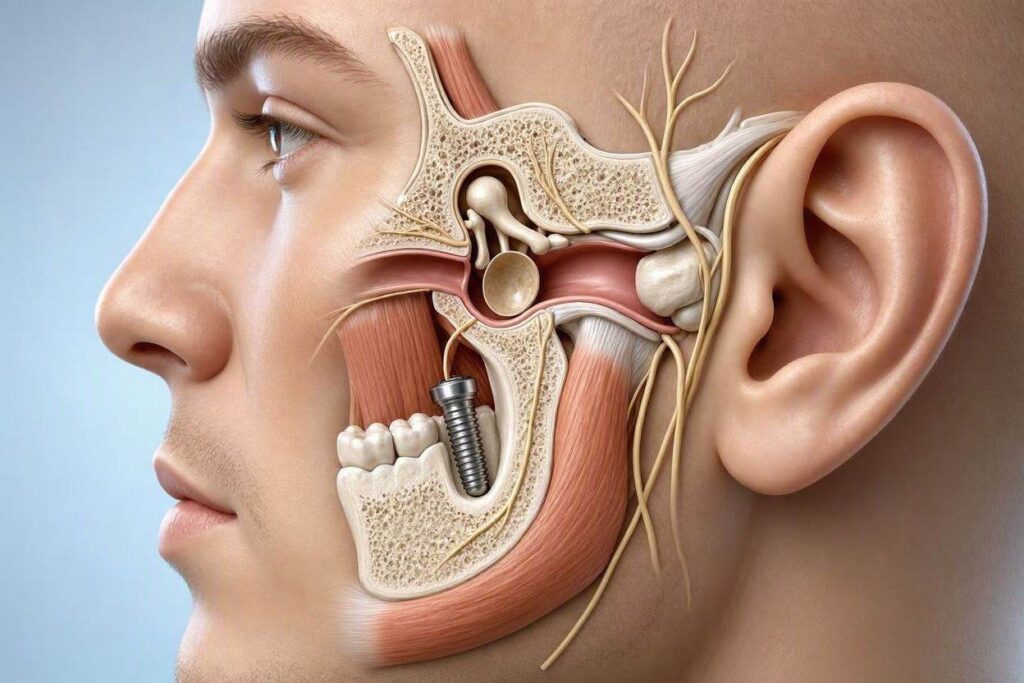
To understand how a dental implant could possibly affect the ear, you must first appreciate the intimate anatomical relationship between the jaw and the ear. They are not separate, distant structures. They share walls, muscles, and crucially, nerves.
Your lower jaw, the mandible, terminates in a rounded knob of bone called the condyle. This condyle sits in a socket, the glenoid fossa, which is part of the temporal bone of the skull. The temporal bone is also the bone that houses the delicate structures of your middle and inner ear. The temporomandibular joint (TMJ), the jaw joint, is separated from the ear canal by only a thin plate of bone. The muscles that move your jaw, particularly the powerful masseter and the medial and lateral pterygoids, attach to the skull in close proximity to the ear.
The nerve supply to the jaw and the ear is deeply intertwined. The trigeminal nerve, the great sensory nerve of the face and mouth, has branches that supply the jaw, the teeth, the TMJ, and, through connections with other nerves, the ear and surrounding tissues. This shared nerve network is the biological substrate for referred pain. A pain signal originating from the jaw joint or the jaw muscles can be perceived by the brain as coming from the ear. This is the most common, non-surgical reason a dental procedure or a jaw issue can feel like an ear problem. The ear is often an innocent bystander, the victim of a crossed neural wire.
The Immediate Post-Operative Phenomenon: Muscle and Joint Soreness
In the days and weeks following implant surgery, the most common cause of ear-related discomfort has nothing to do with the implant post itself. It is the result of the physical stress of the procedure on the jaw joint and the muscles of mastication.
The implant surgery, particularly for a lower molar, requires the patient to hold their mouth wide open for an extended period, often 60 to 90 minutes. This sustained stretch and strain on the jaw muscles and the TMJ ligaments can cause acute post-operative myofascial pain and joint inflammation. The lateral pterygoid muscle, which is intimately related to the TMJ capsule, can go into spasm. This muscle spasm and joint soreness can radiate a dull, aching pain that is felt deep in the ear, around the ear, or in the temple.
This is a muscular and joint problem, not a nerve injury. It is self-limiting. It responds to the standard post-operative care: rest, a soft diet, warm compresses, and anti-inflammatory medication. It resolves as the muscles recover from the sustained stretch, typically within a week or two. This is the most frequent and benign explanation for ear symptoms after an implant. Your ear is fine. Your jaw muscles are just sore from being forced open.
The Nerve Complication: When the Implant is Too Close
There is a more serious, though far less common, biological mechanism by which a dental implant can directly affect the ear. This involves the actual surgical site and its proximity to specific nerves.
The Inferior Alveolar and Lingual Nerves
The inferior alveolar nerve, which provides sensation to the lower teeth, lip, and chin, is not directly connected to the ear. However, it runs through the mandibular canal, and damage to it during lower implant surgery can cause a chaotic, abnormal barrage of nerve signals. This neuropathic pain can, in rare cases, be perceived as a deep, burning earache, a form of central sensitization and referred pain.
The Chorda Tympani Nerve
This small but significant nerve branches off the facial nerve and runs through the middle ear. It then joins the lingual nerve in the jaw to provide taste sensation to the front two-thirds of the tongue. A lower implant surgery that causes trauma to the lingual nerve can, theoretically, affect the chorda tympani fibers it carries. This is more likely to manifest as a loss or alteration of taste, but it could contribute to a general deep ear discomfort due to the nerve’s ear origin.
The Auriculotemporal Nerve
This is perhaps the most direct anatomical link. The auriculotemporal nerve is a branch of the mandibular division of the trigeminal nerve. It supplies sensation to the TMJ, the skin of the temple, and parts of the external ear. It courses very close to the condyle of the mandible. An implant surgery that is nowhere near the ear, but causes significant post-operative inflammation or spasm in the TMJ, can irritate this nerve, leading to a sensation of ear pain or fullness. Again, this is referred pain from the joint, not a direct injury to the nerve within the ear.
A Critical Warning Sign: A sudden, profound, or persistent change in hearing, true vertigo (a spinning sensation, not just dizziness), or a constant, loud tinnitus (ringing in the ear) immediately following an upper posterior implant surgery is a medical emergency. While extremely rare, it can signal a traumatic communication between the oral cavity and the middle ear, or a barotrauma that has affected the inner ear. This is not a wait-and-see symptom. It requires immediate evaluation by the implant surgeon and potentially an Ear, Nose, and Throat specialist.
The Upper Jaw Implant and the Sinus Connection
An upper jaw dental implant in the premolar or molar region is placed in close proximity to the maxillary sinus. The floor of the maxillary sinus is the roof of the upper jaw. The sinus is an air-filled cavity lined with a delicate membrane. It is connected to the nasal passages and, through the Eustachian tube, to the middle ear.
Sometimes, during the placement of an upper implant, the tip of the implant can penetrate through the thin layer of bone and just touch or slightly perforate the sinus membrane. A small, controlled perforation is often of no clinical consequence and heals uneventfully. However, it can cause a post-operative sinusitis, an inflammation of the sinus lining. This sinus inflammation can lead to a feeling of pressure and fullness in the cheek, the teeth, and, through the shared drainage pathways, a feeling of ear fullness or a dull earache. The Eustachian tube, which ventilates the middle ear, can become swollen and blocked due to the nearby sinus inflammation.
This is a sinus-to-ear referred sensation, not a direct implant-to-ear injury. It is treated by managing the sinus inflammation: decongestants, nasal steroid sprays, and careful avoidance of creating pressure in the sinus (no forceful nose blowing). It resolves as the sinus membrane heals around the implant tip.
The Psychological Component: Hypervigilance After Surgery
A final, non-structural factor must be acknowledged. After a significant and expensive surgical procedure like an implant, a patient becomes hypervigilant. Every small sensation, every twinge, every fleeting ache in the entire head and neck region is noticed, amplified, and connected to the surgery. The ear, being so close to the surgical field and sharing a complex nerve network, is a common target for this heightened somatic awareness.
A patient who has never noticed their very mild, age-related, intermittent tinnitus may suddenly become acutely aware of it after surgery, attributing it to the implant. The stress of the surgery, the pain medication, and the disrupted sleep can all temporarily exacerbate existing tinnitus. This is not a new biological phenomenon caused by the implant. It is a change in perception and focus. A calm, clinical examination by the surgeon, ruling out any organic pathology, can provide the necessary reassurance that the ear is not damaged and that the heightened sensation will fade as the patient’s focus returns to normal life.
Conclusion
Dental implants can affect your ears, but in the vast majority of cases, it is through the benign, temporary mechanism of referred muscle and joint pain from the sustained mouth-opening during surgery. A dull ache or fullness in the ear in the days after implant placement is most likely a tired, strained jaw joint talking. The rare, serious nerve complications that directly impact the ear are accompanied by more dramatic and persistent symptoms like vertigo or sudden hearing loss. Understanding the shared nerve anatomy allows you to contextualize your symptoms and seek the appropriate, targeted reassurance or treatment from your surgeon.
Frequently Asked Questions
Can a dental implant cause permanent tinnitus?
A dental implant causing true, permanent, neurologically generated tinnitus is extremely rare. A temporary increase in the perception of an already existing tinnitus, due to surgical stress, medication, and jaw muscle spasm, is more common. If you experience a sudden, loud, unilateral tinnitus immediately after surgery, report it to your surgeon immediately.
Why does my ear feel clogged after an upper implant?
A feeling of ear fullness or clogging after an upper posterior implant is often related to sinus membrane irritation or a small perforation. The resulting sinus inflammation can cause the Eustachian tube, which ventilates the middle ear, to swell shut. This creates a pressure imbalance and a clogged sensation. This is managed with decongestants and time, and typically resolves as the sinus heals.
How long will ear discomfort last after implant surgery?
Muscular and joint-related ear discomfort typically peaks 48-72 hours after surgery and steadily resolves over one to two weeks as the muscles recover. If ear pain persists, worsens, or changes in character after the first week, a follow-up examination with your implant surgeon is necessary to rule out a nerve injury or sinus complication.
Additional Resource:
For a patient-oriented explanation of the relationship between the jaw joint and ear pain, and the phenomenon of referred pain, visit the American Tinnitus Association page on temporomandibular joint disorders and ear symptoms: https://www.ata.org/understanding-facts/causes/tmj