Can Dental Implants Cause Liver Cyst?
You have dental implants, or you are considering them, and you have encountered a disturbing claim in your research. Some online sources, alternative health practitioners, or well-meaning acquaintances have suggested that dental implants, particularly titanium implants, can cause liver cysts. The proposed mechanism sounds plausible enough to be alarming: the implant corrodes over time, releasing titanium particles into the bloodstream, which accumulate in the liver and trigger the formation of cysts. This claim, if true, would fundamentally alter the risk-benefit calculus of implant dentistry. A replacement tooth is not worth a hepatic lesion. The question demands a rigorous, evidence-based answer.
The answer, grounded in the current body of scientific literature and clinical epidemiology, is that there is no credible evidence establishing a causal link between dental implants and liver cysts. The claim is not supported by large-scale epidemiological studies, by the known toxicology of titanium, or by the clinical experience of implant dentistry over more than five decades. Titanium particles can be detected in the tissues surrounding implants and, in trace amounts, in distant organs including the liver. This is an established fact. However, the presence of particles does not equate to the causation of disease. The leap from “titanium particles are detectable” to “titanium particles cause liver cysts” is a speculation that lacks scientific validation and contradicts the vast body of safety data on titanium medical implants.
This guide examines the claim with scientific rigor and clinical honesty. We will explore the evidence for titanium particle release from dental implants, the fate of those particles in the body, the known causes of liver cysts, and the reasons why a causal link between the two is implausible based on current evidence. The goal is not to dismiss patient concerns but to provide the factual foundation upon which an informed decision can be made.
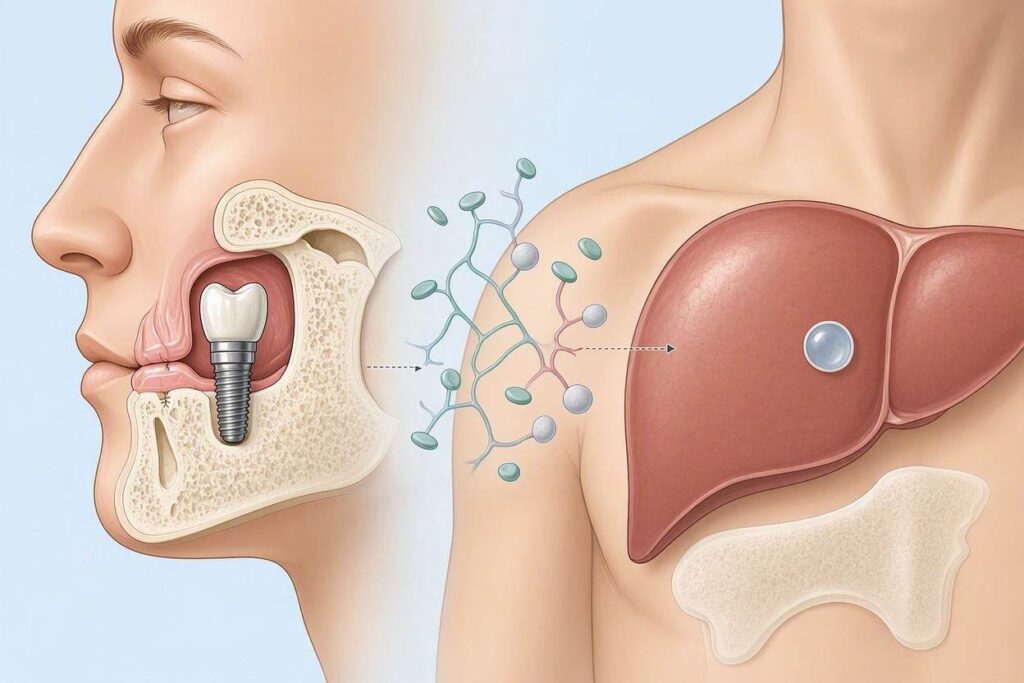
Titanium Particles and Systemic Distribution: What the Research Shows
Titanium and its alloys are widely regarded as biocompatible, corrosion-resistant materials. This is why they have been used for decades in dental implants, orthopedic joint replacements, pacemaker housings, and other permanent medical implants. However, “corrosion-resistant” is not synonymous with “corrosion-proof.” Titanium implants do release particles into the surrounding environment, a fact that the scientific literature has documented extensively.
The surface of a titanium implant is covered by a thin, stable oxide layer, primarily titanium dioxide, that forms spontaneously on contact with air or water. This oxide layer is what gives titanium its excellent biocompatibility. However, under certain conditions—mechanical wear from chewing forces, the acidic and enzymatic environment of inflammation, and the electrochemical conditions created by the presence of dissimilar metals—the oxide layer can be disrupted. Microscopic particles of titanium and titanium dioxide can be released from the implant surface through processes of fretting, corrosion, and wear.
These particles are found in the peri-implant tissues, the gum and bone immediately surrounding the implant. This is expected and well-documented. The more controversial question is whether these particles can enter the systemic circulation and accumulate in distant organs. The answer, based on autopsy studies and animal experiments, is yes. Titanium particles have been detected in the lymph nodes, spleen, liver, and lungs of patients with titanium implants. The lymphatic system drains the peri-implant tissues and transports particles to regional lymph nodes. From there, particles can enter the venous circulation and be distributed systemically. The liver, as the body’s primary filtration organ, is a natural site of particle accumulation.
The critical point, however, is that the detection of particles does not imply the causation of disease. The body has a remarkable capacity to sequester inert particles within tissues without triggering a pathological response. Titanium dioxide particles, in particular, are considered to have low toxicity. The mere presence of titanium in the liver of a person with liver cysts does not establish that the titanium caused the cysts. Correlation is not causation, and in the case of titanium and liver cysts, even a compelling correlation has not been demonstrated.
The Known Causes of Liver Cysts
Liver cysts are fluid-filled sacs that occur within the liver parenchyma. They are extremely common, particularly with advancing age. Simple hepatic cysts are benign, usually asymptomatic, and discovered incidentally on abdominal imaging performed for unrelated reasons. They are estimated to occur in approximately 5% to 18% of the population, with prevalence increasing with age.
The vast majority of liver cysts are congenital, meaning the person is born with a predisposition to develop them. They arise from biliary ducts that fail to connect properly with the main biliary tree during embryonic development and slowly expand over decades. They are not caused by an external agent. Polycystic liver disease, a genetic condition often associated with polycystic kidney disease, leads to the development of multiple cysts throughout the liver. This condition is hereditary, not acquired from environmental exposures.
Other types of hepatic cysts include parasitic cysts, caused by Echinococcus tapeworm infection; neoplastic cysts, which are cystic tumors that can be benign or malignant; and cysts associated with biliary tract diseases. None of these conditions have an established link to titanium or other metallic particles. The known causes of liver cysts are genetic, congenital, infectious, or neoplastic. Metal particle deposition is not recognized as a cause of hepatic cyst formation by hepatology or toxicology.
The Flawed Logic of the Implant-Cyst Connection
The claim that dental implants cause liver cysts typically follows a chain of reasoning that contains multiple logical gaps. The reasoning goes: implants release titanium particles, titanium particles travel to the liver, titanium is a foreign substance, foreign substances cause inflammation, inflammation causes cysts. Each step in this chain is problematic.
First, the release of titanium particles from a well-integrated, healthy implant is extremely low, often at levels that are difficult to distinguish from the background titanium exposure that all humans receive from dietary sources, cosmetics, and environmental pollution. Titanium dioxide is a ubiquitous compound used as a whitening agent in food, toothpaste, sunscreen, and countless consumer products. The contribution of a dental implant to the total body burden of titanium is minor compared to these everyday exposures.
Second, the liver’s response to inert, insoluble particles is typically sequestration, not cyst formation. Macrophages engulf the particles and store them within the liver sinusoids without causing significant architectural disruption or cyst formation. The formation of a cyst requires a specific pathological process: a fluid-filled cavity lined by epithelium. Metal particles do not create this structure.
Third, epidemiological evidence for an association between dental implants and liver cysts is absent. If dental implants caused liver cysts with any meaningful frequency, the millions of people with dental implants, many of whom undergo abdominal imaging for other reasons, would show a higher prevalence of liver cysts than the non-implant population. This signal has not been detected. No large-scale study has demonstrated an increased incidence of hepatic cysts in patients with titanium dental implants. The claim is based on isolated anecdotes, case reports, and theoretical speculation, not on the kind of controlled, population-level evidence that would be required to establish causality.<div style=”border-left: 4px solid #2a9d8f; padding: 15px; margin: 25px 0; background-color: #f0fdfa;”> <p style=”font-weight: bold; margin-bottom: 5px;”>💡 A Note on Online Health Information</p> <p style=”margin: 0;”>The claim that dental implants cause liver cysts circulates primarily in online forums, social media, and websites promoting alternative health philosophies. These sources often cite case reports or anecdotal patient testimonials as proof, while ignoring the vast body of peer-reviewed safety data. When evaluating a health claim, consider the source, the quality of the evidence, and whether the claim is consistent with the broader scientific consensus. Extraordinary claims require extraordinary evidence, and the evidence for an implant-cyst connection is far from extraordinary.</p> </div>
When Patient Concern Is Warranted
While the specific claim linking dental implants to liver cysts lacks evidence, the broader phenomenon of systemic symptoms attributed to implants is a legitimate area of patient concern and ongoing research. As discussed in a previous article on implant-related illness, some patients do experience systemic symptoms that they associate with their implants. These symptoms may include fatigue, cognitive difficulties, joint pain, and skin rashes. Liver cysts are not part of this symptom complex, but the concern about the implant affecting systemic health is shared.
The appropriate response to a patient who is worried about the systemic effects of their implant is not dismissiveness but a thoughtful, evidence-informed conversation. The patient should be encouraged to discuss their concerns with their primary care physician, who can evaluate any systemic symptoms on their own merits, independent of assumptions about the implant. If an abdominal ultrasound or CT scan incidentally reveals a liver cyst, the cyst should be evaluated by a hepatologist or gastroenterologist according to standard medical guidelines, which do not include implant removal as a treatment for hepatic cysts.
If a patient with liver cysts insists that their implants are the cause and demands removal, the clinician should acknowledge the patient’s conviction while providing the best available scientific evidence. A decision to remove a well-integrated, functional implant should be based on a clear, documented indication—peri-implantitis, implant fracture, nerve injury, verified allergy—not on an unsubstantiated theory of systemic particle toxicity.
Conclusion
There is no credible scientific evidence that dental implants cause liver cysts. While titanium particles from implants can be detected in distant organs including the liver, the presence of these particles does not establish a causal link to hepatic cyst formation, a condition that is common, usually congenital, and not associated with metal exposure in the medical literature. The claim circulates primarily in non-scientific venues and lacks the epidemiological, toxicological, and pathological support required to be taken seriously as a clinical risk.
Frequently Asked Questions
Q: Should I have my liver checked if I have dental implants?
A: There is no medical indication for routine liver imaging or liver function testing solely because you have dental implants. Standard medical care, including age-appropriate screening and evaluation of any new symptoms, should be followed. If you have symptoms such as abdominal pain, jaundice, or unexplained weight loss, consult your physician for a medical workup, not an implant surgeon.
Q: Can removing my dental implants resolve existing liver cysts?
A: There is no evidence that removing dental implants has any effect on pre-existing liver cysts. Liver cysts are fluid-filled structures that, once formed, do not typically resolve with the removal of a distant foreign body. Explantation of a well-functioning implant in the hope of shrinking a liver cyst is not a medically justified procedure.
Q: Are zirconia implants safer for the liver than titanium implants?
A: Zirconia implants eliminate the exposure to titanium particles, which may be a consideration for patients who are concerned about metal exposure or who have a documented titanium allergy. However, because the link between titanium particles and liver cysts is unsubstantiated, there is no evidence that zirconia implants confer a specific hepatic health benefit. The choice between titanium and zirconia should be based on well-established factors: aesthetics, the clinical track record, the specific implant system, and the surgeon’s experience.
Q: What about other systemic diseases? Can implants cause autoimmune disease or cancer?
A: Large-scale, long-term studies have not demonstrated an increased risk of autoimmune disease or cancer in patients with dental implants. Titanium is not classified as a carcinogen. The safety record of titanium implants over more than fifty years, with millions of patients, is robust. Ongoing research into the systemic effects of implant-derived particles is appropriate and necessary, but the current evidence does not support the removal of implants to prevent or treat systemic disease.
Additional Resource:
For information on liver cysts and hepatic health, visit the American Liver Foundation: https://liverfoundation.org/