Can Dental Implants Help TMJ?
You suffer from the distinctive, often debilitating symptoms of a temporomandibular joint disorder. Pain radiates from the jaw joint in front of your ear. Clicking, popping, or grating sounds accompany your chewing. Your jaw locks, your muscles ache, and headaches are a frequent companion. You also happen to be missing one or more teeth, and you have been considering dental implants to restore your smile and chewing function. The question forms at the intersection of these two conditions: could the implants that replace your missing teeth also help your TMJ? Or could they make it worse?
The relationship between dental implants and temporomandibular disorders is neither simple nor predictable. Dental implants are not a treatment for TMJ disorders, and they should never be marketed or pursued as such. However, in specific clinical scenarios, restoring missing teeth with implants can contribute to a more stable, balanced bite, which may reduce the mechanical stressors that exacerbate TMJ symptoms. Conversely, poorly planned or executed implant restorations that alter the bite unfavorably can trigger or worsen TMJ problems. The implant itself is neutral; the outcome for the jaw joint depends entirely on how the restoration changes the way the teeth come together.
This guide explores the biomechanical link between tooth loss, dental restorations, and the health of the temporomandibular joints. We will explain how missing teeth can destabilize the bite and contribute to TMJ dysfunction, how properly designed implant restorations can restore occlusal stability, and how improperly designed restorations can become a source of joint aggravation. If you have TMJ symptoms and are considering implants, this guide will help you understand the questions to ask and the precautions to take.
Understanding Temporomandibular Joint Disorders
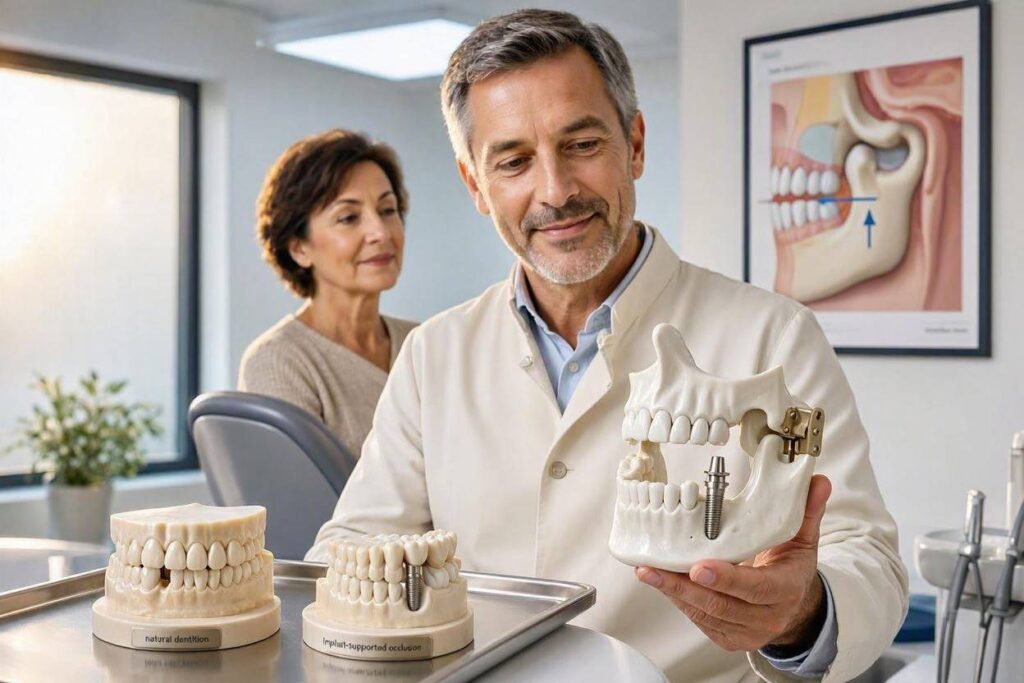
The temporomandibular joints are the paired hinges that connect the lower jaw, the mandible, to the temporal bones of the skull. You can feel them by placing your fingers just in front of your ears and opening and closing your mouth. These joints are among the most complex in the body, capable of both hinge-like rotation and sliding translation. A small cartilaginous disc sits between the condyle of the mandible and the glenoid fossa of the temporal bone, cushioning the joint and allowing smooth movement.
Temporomandibular disorders, commonly abbreviated as TMD or TMJ, encompass a range of conditions affecting the jaw joints, the chewing muscles, and the associated nerves. The etiology is often multifactorial, involving a combination of anatomy, muscle tension, stress, bruxism, trauma, and occlusal factors. TMD can manifest as myofascial pain, involving the muscles of mastication; internal derangement of the joint, involving disc displacement; or degenerative joint disease, such as osteoarthritis of the condyle.
The role of occlusion—the way the teeth come together—in TMD is complex and historically controversial. For decades, dentistry operated under the assumption that a “bad bite” was a primary cause of TMD, and that extensive occlusal adjustments, orthodontics, or full-mouth reconstruction were necessary treatments. This mechanistic view has been largely supplanted by a biopsychosocial model that recognizes the multifactorial nature of TMD. Occlusion is a contributing factor in some patients, but it is rarely the sole cause. Many people with severely maligned teeth have no TMJ symptoms. Many people with textbook-perfect occlusion suffer from severe TMD. The relationship is not linear.
How Missing Teeth Can Destabilize the Bite
When a tooth is lost and not replaced, the equilibrium of the stomatognathic system is disrupted. The teeth on either side of the gap tend to drift and tilt into the empty space. The opposing tooth, with nothing to bite against, can supra-erupt, extruding outward from its socket in a process known as overeruption. These changes alter the occlusal plane, the imaginary surface along which the teeth meet. The formerly harmonious, simultaneous contact of teeth during biting becomes uneven.
The patient may unconsciously adapt to the uneven bite by shifting the jaw into a different position during chewing. This altered jaw posture can strain the muscles of mastication and place asymmetric loads on the temporomandibular joints. The condyles may be displaced from their optimal position within the glenoid fossae. The masticatory muscles may go into protective spasm. Over time, these adaptations can contribute to myofascial pain, joint clicking, and accelerated wear of the remaining teeth.
Missing posterior teeth, particularly molars, are especially destabilizing. The molars provide the vertical support that maintains the height of the lower face and the position of the condyles. When multiple posterior teeth are lost, the vertical dimension of occlusion—the distance between the upper and lower jaws when the teeth are together—can collapse. The condyles are displaced superiorly and posteriorly within the fossae, potentially compressing the retrodiscal tissues, which are highly vascular and richly innervated. This posterior condylar displacement can be a source of significant joint pain.
In this specific context, replacing missing teeth to restore occlusal stability can have a beneficial effect on TMJ symptoms that are driven by mechanical derangement. The implant-supported crowns or bridges re-establish the lost vertical support, allow the condyles to return to a more physiological position, and provide a stable, even occlusal platform for chewing. The improvement is not a direct treatment of the joint pathology, but a reversal of the destabilizing effect of tooth loss.
The Implant Restoration and Occlusal Design
The crucial variable is not whether an implant is placed, but how the crown on top of it is designed to contact the opposing teeth. An implant crown that is too high, too bulky, or placed in an unfavorable position can become a constant source of occlusal interference, forcing the jaw to deviate around it with every bite. This interference can trigger or exacerbate TMD symptoms in a susceptible patient.
The occlusal design of an implant restoration follows principles that differ from those for natural teeth. A natural tooth has a periodontal ligament that provides proprioceptive feedback and a cushioning effect. The patient can sense a heavy contact and adjust their bite reflexively. An implant lacks this ligament. It transmits force directly and without sensory modulation. A heavy occlusal contact on an implant crown is more damaging and more likely to cause symptoms than a similar contact on a natural tooth.
The standard occlusal scheme for a single posterior implant crown is to provide light contact in centric occlusion—when the teeth are fully together—and to eliminate contact on the implant crown during excursive movements, when the jaw slides side to side or forward. This is called implant-protected occlusion. The natural teeth, particularly the canines, guide the jaw during lateral excursions, and the implant is shielded from these non-axial, shearing forces. This design protects the implant from overload and prevents it from becoming an occlusal interference.
For a full-arch implant restoration, such as an All-on-4 bridge, the occlusal design is even more critical. The entire occlusal platform is supported by implants, with no natural teeth remaining. The occlusion must be bilaterally balanced, providing simultaneous, even contact on both sides during chewing, and must avoid any eccentric contacts that would create a fulcrum and lever forces on the implants. The vertical dimension is carefully calibrated to avoid overloading the joints or the muscles. A full-arch restoration that opens the vertical dimension too much can strain the muscles and cause myofascial pain. One that fails to restore adequate vertical support perpetuates the condylar displacement.
The Pre-Implant TMJ Evaluation
If you have a history of TMD and are considering dental implants, a thorough preoperative evaluation of your jaw joints and masticatory muscles is essential. The implant surgeon or restorative dentist should perform a screening examination that includes palpation of the muscles of mastication for tenderness, auscultation of the joints for clicking or crepitus, measurement of the range of motion, and assessment of any deviation or deflection during opening.
If active TMD symptoms are present, they should be addressed and stabilized before proceeding with implant treatment. This may involve a course of conservative therapy: a stabilization splint or night guard to relax the muscles and allow the condyles to seat in a physiological position, physical therapy, anti-inflammatory medications, stress management, and behavioral modifications. The goal is to achieve a stable, asymptomatic baseline. Placing implants into a system that is already inflamed and dysfunctional is likely to worsen both the TMD and the implant prognosis.
The patient with severe, uncontrolled TMD, particularly internal derangement with disc displacement without reduction, or advanced degenerative joint disease, may not be a suitable candidate for extensive implant reconstruction until the joint condition is medically or surgically managed. The forces generated by parafunctional activity—clenching and grinding—in TMD patients can overload implants and lead to mechanical failure. The patient must be counseled realistically about the risks.
When Implants Trigger or Worsen TMD
An implant restoration that changes the bite in a way that the neuromuscular system cannot adapt to can trigger TMD symptoms in a previously asymptomatic patient, or worsen symptoms in a patient with a history of TMD. The most common iatrogenic cause is a crown that is left “high” in occlusion. The patient feels that the implant crown hits before the other teeth, and the jaw reflexively shifts to find a more comfortable position. This chronic, repetitive mandibular repositioning fatigues the muscles and strains the joint structures.
Another potential trigger is an implant placed in a position that requires the jaw to deviate significantly during function to avoid the implant. This can occur when the implant is placed too far buccally or lingually, and the crown is contoured to compensate, but the resulting occlusal table is not centered over the implant axis. The jaw must move in an unnatural path to chew on that side.
The careful, methodical dentist minimizes these risks through meticulous occlusal adjustment at the time of crown delivery. The bite is checked with articulating paper in centric occlusion and in all excursive movements. The patient is given specific instructions to report any sensation of a “high” tooth, any clicking or popping, or any muscle soreness in the days following crown delivery. A minor occlusal adjustment can resolve the symptoms if addressed promptly.
⚠️ The Importance of a Stabilization Period
If you have active TMJ symptoms, do not proceed directly to implant surgery without a stabilization period. A well-fabricated occlusal splint, worn for several weeks or months, can deprogram the muscles, allow the condyles to seat, and reveal the true, physiological jaw position. This position becomes the foundation for the implant occlusal design, greatly increasing the probability of a harmonious result.
Conclusion
Dental implants are not a treatment for TMJ disorders, but in patients whose joint symptoms are driven by the destabilizing effects of missing teeth, restoring the occlusion with properly designed implant restorations can contribute to mechanical stability and symptom reduction. The occlusal design of the implant crown—light centric contact, protected excursive guidance—is the critical variable that determines whether the implant helps or harms the jaw joints. A thorough TMJ evaluation and stabilization before implant treatment is essential for patients with a history of joint dysfunction.
Frequently Asked Questions
Q: Can a dental implant cure my TMJ clicking or popping?
A: No. Clicking and popping are typically caused by internal derangement of the joint disc. Replacing a missing tooth will not reposition the disc or cure the derangement. If the clicking is caused by the jaw deviating to avoid a missing-tooth-related occlusal interference, restoring the occlusion may reduce the adaptive jaw movement and the associated joint noise, but this is an indirect effect.
Q: Should I get implants or treat my TMJ first?
A: Treat and stabilize your TMJ first. Active joint inflammation and muscle spasm alter the jaw position and the occlusion. Implants placed according to an unstable, dysfunctional bite will be designed to a moving target. Stabilize the joints and muscles with conservative therapy, then plan the implant restoration to match the stable, physiological jaw position.
Q: Can an improperly placed implant cause permanent TMJ damage?
A: In most cases, the occlusal interference from an implant crown causes reversible myofascial pain and muscle spasm that resolves when the high spot is adjusted. Permanent structural damage to the joint from a single occlusal interference is rare, though chronic, uncorrected malocclusion over years can contribute to degenerative changes in a susceptible individual.
Q: Is a full-arch implant bridge better or worse for TMJ than individual implant crowns?
A: A full-arch bridge provides a single, unified occlusal platform that can be precisely designed to distribute forces evenly and to guide jaw movements harmoniously. This can be beneficial for TMJ stability when executed well. However, the stakes are higher: an error in the occlusal design of a full-arch bridge affects every chewing stroke, whereas an error on a single crown affects only that one tooth.
Additional Resource:
For patient education on temporomandibular disorders, visit the American Academy of Orofacial Pain: https://www.aaop.org/