Can I Get an Implant Before Braces? The Critical Sequence of Treatment
You are facing a complex dental situation. You have a missing tooth that needs an implant, and you also need orthodontic treatment to straighten your other teeth. This raises a fundamental sequencing question: can I get the implant first, before I get braces? The short, emphatic answer from an interdisciplinary treatment planning perspective is no. You should not. The standard of care is to complete orthodontic treatment first and then place the dental implant. This guide will explain the biological and mechanical reasons for this strict sequence. We will explore the disastrous consequences of placing an implant in a dental arch that will subsequently be moved by orthodontic forces, and outline the correct, staged treatment plan that protects your investment and delivers a perfect result.
The Immovable Object: Why the Implant Must Come Last
The reason for the orthodontics-first, implant-second sequence is rooted in the fundamental, irreversible biological nature of the dental implant. As we have established in previous articles, a dental implant is ankylosed. It is rigidly fused to the jawbone with no intervening periodontal ligament. A natural tooth, when subjected to the light, sustained force of braces, moves. The bone resorbs on the pressure side and forms on the tension side. An implant cannot do this. It will not move. If you place an implant and then apply orthodontic forces to the surrounding teeth, the natural teeth will move, and the implant will remain exactly where it was placed. The result is an implant that is left behind, in a position that is suddenly completely wrong for the new, orthodontically corrected arch. It will be out of alignment, in a bad bite, and likely an aesthetic disaster. The implant is a fixed, passive anchor. It is the final piece of the puzzle, and the puzzle must be completed before the final piece is placed.
The Role of the Implant as an Orthodontic Anchor
The very property that makes an implant problematic for moving also makes it incredibly useful as an anchorage device. An orthodontist can strategically plan to use a future implant site to their advantage, but this does not mean placing the permanent implant early. The orthodontist can use the edentulous space to create the perfect amount of room for the future implant crown. They will meticulously align the roots of the adjacent teeth to leave a precise, parallel-sided gap. They are building the perfect, architectural foundation for the surgeon and the restorative dentist. In some complex cases, a Temporary Anchorage Device, or TAD, which is a small, temporary mini-screw, may be placed in or near the implant site to serve as a fixed anchor to pull other teeth into position. But this TAD is a temporary, narrow-diameter screw that is removed once its job is done. The permanent dental implant is only placed after the braces are removed and the orthodontic result is stable.
The Consequences of Getting the Sequence Wrong
Let’s make this failure mode vividly clear with a clinical example. A patient is missing a lower first molar. They are tired of the gap and go to an implant dentist who places a beautiful implant and crown. The patient, now motivated to fix their smile, then decides to get braces. The orthodontist begins treatment. The teeth on either side of the implant begin to move and upright. The implant stays still. Within a few months, the implant crown no longer contacts the opposing tooth correctly. It is now too low, or in a traumatic, heavy bite. The contact points with the adjacent teeth open up, creating a food trap. The implant is now in a different alignment than the rest of the arch. The only way to fix this is to remove the implant crown and have a new one made that fits the new bite, and even then, the implant’s position in the bone may be fundamentally suboptimal for the new arch form. The patient has wasted time, money, and a perfectly good restoration. The correct sequence would have been braces first, creating the ideal space and alignment, and then the implant placed into that stable, final environment.
The Phased, Interdisciplinary Treatment Plan
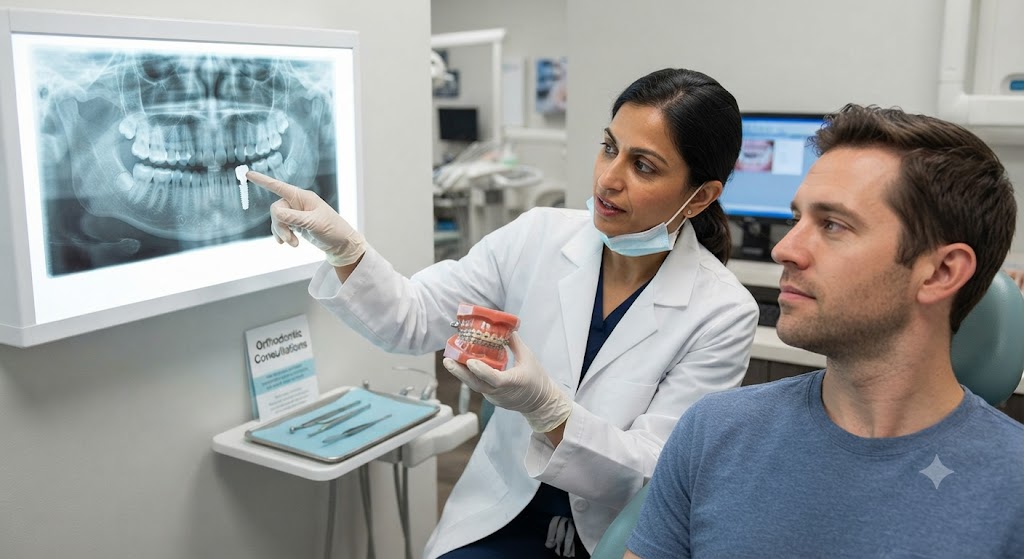
The correct, predictable path for a patient needing both an implant and orthodontics is a carefully phased, team-driven plan. Phase one is orthodontic treatment. The patient enters braces or clear aligner therapy. The orthodontist’s goal is not just to straighten the teeth but to open the ideal amount of space for the future implant. They will align the roots of the adjacent teeth so they are parallel to each other, leaving a perfect, rectangular space. Phase two is the retention and stability phase. After the braces are removed, the patient wears retainers. The teeth must be allowed to stabilize in their new positions for a period of time. Phase three is the implant surgery. Using a 3D CBCT scan and a surgical guide that is based on the final orthodontic position, the implant surgeon places the implant into the bone in the exact ideal location. Phase four is the implant restoration. After osseointegration, the restorative dentist places the final, custom implant crown that perfectly fills the orthodontically created space and harmonizes with the new, corrected bite. This coordinated sequence is the hallmark of a well-managed, comprehensive case.
The Hybrid Approach: Implants to Anchor Braces
There is one specific, advanced exception to the “no implant before braces” rule. In a full-mouth rehabilitation case of a patient who is edentulous or has a severely mutilated dentition, a full-arch fixed implant bridge may be used as a rigid, fixed orthodontic anchor. This is an adult, surgical-orthodontic case of great complexity. The patient has a failing dentition. They are converted to a fixed, screw-retained provisional bridge on implants. This bridge is the final prosthetic platform. Some limited orthodontic movement of remaining teeth can be done against this fixed, implant-supported structure. But this is not a single implant before braces. This is a complete, full-arch surgical reconstruction that then serves as the orthodontic anchor. It is a highly sophisticated, atypical treatment plan.
Conclusion
You cannot place a permanent dental implant before braces because the implant is an ankylotic, immovable fixture that will not respond to orthodontic forces, resulting in a malpositioned tooth that is left behind in a disastrous, uncorrectable position once the natural teeth have moved. The standard, predictable sequence is to complete all orthodontic tooth movement first, creating a stable, ideal arch with a perfectly sized and shaped space, and then to place the implant into that final, unchanging environment. The only exception is the use of temporary mini-screws, or TADs, as orthodontic anchors, which are removed before the permanent implant is placed.
Frequently Asked Questions
How long after braces do I have to wait to get an implant?
The implant can be placed as soon as the orthodontist confirms the teeth are in a stable final position and the patient is in a retention protocol. This can be immediately after braces removal if the implant site is ready, or it may involve a short waiting period for the soft tissue to settle.
What happens if I lose a tooth while I have braces?
The orthodontist will place a placeholder, a fake tooth on the orthodontic wire, to maintain the space. The orthodontic treatment will continue. The implant will be planned for after the braces are completed.
Can I get a dental implant and Invisalign at the same time?
No. The principle is identical. Clear aligners move teeth through bone, and an implant is immovable. The aligner treatment must be completed first, and the implant placed after the final, stable result is achieved.
What is a “prosthetically-driven” implant placement?
This is the philosophy of planning the ideal final position of the tooth crown first, and then placing the implant to support that crown. In a combined braces and implant case, the orthodontics creates the ideal restorative space, and the implant is placed in a prosthetically-driven manner within that space.
Can a loose implant be used as an orthodontic anchor?
Absolutely not. A loose implant is a failed implant. It is not integrated. It has no anchorage value and is a mobile source of infection. It must be removed.
Additional Resource: Link
For information on the interdisciplinary relationship between orthodontics and restorative implant dentistry, you can visit the American Academy of Periodontology’s patient resources. Visit the AAP Patient Page
Meta Description
Can I get an implant before braces? The definitive answer is no. Learn the critical biological reason why implants must come after orthodontics, the risk of a malpositioned tooth, and the correct phased treatment plan.
continue
Has Anyone Had a Dental Implant? Real Stories, Success Rates, and What Patients Actually Experience
You are standing at the edge of a decision. You have heard the clinical explanations, the statistics, and the technical details, but you are still asking a deeply human question: has anyone else actually gone through this? You want to know that you are not alone, that real people, just like you, have faced tooth loss, felt the same anxiety, and come out on the other side with a restored smile. This guide is a departure from the purely technical. We will explore the lived experience of dental implant patients. We will look at the staggering statistics of how many millions of people have successfully received implants, share composite narratives of the patient journey, discuss the psychological transformation, and provide an honest look at what people wish they had known beforehand. This is your connection to the vast, silent community of implant patients who are walking around with titanium roots and living their lives fully.
The Numbers: Millions of People, Every Single Year
The first and most reassuring answer to “has anyone had a dental implant?” is a resounding, statistical yes. Dental implant placement is not a rare, experimental fringe procedure. It is one of the most common and predictable surgical procedures in modern dentistry. In the United States alone, over 5 million dental implants are placed by clinicians each year. Globally, that number is many times higher. The American Academy of Implant Dentistry reports that over 3 million people in the US have at least one dental implant, and that number is growing by 500,000 patients annually. You are not contemplating a niche treatment. You are contemplating a mainstream, widely adopted, and heavily researched standard of care. The waiting rooms of periodontists, oral surgeons, and skilled general dentists across the country are filled every day with patients from all walks of life receiving implants. The procedure has a documented long-term survival rate consistently exceeding 95% over 10 years. This is a treatment with a track record.
The Typical Single Tooth Patient Journey: Sarah’s Story
Let’s follow a composite patient narrative, drawn from the common experiences of countless single-implant recipients. Sarah is a 42-year-old marketing manager. She lost a lower molar to a fracture that was non-restorable. She was devastated. She felt a sense of body failure and was mortified by the gap in her smile. The idea of a titanium screw in her jaw was terrifying. Her dentist referred her to a periodontist.
Sarah’s first appointment was a consultation and a 3D scan. The scan was a turning point. Seeing her own jawbone in three dimensions, and hearing the surgeon explain exactly where the implant would go, demystified the process. The surgery day was, in her own words, “a non-event.” The IV sedation was a profound, dreamless sleep. She woke up with no memory of the procedure, a slightly sore jaw, and a feeling of immense relief. The first three days involved a soft diet, scheduled ibuprofen, and some Netflix. She returned to work on day two with minimal swelling. The months of healing were silent. The day her final crown was placed, she cried in the car. The tooth looked and felt exactly like her own. Five years later, she brushes, flosses, and does not think about it at all. It is just her tooth. Her story is the story of the vast, silent majority of implant patients.
The Full-Arch Transformation: John’s New Beginning
John is a 68-year-old retired teacher. He had struggled with failing teeth, loose bridges, and an ill-fitting lower partial denture for decades. He had stopped smiling. He avoided social dinners. His nutrition was suffering because he could not chew. His daughter finally convinced him to consult an implant center about a full-arch fixed bridge, the All-on-4 concept. The cost was a significant, difficult decision. He used a portion of his retirement savings and financed the rest.
The day of surgery, he arrived with his daughter, nervous and quiet. He underwent sedation, had his remaining failing teeth removed, four implants placed in his jaw, and a fixed, temporary set of beautiful teeth screwed in. He woke up and looked in a mirror. He did not speak for a full minute. He just stared. Then he smiled a wide, unencumbered smile for the first time in 20 years. His daughter took a photo. He calls that day his “re-birthday.” The post-operative recovery with a full-arch bridge was a period of adaptation. Eating was a slow, deliberate relearning process. But the fixed, solid bridge never moved. It was his. A year later, he eats steak, laughs loudly in restaurants, and volunteers at a local charity. His story is a testament to the profound psychological and functional transformation of full-mouth implant rehabilitation.
The Denture Stabilization Success: Maria’s Quiet Victory
Maria is a 72-year-old widow on a fixed income. Her lower denture was a constant torment. It floated and clicked when she spoke. She had to use gobs of adhesive. She was told she did not have enough bone for standard implants and a fixed bridge. She felt she was out of options. A prosthodontist suggested two mini dental implants to stabilize her existing lower denture. It was an affordable, minimally invasive plan.
The procedure was done under local anesthesia. The mini implants were placed in less than an hour. Her denture was retrofitted with the O-ring housings, and she snapped it in. The immediate stability was overwhelming. She went home and ate an apple for the first time in a decade. She takes her denture out at night to clean it. The O-rings are replaced during her check-ups. She is not wealthy, and she does not have a fixed set of perfect teeth. But she has a stable, functional denture that does not embarrass her. She calls it her “quiet victory.” Her story is a reminder that implant dentistry has a spectrum of solutions, and the life-changing benefit is not exclusive to the most expensive, high-end option.
What Patients Wish They Had Known: Honest Reflections
When you ask patients years later what they wish they had known, a few themes consistently emerge. The first is a reflection on the fear itself. “I wish I hadn’t wasted so much energy being terrified. The fear was so much worse than the actual experience.” The second is about the timeline. “I didn’t fully understand it’s a journey. I wanted a tooth now. The waiting for the bone to heal was the hardest part, not the pain.” The third is about maintenance. “No one told me I would have to floss under a bridge so meticulously. It’s a different kind of cleaning.” The fourth is a feeling of profound gratitude and a common regret: “I only wish I had done it ten years sooner.” The psychological burden of a missing tooth or a bad denture, carried for years, is a weight that patients do not fully appreciate until it is lifted. The positive, liberating psychological outcome is one of the most consistent findings in patient satisfaction studies.
The Rare but Real Negative Experiences
To be completely honest, we must acknowledge that not every story is a success. A small percentage of patients experience a failure. There is the patient who followed every instruction, had no risk factors, and the implant simply failed to integrate for unknown reasons. There is the patient who did not quit smoking and watched a beautifully placed implant fail. There is the patient who developed peri-implantitis years later from neglected hygiene and lost the implant. These stories are real and painful. They underscore the fact that, while highly predictable, an implant is not a guarantee. It is a partnership between a patient and a clinician, and it requires a lifelong commitment to meticulous home care and professional maintenance. Reading these experiences is not meant to scare you, but to soberly inform you of the serious responsibility that comes with a dental implant.
Conclusion
Yes, millions of ordinary people have successfully undergone dental implant treatment, making it one of the most common and predictable procedures in modern dentistry, with a long-term success rate exceeding 95%. The real stories of patients, from single tooth recipients who forget they have an implant to full-arch patients who describe the experience as a life-altering rebirth, consistently reveal a journey where the pre-surgical fear is vastly out of proportion to the manageable, often surprisingly easy lived experience. The universal patient reflection is one of profound gratitude, functional liberation, and a single common regret: that they did not do it sooner, a sentiment tempered only by the honest reality that the implant requires a lifelong personal commitment to meticulous hygiene to protect against the preventable threat of peri-implantitis.
Frequently Asked Questions
Will I be able to feel the difference between my implant and a real tooth?
Most patients report that after a period of adaptation, they are completely unaware of the implant. It feels like their own tooth. The sensory difference, the lack of a periodontal ligament’s “give,” is a subtle, non-disruptive experience.
How soon after surgery can I eat normally?
You will follow a strict soft diet for the first several weeks to protect the surgical site. After osseointegration and the placement of the final crown, you can gradually return to a full, normal diet. Patients with a single implant crown return to nearly full function.
What if I am a very anxious dental patient?
You are the majority. IV sedation is a transformative tool for anxious patients. It provides a profound, safe level of conscious sedation that erases the memory and the anxiety of the procedure. Speak openly with your surgeon about your fears; they are entirely normal and manageable.
Is there a support group or forum where I can talk to other implant patients?
Yes. Online health communities, such as the dental implant forums on RealSelf or dedicated patient groups, contain thousands of threads where real patients share their honest, unvarnished experiences, photos, and support.
What is the single most important piece of advice from long-term implant patients?
Attend every single professional maintenance and cleaning appointment. Treat the implant like a priceless investment that requires a routine service schedule. And floss it, meticulously, every single day.
Additional Resource: Link
To read real patient stories and see before-and-after photo galleries of dental implant cases, you can visit the patient education portal of the American Academy of Implant Dentistry. Visit the AAID Patient Stories Page