Can You See Metal In A Dental Implant?
If you are considering a dental implant to replace a missing tooth, you likely have two main goals: to restore your ability to chew and to improve the appearance of your smile. The last thing you want is to invest in a new tooth, only to have it look like a hunk of metal sitting in your mouth.
It is a common fear. Patients often picture a shiny titanium post glinting in the light every time they smile. They worry that people will look at their mouth and see a machine, not a tooth.
The good news is that a properly placed and restored dental implant should be completely invisible. It is designed to look, feel, and function just like a natural tooth. You should not be able to see any metal at all. However, there are specific circumstances—often involving complications or specific angles—where a sliver of gray might peek through. This guide will explain how implant aesthetics are achieved, when metal can become visible, and how modern dentistry solves these challenges.
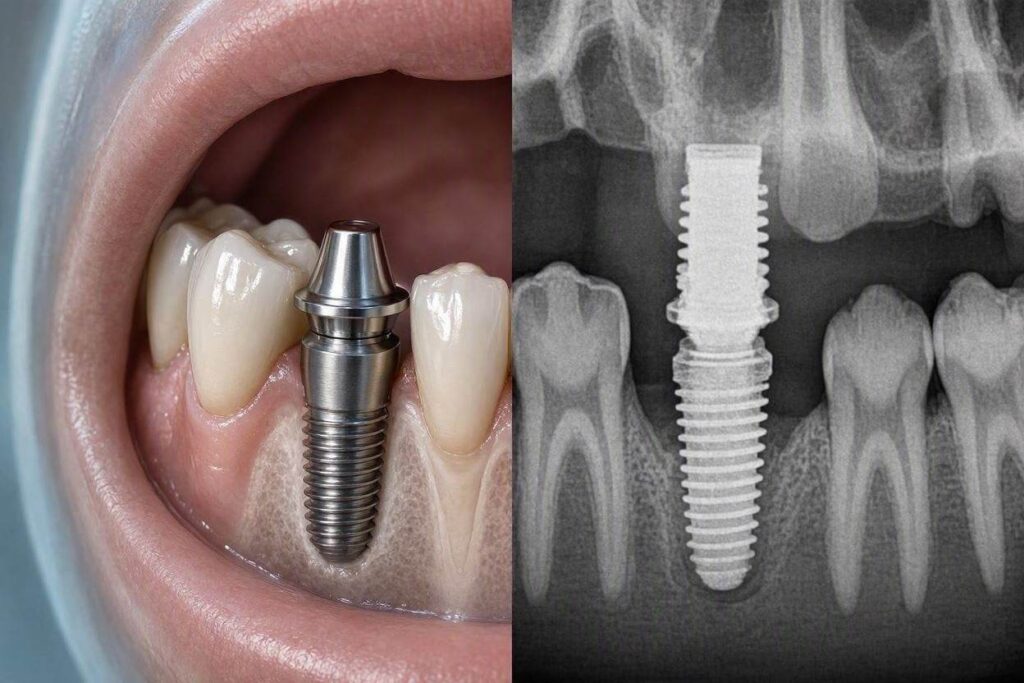
The Illusion of Nature: How Implants Hide the Metal
A dental implant is a three-part system, but the only part you should ever see is the crown (the fake tooth). The metal parts are buried deep within the anatomy of your mouth.
1. The Implant Post (Hidden in Bone)
The titanium post is surgically placed into your jawbone. It sits completely beneath your gum line. You cannot see it because it is encased in bone and soft tissue. Think of it like the roots of a tree—you know they are there, but they are underground.
2. The Abutment (Hidden by Gums or Crown)
The abutment is the connector that screws into the implant post. It sits partially above the gum line. However, dentists use “tooth-colored” abutments when they are concerned about aesthetics. Instead of gray titanium, these abutments are made of white/gold-shaded zirconia or ceramic. Even if your gum recedes slightly, a white abutment blends in with the tooth and gum tissue.
3. The Crown (The Visible Part)
The crown is made of porcelain, ceramic, or zirconia. These materials are opaque. The crown is designed to fit over the abutment like a helmet. The metal or ceramic underneath cannot be seen through the crown because light does not pass through the solid material.
The “Gray Line” Problem: When Metal Becomes Visible
While the goal is perfect aesthetics, there are scenarios where patients report seeing a dark or gray line at the gum line of their implant. This is the most common aesthetic complaint. Here is why it happens.
1. Gum Recession
This is the primary culprit. If you lose bone or gum tissue around the implant (due to peri-implantitis, aggressive brushing, or natural aging), the gum line recedes. As it recedes, it exposes the top of the abutment or, in severe cases, the top of the titanium implant post itself.
If the abutment is metal (titanium), you will see a dark gray ring at the base of the crown. If the abutment is white zirconia, you might not see anything at all.
2. Thin Gum Tissue
Some patients naturally have very thin, delicate gums. Even with perfect placement, the dark color of a titanium post can sometimes show through the gum tissue, making the gums look slightly darker or grayish compared to the surrounding pink tissue. This is similar to how a dark shirt can show through a thin white fabric.
3. Insufficient Depth of Placement
If the dentist places the implant too shallowly (too close to the surface of the bone), the metal collar of the implant might be right at the gum line. When the crown is placed, the edge of the metal might peek out from under the porcelain.
How Dentists Prevent Metal from Showing
Modern implant dentistry is heavily focused on aesthetics. Dentists use several techniques to ensure no metal is ever seen.
The “3mm Rule”
Experienced implant surgeons follow a principle called the “3mm rule.” This means they place the top of the implant fixture at least 3 millimeters below the level of the surrounding gum tissue. This provides a buffer zone. It ensures that even if the gum recedes a little bit over time, the metal post stays hidden.
Custom (Ceramic) Abutments
As mentioned earlier, the industry has moved away from metal abutments for front teeth. A custom zirconia abutment is white. Even if a bit of it is exposed, it looks like a natural tooth root or a bit of filling, not metal.
Pink Porcelain
If a patient has a severe gum recession before getting an implant, the dentist might build “fake gums” into the crown. The porcelain crown is crafted to include a pink-colored section that mimics natural gum tissue. This hides both the metal and the space left by the missing gum.
Gum Grafting
If the gums are too thin, a periodontist can perform a gum graft. They take a small piece of tissue from the roof of the mouth and attach it to the gum area around the implant. This thickens the tissue, preventing the metal color from showing through and protecting against future recession.
Zirconia Implants: The “Metal-Free” Option
If you have a metal allergy or a severe phobia of having any metal in your body, there is an alternative: zirconia implants.
Traditional implants are made of titanium. However, some manufacturers now make the implant post itself out of zirconia—a high-strength, tooth-colored ceramic. These are sometimes marketed as “holistic” or “metal-free” implants.
Advantages:
- Aesthetics: The post is white. Even if gums recede or are thin, there is no gray color to show through.
- Biocompatibility: Some patients report less inflammation and better tissue attachment with zirconia.
Disadvantages:
- Cost: Zirconia implants are often more expensive.
- Durability: Titanium is much more flexible and resistant to fracture than zirconia. Titanium is generally considered superior for long-term structural strength, especially in the back molars where biting forces are high.
- Availability: Not all dentists offer zirconia implants, and they require specialized training.
What About Seeing Metal on the Biting Surface?
There is one exception to the “no visible metal” rule, and it usually applies to back teeth.
If you have a screw-retained implant crown, the dentist places the crown and then covers the screw access hole with a tooth-colored composite filling. Sometimes, if the crown is made of a very translucent material, the dark gray color of the titanium screw deep inside might cause a slight shadow on the biting surface. Also, if the composite filling material stains or wears away, you might see a small dark dot in the center of the tooth.
This is not visible when you smile (it is on the top of the tooth, facing the other jaw), but you might feel it with your tongue. If this happens, it is a simple fix for the dentist to remove the old filling material and replace it with fresh composite.
The “Titanium Allergy” Concern
A small percentage of the population has a genuine allergy to nickel or titanium. While titanium is generally considered hypoallergenic, some patients still experience localized inflammation, redness, or a metallic taste.
If you know you have a metal sensitivity, you must discuss this with your dentist. They can perform a MELISA test (a blood test for metal allergies) or simply opt for a zirconia implant to eliminate the risk entirely.
The Bottom Line: Smiling with Confidence
If you are worried about the aesthetics of a dental implant, you are worrying about a problem that modern dentistry has largely solved.
When you look at a successful implant restoration, you should see only a beautiful, natural tooth. The metal is hidden by design. It is buried in bone, covered by gum tissue, and capped with opaque porcelain.
If you are looking at a specific dentist’s work and you are concerned, ask them one question: “Can you show me photos of your implant cases, especially the before and after?” A dentist who is skilled in aesthetic implantology will have a portfolio of cases showing that their implants are indistinguishable from natural teeth.
Conclusion
In a successful dental implant procedure, no metal should be visible. The titanium post is buried in the jawbone, the abutment is often made of tooth-colored ceramic, and the crown is made of opaque, natural-looking porcelain. If metal does become visible, it is usually due to gum recession or thin gum tissue, which can be prevented with proper surgical depth and treated with ceramic abutments, gum grafts, or pink porcelain. For patients seeking a completely metal-free option, zirconia implants offer an aesthetic alternative.
Frequently Asked Questions (FAQ)
1. Will my dental implant set off metal detectors at the airport?
No. Dental implants are made of titanium, which is non-magnetic. Airport security metal detectors are designed to detect ferrous metals like steel and iron. Your implant will not trigger the alarm. You can travel with peace of mind.
2. Can I see the screw hole in my new tooth?
If you have a screw-retained crown, the dentist fills the access hole with a composite resin. Initially, it is invisible. However, over time, this small filling can stain or wear down, revealing a faint outline or a slightly darker spot on the biting surface. It is easily polished or replaced by your dentist.
3. Why does my gum look darker around my implant compared to my other teeth?
This is usually the “gray show-through” effect of a titanium post. It happens when the gum tissue is thin or has receded. To fix this, a dentist can sometimes graft gum tissue to thicken the area, or if the crown is removable, they might be able to switch out a metal abutment for a white ceramic one.
4. Is it okay to have an MRI if I have a titanium implant?
Yes. Titanium is not affected by the magnetic field of an MRI machine. It is completely safe. The only issue is that if the MRI is focused specifically on your jaw or mouth, the implant might cause some “scatter” or distortion on the image, making it harder for the doctor to see the surrounding bone.
5. What is the “metal taste” I have after getting an implant?
A metallic taste immediately after surgery is usually due to blood in the mouth or the medication used during the procedure. It should go away in a few days. If the metallic taste persists for weeks or months, it could indicate a loose screw, a failing seal, or an allergy to the metal. Contact your dentist.