What Are The Connections Between Dental Implants?
A dental implant is not a single piece of hardware. It is a meticulously engineered system of separate components, each with a distinct mechanical function. The term “connections” in implant dentistry refers to the specific interfaces where these components join together. These connection points are the most mechanically stressed areas of the entire restoration. The long-term success or failure of an implant often depends on the precision, stability, and design of these connections.
This article provides a detailed, technical, yet accessible exploration of the connections within a dental implant system. You will learn about the implant-abutment connection, the abutment-crown connection, and the biological connection between the implant and the bone. We will examine the different types of interfaces, their advantages and disadvantages, and why the engineering of these connections is fundamental to a functional, durable outcome.
The Three Critical Connections in an Implant System
A complete dental implant restoration has three primary connection zones. Each must perform flawlessly under years of dynamic, cyclic loading.
- The Biological Connection: The interface between the titanium implant fixture and the living jawbone. This is the osseointegration interface.
- The Implant-Abutment Connection: The mechanical interface between the implant fixture (the root) and the abutment (the connector post).
- The Abutment-Crown Connection: The interface between the abutment and the final visible crown.
Of these, the mechanical implant-abutment connection is what clinicians most commonly refer to when discussing “implant connections.” It is a complex, micro-mechanical joint that must resist the forces of mastication without loosening or fracturing.
Connection 1: The Biological Connection (Osseointegration)
The foundational connection is not mechanical; it is cellular. This is the direct structural and functional link between living bone and the load-bearing artificial implant. As discovered by Per-Ingvar Brånemark, titanium is uniquely capable of forming this bond.
The Nature of the Bond
Osseointegration is not a chemical bond like an adhesive. It is a microscopic interlocking. The surface of a modern dental implant is not smooth. It is treated with sandblasting and acid-etching to create a complex, three-dimensional topography of peaks and valleys at the micron scale. When the implant is placed, the blood clot in the surgical site forms a matrix. Osteoblast cells migrate to the titanium surface and begin to lay down new bone directly onto this roughened surface. The bone grows into the microscopic irregularities. Under an electron microscope, there is no soft tissue gap between the bone and the implant. The bone matrix is directly apposed to the titanium oxide layer.
This biological connection serves two functions. It provides the absolute stability that prevents the implant from moving under load. It also forms a biological seal, a defense barrier against the invasion of bacteria from the oral environment down into the bone. The loss of this biological connection, known as peri-implantitis, is the most common cause of late implant failure.
Connection 2: The Implant-Abutment Connection (The Mechanical Joint)
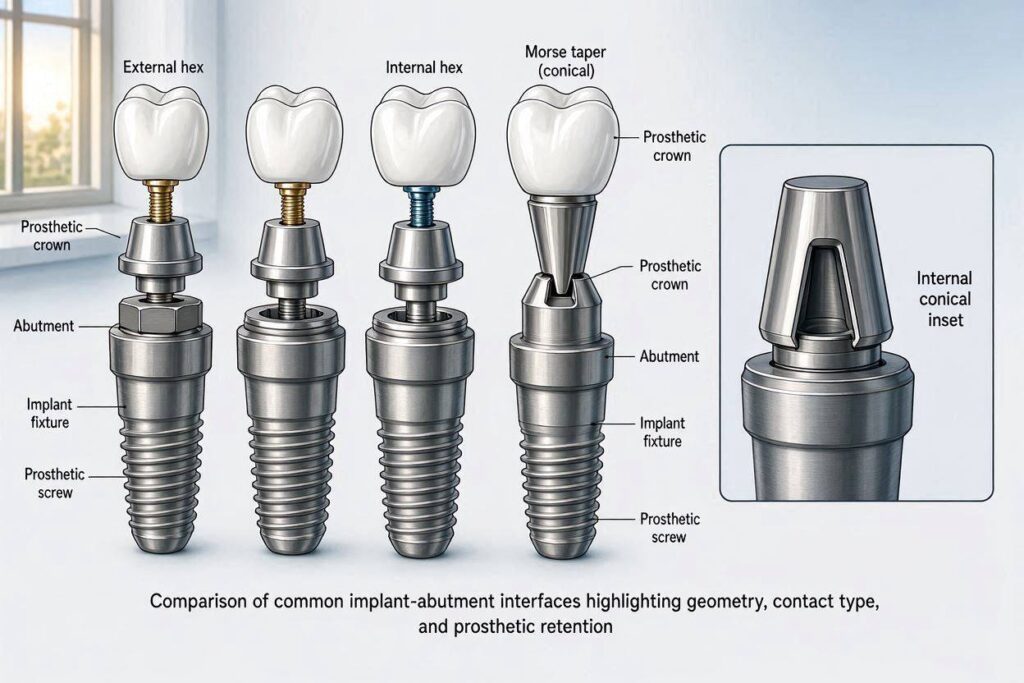
This is the precision, man-made mechanical interface where the abutment is secured into the implant fixture. The engineering of this connection has evolved significantly and is a key differentiator between implant systems.
The External Hex Connection
The original Brånemark design featured an external hexagon. The top of the implant had a raised hexagonal platform that protruded above the implant body. The abutment had a matching female hex recess and sat on top of this external hex.
- Advantages: Simple, versatile, anti-rotational.
- Disadvantages: The connection relies almost entirely on the abutment screw to withstand lateral forces. The micro-gap between the abutment and the implant is high, near the crest of the bone. Under heavy side loading, the abutment screw can loosen. This design is now considered legacy technology and is not used in most modern, high-end implant systems.
The Internal Hex Connection
The connection geometry is moved inside the implant body. The implant has a deep internal hexagonal recess. The abutment has a corresponding hexagon that inserts deep into the implant.
- Advantages: The internal connection provides a longer lever arm to resist lateral forces. The abutment is supported by the walls of the implant itself, not just the screw. This design reduces micromovement and the risk of screw loosening. It moves the mechanical micro-gap deeper inside the implant, away from the bone crest.
- Disadvantages: The wall of the implant is thinnest at the top, where the connection is, which can be a point of fracture risk under extreme loads, especially in narrow-diameter implants.
The Morse Taper (Conical) Connection
This is widely considered the most mechanically stable connection in modern implant dentistry. It combines an internal connection with a precise, locking taper. The abutment and the internal wall of the implant have perfectly matched conical angles, typically between 1.5 and 3 degrees. When the abutment is inserted and the screw is torqued down, the two conical surfaces engage and create a cold-weld friction lock.
- Advantages: This connection virtually eliminates the micro-gap, providing an exceptional bacterial seal. The friction lock massively reduces the risk of abutment screw loosening. The forces are distributed evenly along the walls of the implant, creating a highly stable, almost monolithic unit.
- Disadvantages: Requires extremely precise manufacturing. If the abutment is not seated perfectly during clinical placement, it can be difficult to fully engage the taper.
The Screw That Holds It All Together
Regardless of the connection design, the abutment screw is the component that provides the clamping force. It is a small, high-strength gold or titanium alloy screw. It is torqued to a very specific value (often 15 to 35 Newton centimeters) using a calibrated torque wrench. This preload creates a clamping force that holds the abutment firmly against the implant seat. A loose screw is the most common mechanical complication in implant dentistry, and it is almost always a warning sign of an ill-fitting connection or excessive occlusal forces.
Connection 3: The Abutment-Crown Connection
The final visible connection is between the prosthetic crown and the abutment. There are two distinct philosophies.
Screw-Retained Connection
The crown is fabricated with a small access channel through its biting surface. It is placed directly onto the abutment and secured with a small screw that passes through the crown and into the abutment. The access hole is then filled with a tooth-colored composite material.
- Advantages: It is completely retrievable. The crown can be removed without damaging it for maintenance, repair, or to clean the implant abutment. No excess cement is left below the gums.
- Disadvantages: The screw access hole can slightly weaken the porcelain, though modern materials have minimized this risk. For anterior teeth, the access hole emerging through the facial surface can be an aesthetic compromise.
Cement-Retained Connection
The abutment is screwed onto the implant. The crown is then cemented onto the abutment using a permanent dental cement, exactly like a traditional crown on a natural tooth.
- Advantages: Superior aesthetics for front teeth, as there is no screw access hole. The crown can be passively fitted, and the occlusion can be absolutely perfect.
- Disadvantages: The greatest risk is “cement sepsis.” If excess cement extrudes below the gum line and is not meticulously cleaned off, it will cause a rapid, severe inflammatory response and bone loss (peri-implantitis). Retrieving the crown for repair often requires cutting it off.
The Platform Switching Concept
A critical concept in the biological management of the implant-abutment connection is platform switching. In a traditional connection, the abutment and the implant have the same diameter at their junction. In a platform-switched design, the abutment is intentionally narrower than the implant platform. The abutment sits inboard from the edge of the implant.
This simple dimensional change has a profound biological effect. It moves the inflammatory cell infiltrate—the microscopic zone of inflammation that always forms around a connection micro-gap—away from the crestal bone and inward, over the implant platform. Numerous studies have shown that platform switching helps preserve the crestal bone level and reduces the risk of peri-implant bone loss over time.
Conclusion
The connections in a dental implant system are a three-tiered hierarchy of interfaces: the biological fusion of bone to titanium (osseointegration), the precision-engineered mechanical lock between the implant and the abutment (internal hex or Morse taper), and the restorative interface between the abutment and the crown (screw-retained or cemented). The long-term stability of the restoration depends on the quality of each connection. A Morse taper internal connection offers the highest mechanical stability and bacterial seal, while the crown connection method balances aesthetics against the risk of residual cement. All of these engineered connections serve to protect the most vulnerable and vital connection of all: the living bone-to-implant interface.
FAQ
1. What is the strongest implant-abutment connection?
The Morse taper (conical) internal connection is considered the most stable. It creates a friction lock that resists screw loosening and provides an excellent microbial seal.
2. What is the difference between an external and an internal hex connection?
In an external hex, the hexagon protrudes from the top of the implant. In an internal hex, the hexagon is recessed inside the implant body. Internal connections provide better force distribution and reduced screw loosening.
3. Is it better to have the crown screwed on or cemented?
It is a clinical decision. Screw-retained crowns are fully retrievable and avoid the risk of cement-induced gum disease. Cement-retained crowns can offer a more perfect aesthetic and occlusal surface with no access hole.
4. What causes an abutment screw to loosen?
Screw loosening is usually caused by excessive side-loading forces (like teeth grinding), an improper fit between the abutment and implant, or not torquing the screw to the manufacturer’s exact specification.
5. What is platform switching?
It is a design feature where the abutment is narrower than the implant. This shifts the micro-gap inward, moving the zone of inflammation away from the crestal bone, which helps preserve bone levels long-term.
Additional Resource
For an in-depth scientific review of implant macro-design, connection types, and surface technologies, explore the research and publications available through the Academy of Osseointegration (AO).