Dental Implant After Root Canal Failure
When a Root Canal Doesn’t Work Out
You did everything right. You went to the dentist when you felt that toothache. You agreed to the root canal treatment. You hoped it would save your tooth and end the pain.
But now, months or even years later, something feels wrong again. Maybe there’s discomfort when you bite down. Maybe you notice swelling near the gumline. Or perhaps your dentist just told you the news you were dreading: the root canal failed.
You’re probably feeling frustrated, confused, and maybe a little scared. After all, you invested time, money, and hope into saving that tooth. Now you’re facing the possibility of losing it after all.
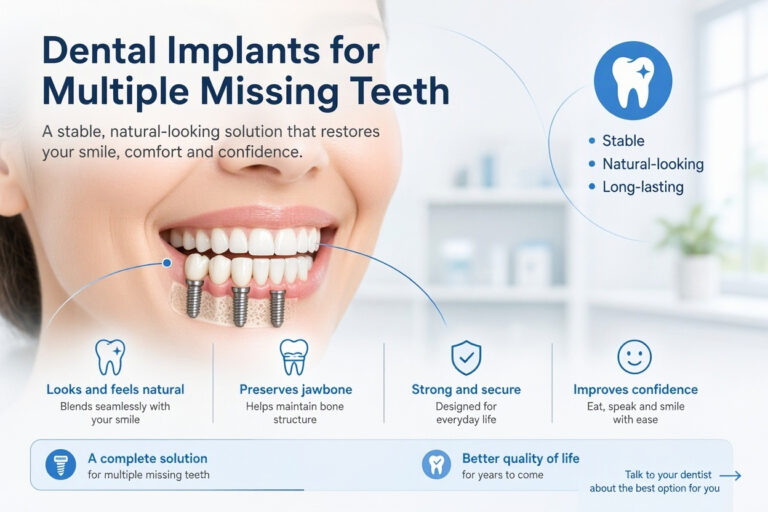
Here’s what you need to know: root canal failure is more common than you might think, and it doesn’t mean you’ve done anything wrong. More importantly, you have options. Dental implants offer a reliable, long-lasting solution when a root canal fails and the tooth can’t be saved.
This comprehensive guide will walk you through everything you need to know about dental implants after root canal failure. We’ll explain why root canals fail, how to know if yours has failed, what your treatment options are, and how to plan for a successful implant. By the end, you’ll have a clear roadmap for moving forward with confidence.
Understanding Root Canal Failure
What Is a Root Canal?
Before we dive into failure, let’s briefly review what a root canal is supposed to do. A root canal (also called endodontic treatment) is a procedure designed to save a tooth that has become infected or severely damaged.
During a root canal, your dentist:
- Removes the infected or damaged pulp (the soft tissue inside the tooth)
- Cleans and disinfects the inside of the tooth
- Fills and seals the space with a special material
- Usually places a crown on top to protect the tooth
The goal is simple: eliminate infection, relieve pain, and keep your natural tooth in place.
Why Root Canals Fail
Root canals have a high success rate—around 90-95% when performed properly. But they’re not perfect. Sometimes, despite everyone’s best efforts, a root canal fails.
Here are the most common reasons:
Incomplete cleaning
The root canal system is complex. Some teeth have multiple canals, curved roots, or tiny branches that are difficult to reach. If any infected tissue remains, the infection can return.
Missed canals
Some teeth have more canals than expected. If a dentist misses one, bacteria can thrive in that untreated space.
Leakage
The filling material or crown seal can break down over time, allowing bacteria to re-enter the tooth.
New decay
Even a treated tooth can develop new cavities if oral hygiene isn’t maintained. New decay can expose the root canal filling to bacteria.
Cracked or fractured tooth
A tooth that has been treated with a root canal is more brittle. It can crack or fracture under pressure, allowing bacteria to enter and cause failure.
Instrument breakage
Occasionally, tiny files used during the procedure can break off inside a canal. This can harbor bacteria and lead to failure.
Poor crown fit
If the crown doesn’t seal properly, bacteria can leak in around the edges.
Delayed treatment
Waiting too long to get a root canal, or delaying the final restoration, increases the risk of failure.
“Root canal failure is rarely the patient’s fault. It’s usually a combination of anatomical complexity and the limits of what we can see and reach. That’s why follow-up care and regular check-ups are so important.” – Dr. Rachel Steinberg, Endodontist
Signs Your Root Canal May Have Failed
How do you know if your root canal has failed? Here are the warning signs:
- Pain or discomfort when biting or chewing
- Swelling or tenderness near the treated tooth
- A persistent bad taste or odor
- Pus or discharge near the gumline
- Discoloration of the tooth
- A small bump on the gum near the tooth
- Sensitivity to hot or cold
- Loose tooth
- X-ray findings showing bone loss or infection
Sometimes, root canal failure has no symptoms at all. Your dentist may discover it during a routine check-up and X-ray. This is why regular dental visits are essential.
Diagnosing Root Canal Failure
If your dentist suspects root canal failure, they’ll perform a thorough evaluation:
Clinical examination
Your dentist will examine the tooth, check for swelling, and probe the gums around it.
X-rays
X-rays can reveal bone loss, infection, or problems with the root canal filling.
Cone beam CT scan
This advanced imaging provides a 3D view of the tooth and surrounding bone, helping identify issues that regular X-rays might miss.
Percussion and palpation tests
Tapping on the tooth or pressing on the gums can help identify inflammation or infection.
Bite tests
Your dentist may ask you to bite down on a special instrument to check for cracks or fractures.
Treatment Options After Root Canal Failure
Option 1: Retreatment
If the root canal can be redone, retreatment is often the first option considered. During retreatment, your dentist or endodontist:
- Removes the old filling material
- Cleans and disinfects the canals again
- Looks for missed canals or fractures
- Refills and reseals the tooth
Pros:
- Saves your natural tooth
- Often less expensive than an implant
- Less invasive than extraction
Cons:
- Not always possible (depends on the reason for failure)
- Success rate is lower than initial root canal
- May not be recommended if the tooth is cracked or has poor bone support
Option 2: Apicoectomy (Root-End Surgery)
An apicoectomy is a surgical procedure that involves removing the tip of the tooth’s root and sealing it from the outside. This is often recommended when retreatment isn’t possible or has failed.
Pros:
- Can save a tooth that would otherwise be extracted
- Addresses problems at the root tip that can’t be reached from above
Cons:
- Requires surgery
- Not suitable for all cases
- Success rate varies
Option 3: Extraction and Dental Implant
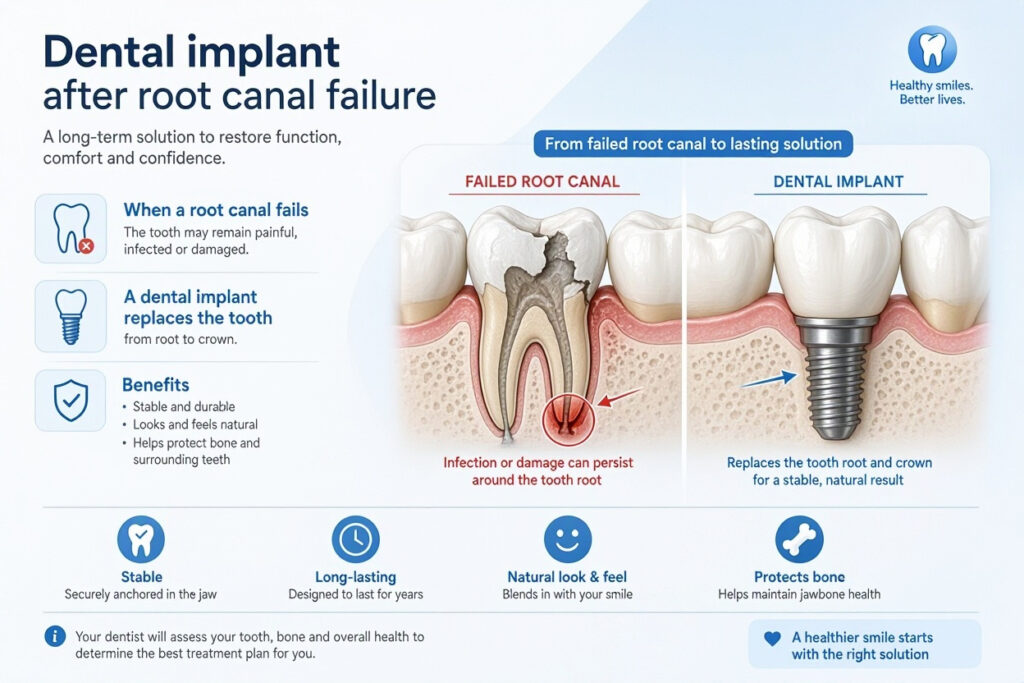
When a root canal fails and the tooth cannot be saved through retreatment or surgery, extraction becomes necessary. At that point, a dental implant offers the best long-term solution for replacing the tooth.
Pros:
- Highly predictable and durable
- Preserves bone
- Doesn’t affect adjacent teeth
- Looks and functions like a natural tooth
- Long-term success rate above 95%
Cons:
- Requires surgery
- Higher upfront cost
- Takes several months to complete
- Requires adequate bone and healthy gums
Comparison Table: Treatment Options After Root Canal Failure
| Factor | Retreatment | Apicoectomy | Extraction + Implant |
|---|---|---|---|
| Saves natural tooth | Yes | Yes | No |
| Success rate | 70-85% | 60-80% | 95%+ |
| Invasiveness | Moderate | Surgical | Surgical |
| Treatment time | 1-2 visits | 1 visit + healing | 4-9 months |
| Cost | $800-$1,500 | $1,000-$2,000 | $3,000-$6,000 |
| Long-term durability | Variable | Variable | Excellent |
| Bone preservation | Yes | Yes | Yes (with implant) |
| Affects adjacent teeth | No | No | No |
“When a tooth has failed a root canal and can’t be retreated, an implant is usually the best option. It’s more predictable than trying to save a compromised tooth, and it gives the patient a permanent solution.” – Dr. Michael Hart, Implant Dentist
Why Choose a Dental Implant After Root Canal Failure?
The Case for Implants
When a root canal fails and the tooth must be extracted, dental implants offer several significant advantages:
Predictable results
Implant success rates exceed 95% in healthy patients with adequate bone. This is higher than the success rate of retreatment or apicoectomy.
Bone preservation
When you lose a tooth, the jawbone begins to shrink. An implant prevents this bone loss by stimulating the bone, just like a natural tooth root.
No impact on adjacent teeth
Unlike a dental bridge, an implant doesn’t require cutting down healthy neighboring teeth. Your other teeth remain untouched and intact.
Natural appearance and function
Modern implant crowns are custom-made to match your natural teeth. They look, feel, and function like real teeth.
Long-term value
While the upfront cost is higher, implants often last decades—sometimes a lifetime. When you consider the cost per year of use, implants are often the most economical choice.
Freedom and confidence
Implants allow you to eat, speak, and smile without worry. There’s no slipping, clicking, or removal for cleaning like with dentures.
Implants vs. Bridge After Root Canal Failure
Many patients wonder whether a bridge or an implant is better after losing a tooth to root canal failure. Here’s how they compare:
| Feature | Implant | Bridge |
|---|---|---|
| Adjacent tooth impact | None | Requires cutting down healthy teeth |
| Bone preservation | Yes | No |
| Longevity | 20+ years (often lifetime) | 10-15 years average |
| Maintenance | Brush and floss like natural teeth | Special cleaning tools needed |
| Success rate | 95%+ | 70-80% at 10 years |
| Initial cost | Higher | Lower |
| Long-term cost | Lower | Higher (replacement needed) |
For most patients, an implant is the superior choice. However, a bridge may be appropriate in certain situations, such as when bone quality is poor or when multiple adjacent teeth need restoration.
Preparing for a Dental Implant After Root Canal Failure
Initial Evaluation
Before implant placement, your dentist will conduct a thorough evaluation:
Medical and dental history
Your dentist will review your health history, medications, and any previous dental treatments. Be honest about all medications, supplements, and health conditions.
Clinical examination
Your dentist will examine the extraction site (or planned extraction site), assess your gums, and check your bite.
Imaging
X-rays and possibly a CT scan will show your bone structure and help plan the implant position. This imaging is crucial for avoiding complications.
Discussion of options
You’ll discuss the pros and cons of implants versus other options, as well as the timeline and cost.
Addressing Infection Before Implant Placement
If your failed root canal has caused an infection, it must be treated before implant placement. Treatment may include:
- Antibiotics to control the infection
- Drainage of any abscess
- Extraction of the failed tooth with thorough cleaning of the socket
- Bone grafting if infection has caused bone loss
Your dentist will confirm that the infection is fully resolved before proceeding with implants. Placing an implant into an infected site significantly increases the risk of failure.
Bone Grafting: Rebuilding Your Foundation
Root canal failure often leads to bone loss around the root tip. This can compromise implant stability. Bone grafting may be necessary to rebuild a solid foundation.
Types of bone grafts:
Autograft – Bone taken from another part of your body. This is the gold standard because it contains living bone cells.
Allograft – Bone from a human donor (processed and sterilized).
Xenograft – Bone from an animal source, usually bovine (cow).
Synthetic graft – Man-made materials that mimic natural bone.
The grafting procedure is typically straightforward. Your dentist places the graft material into the deficient area and covers it with a membrane if needed. Healing takes several months as your body replaces the graft with new bone.
Soft Tissue Considerations
If the failed root canal has affected your gums, soft tissue grafting may be recommended. This restores gum thickness and coverage, which is important for both aesthetics and implant health.
The Dental Implant Procedure: Step by Step
Phase 1: Consultation and Treatment Planning
Your implant journey begins with a comprehensive consultation:
- Review of your medical and dental history
- Clinical examination
- X-rays and possibly a CT scan
- Discussion of your goals and expectations
- Explanation of the procedure and timeline
- Cost estimate and payment options
Your dentist will use digital planning tools to determine the ideal position, angle, and depth for your implant. This precision planning is crucial for success.
Phase 2: Tooth Extraction
If your failed root canal tooth hasn’t been extracted yet, this is done first. Your dentist removes the tooth carefully, preserving as much bone as possible. The socket is cleaned thoroughly to remove any remaining infection.
Phase 3: Implant Placement Surgery
The implant placement procedure typically takes 30-60 minutes for a single implant. Here’s what to expect:
Anesthesia
Local anesthesia numbs the area. Sedation options are available for anxious patients.
Incision
A small incision exposes the bone if the gum has healed over the extraction site.
Drilling
A series of drills creates a precise hole in the bone, gradually widening it to the exact size needed for your implant.
Implant insertion
The titanium implant is carefully threaded into the prepared site.
Closure
The gum is sutured closed over the implant, or a healing abutment is attached if a one-stage approach is used.
Phase 4: Osseointegration (Healing)
Over the next 3-6 months, the implant fuses with your bone through a process called osseointegration. During this time:
- Follow a soft diet initially
- Avoid putting pressure on the implant site
- Maintain excellent oral hygiene
- Attend follow-up appointments
- Report any unusual symptoms
Phase 5: Abutment Placement
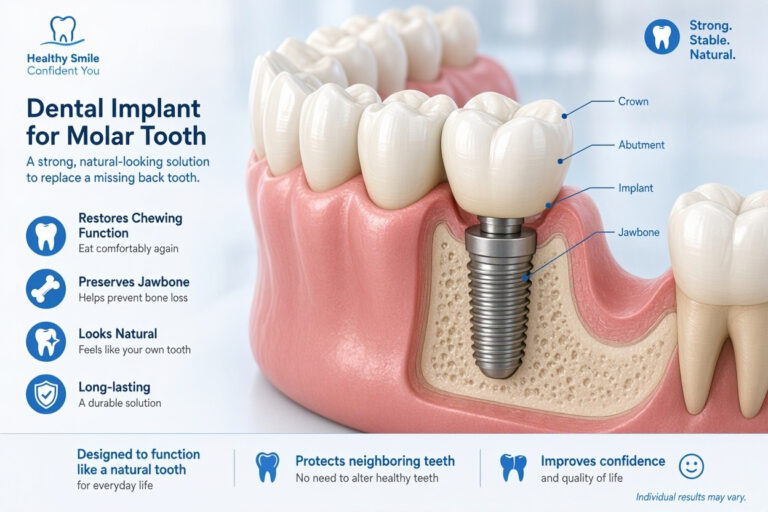
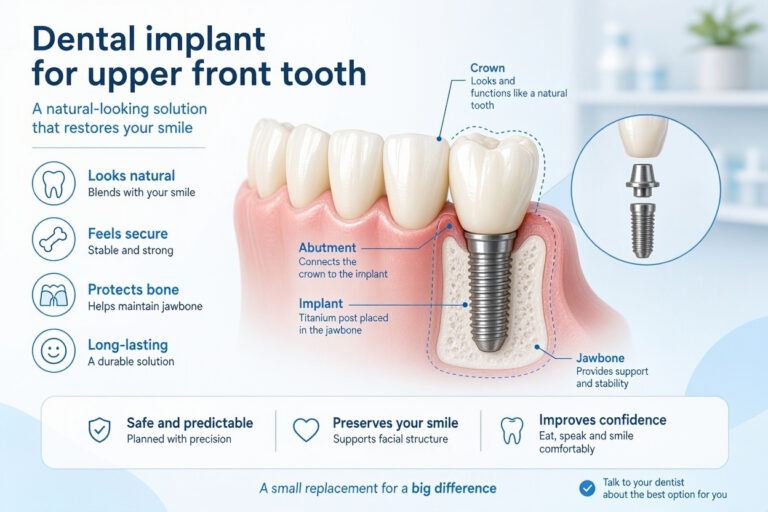
Once osseointegration is complete, your dentist exposes the implant and attaches an abutment. This small connector piece will hold your final restoration.
Phase 6: Final Restoration
After your gums have healed around the abutment (typically 2-4 weeks), impressions are taken for your final crown. The restoration is custom-made to match your natural teeth and bite.
When ready, your dentist attaches the final restoration to the abutment. You now have a fully functional, natural-looking replacement tooth.
Timeline Overview
| Phase | Duration |
|---|---|
| Consultation and planning | 1-2 visits |
| Tooth extraction | 1 visit |
| Healing after extraction | 3-6 months (if delayed implant) |
| Implant placement | 1 visit (30-60 minutes) |
| Osseointegration | 3-6 months |
| Abutment placement | 1 visit |
| Gum healing | 2-4 weeks |
| Final restoration | 1-2 visits |
| Total | 4-9 months |
Risks and Complications
What Can Go Wrong?
While implant success rates are high, complications can occur:
Infection
Bacteria around the implant can cause peri-implantitis, leading to bone loss and implant failure. This is more common in patients with a history of gum disease or poor oral hygiene.
Implant failure (osseointegration failure)
The implant may not fuse with the bone. This is more common in smokers and patients with uncontrolled health conditions.
Nerve damage
Rare, but possible if the implant is placed near a nerve. This can cause numbness or tingling.
Sinus problems
In the upper jaw, implants can intrude into the sinus cavity. Sinus lift procedures can prevent this.
Bone loss
Without proper maintenance, bone can recede around the implant.
Restoration complications
The crown may chip, loosen, or need replacement over time.
How to Minimize Risks
- Choose an experienced implant dentist
- Follow all pre- and post-surgical instructions
- Quit smoking
- Control systemic conditions like diabetes
- Maintain excellent oral hygiene
- Attend regular check-ups
“The most successful implant patients are those who treat their implants like a valuable investment. They brush, floss, attend check-ups, and address problems early. That’s the formula for long-term success.” – Dr. Susan Bradley, Periodontist
Cost of Dental Implants After Root Canal Failure
What Factors Affect the Cost?
The cost of your implant treatment depends on several factors:
- Number of implants needed
- Need for bone grafting or soft tissue grafting
- Complexity of the case
- Geographic location
- Dentist’s experience and credentials
- Type of final restoration
Typical Cost Breakdown
| Procedure | Cost Range |
|---|---|
| Tooth extraction | $150 – $500 |
| Bone grafting | $600 – $3,000 |
| Implant placement (single) | $1,500 – $3,000 |
| Abutment and crown | $1,500 – $3,000 |
| Total for single implant | $3,000 – $6,000 |
| Retreatment (for comparison) | $800 – $1,500 |
| Apicoectomy (for comparison) | $1,000 – $2,000 |
Is an Implant Worth the Cost?
While implants cost more upfront than retreatment or a bridge, they offer superior long-term value. Consider this:
- A bridge typically needs replacement every 10-15 years
- Retreatment may fail again, requiring further treatment or extraction
- An implant can last decades with proper care
When you calculate the cost per year of use, implants are often the most economical choice.
Insurance Coverage
- Dental insurance may cover a portion of the implant and crown
- Medical insurance may cover implants if the tooth loss resulted from a medical condition or accident
- Check with your provider to understand your benefits
- Some plans have waiting periods for major services
Financial Options
- Payment plans through your dentist
- Dental financing companies (CareCredit, etc.)
- Health savings accounts (HSAs)
- Flexible spending accounts (FSAs)
- Third-party lenders
Recovering from Implant Surgery
What to Expect After Surgery
Day 1-3:
- Mild swelling and discomfort
- Some bleeding (manageable with gauze)
- Soft diet recommended
- Avoid strenuous activity
Week 1:
- Swelling subsides
- Sutures may be removed
- Return to normal activities (with precautions)
Week 2-4:
- Soft tissue healing
- Gradual return to normal diet
- Follow-up appointment
Month 3-6:
- Osseointegration continues
- Bone fuses with implant
Tips for a Smooth Recovery
- Take prescribed medications as directed
- Use ice packs for swelling
- Eat soft, nutritious foods
- Avoid smoking and alcohol
- Keep the surgical site clean
- Attend all follow-up appointments
- Report any unusual symptoms immediately
Long-Term Care for Your Implant
Daily Maintenance
Brushing
Brush twice daily with a soft-bristled toothbrush. Pay special attention to the gumline around your implant.
Flossing
Use floss or interdental brushes daily to clean between the implant and adjacent teeth.
Mouthwash
An antimicrobial mouthwash can help control bacteria.
Professional Maintenance
- Dental cleanings every 6 months (or more frequently if recommended)
- Regular probing around the implant to check for pocket formation
- X-rays to monitor bone levels
- Professional assessment of gum health
Warning Signs to Watch For
Contact your dentist if you notice:
- Bleeding when brushing
- Swelling or redness
- Pain or discomfort
- Implant mobility
- Pus or discharge
- Bad breath that doesn’t improve
Lifestyle Factors
Quit smoking
Smoking is the biggest preventable risk factor for implant failure.
Control systemic conditions
Keep diabetes well-managed. Work with your doctor to control any conditions that affect healing.
Maintain a healthy diet
Good nutrition supports tissue health and immune function.
Manage stress
Chronic stress impairs healing and immune function.
Real Patient Stories
Jennifer’s Story: A Second Chance
Jennifer, a 48-year-old accountant, had a root canal on her lower molar five years ago. The tooth never felt quite right, and eventually, her dentist discovered a recurring infection.
“I was so frustrated. I’d spent all that money on a root canal, and now I was losing the tooth anyway. My dentist explained that the root had cracked, and the tooth couldn’t be saved. She recommended an implant. The process took about six months, but now I have a tooth that feels completely normal. I wish I’d done it sooner.”
Tom’s Story: Learning from Failure
Tom, 55, had a root canal that failed after just two years. He initially considered retreatment but ultimately chose an implant.
“My endodontist said retreatment had a decent chance of working, but it might fail again. I didn’t want to keep throwing money at a tooth that might not last. I chose the implant, and I’m glad I did. It’s been three years, and it feels like my own tooth.”
Maria’s Story: The Importance of Follow-Up
Maria, 62, had a root canal that seemed fine for years. But at a routine check-up, her dentist noticed bone loss on the X-ray.
“I had no symptoms at all. I was shocked when my dentist told me the root canal had failed. Because I caught it early, I had options. I chose an implant, and the whole process went smoothly. Now I never miss a check-up.”
Frequently Asked Questions
How common is root canal failure?
Root canal failure occurs in about 5-15% of cases, depending on the study. Most root canals are successful, but failure can happen due to incomplete cleaning, new decay, cracks, or other factors.
How do I know if my root canal has failed?
Signs include pain when biting, swelling, a bad taste, pus, discoloration, or a bump on the gum. However, some failures have no symptoms and are only discovered on X-rays. Regular dental check-ups are essential for early detection.
Can a failed root canal be retreated?
Sometimes. Retreatment is possible if the canals can be properly cleaned and sealed again. However, if the tooth is cracked or has poor bone support, retreatment may not be recommended.
When should I choose an implant over retreatment?
An implant may be the better choice if the tooth is cracked, has significant bone loss, or if retreatment has already failed. Your dentist will evaluate your specific situation and discuss the pros and cons of each option.
How long after extraction can I get an implant?
Typically, you can get an implant 3-6 months after extraction to allow for bone healing. In some cases, immediate implant placement (same day as extraction) is possible if there’s no infection and adequate bone.
Is implant surgery painful after root canal failure?
Most patients report minimal discomfort during the procedure thanks to local anesthesia. Post-operative discomfort is typically manageable with over-the-counter pain relievers and usually subsides within a few days.
How long does the entire implant process take?
The complete process typically takes 4-9 months. This includes extraction, healing time, implant placement, osseointegration (3-6 months), and final restoration.
Can I get an implant if I have a history of failed root canals?
Yes. A failed root canal doesn’t disqualify you from implants. However, your dentist will want to ensure that any infection is fully resolved before placing the implant.
What if I can’t afford an implant after root canal failure?
Talk to your dentist about payment plans and financing options. Some dental schools offer reduced-cost treatment. Don’t assume implants are out of reach—explore all options before settling for less ideal alternatives.
Will my implant look natural?
Yes. Modern implant crowns are custom-made to match your natural teeth in color, shape, and size. With proper planning and high-quality laboratory work, most implants are indistinguishable from natural teeth.
Can I smoke after getting an implant?
Smoking significantly increases the risk of implant failure. If you smoke, you should quit before surgery and remain smoke-free throughout the healing process. Ideally, you should quit permanently.
What happens if I don’t replace a failed root canal tooth?
Leaving a gap after tooth extraction can cause several problems. Adjacent teeth may shift, your bite may change, and the bone in the missing tooth area will begin to shrink. Over time, this can lead to further tooth loss and more complex treatment.
Is age a factor in getting an implant after root canal failure?
Age itself is not a barrier to implants. What matters more is your overall health, bone quality, and healing capacity. Older adults can successfully receive implants, provided they are in good general health and committed to proper maintenance.
How do I choose the right dentist for my implant?
Look for a dentist with experience in implant dentistry, preferably one who has completed advanced training. Ask about their success rates, view before-and-after photos, and read patient reviews. Don’t be afraid to ask questions.
What if I have gum disease and a failed root canal?
Gum disease must be treated before implant placement. Active gum disease increases the risk of implant failure. Your dentist will recommend a treatment plan that addresses both the gum disease and the missing tooth.
Additional Resource
For more information about root canal treatment and dental implants, visit the American Association of Endodontists website: www.aae.org
This professional organization provides resources for patients, including information about root canal treatment, retreatment, and when to consider alternatives.
Your Next Steps
If you’ve experienced root canal failure and are considering a dental implant, here’s your action plan:
1. Get a thorough evaluation
Meet with a dentist or endodontist to determine why the root canal failed and what your options are.
2. Discuss all treatment options
Consider retreatment, apicoectomy, and extraction with implant. Ask about success rates, costs, and timelines for each.
3. Address any infection
If infection is present, it must be treated before implant placement.
4. Plan for bone grafting if needed
Your dentist will assess your bone quality and recommend grafting if necessary.
5. Choose an experienced implant dentist
Look for someone with advanced training and a proven track record.
6. Commit to long-term maintenance
Implants require excellent oral hygiene and regular professional care.
Conclusion
Root canal failure can feel like a setback, but it doesn’t have to be the end of your smile. Dental implants offer a reliable, natural-looking solution when a tooth cannot be saved. The journey requires careful planning, proper healing time, and a commitment to long-term care. With an experienced dental team and a proactive approach, you can move past root canal failure and enjoy a healthy, functional smile for years to come. Don’t let a failed root canal hold you back—explore your options today and take the first step toward a lasting solution.