Do Dental Implants Wear Out?
The promise of dental implants as a permanent solution for missing teeth raises an obvious question: can something implanted in the human body truly last forever? Patients want to know whether their significant investment will provide a lifetime of service or whether they should budget for eventual replacement. The answer requires understanding the different components of implant restorations and how each responds to decades of function in the oral environment.
Dental implants can last a lifetime, but the restorations they support do wear out over time. The titanium implant post that integrates with bone is designed for permanent function and has no built-in expiration date. However, the crown, bridge, or denture attached to the implant is subject to the same wear and tear as any dental restoration. Most implant crowns last 15 to 20 years before requiring replacement. The opposing natural teeth, the patient’s oral habits, and the quality of maintenance all significantly influence restoration longevity.
The Titanium Implant Post: Built for Permanence
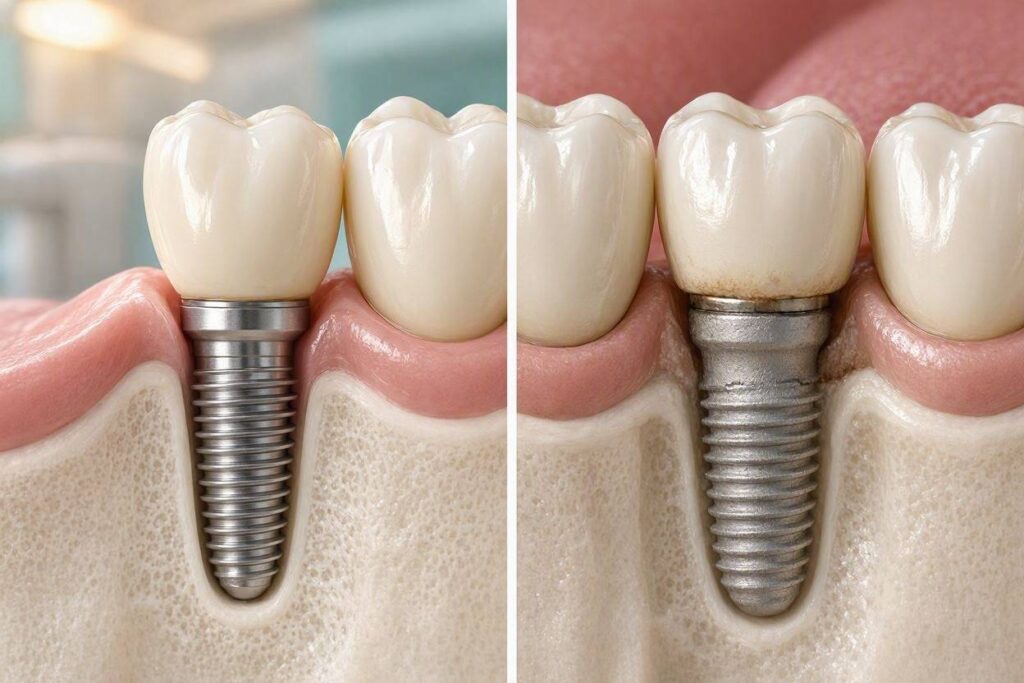
The portion of the dental implant that goes into the bone represents one of the most durable medical devices ever developed.
Why Titanium Implants Do Not Wear Out
The titanium alloy used in dental implants is extraordinarily resistant to the forces and chemical environment of the human body. Several properties contribute to its remarkable longevity.
Titanium is biocompatible, meaning the body does not recognize it as foreign material requiring immune response. Unlike some metals that corrode in the warm, salty, acidic environment of the mouth, titanium forms a stable oxide layer on its surface. This oxide layer is chemically inert and protects the underlying metal from corrosion indefinitely.
The fatigue resistance of titanium is exceptional. Implants endure millions of chewing cycles over decades, with forces ranging from gentle (20-30 pounds for soft foods) to substantial (100-200+ pounds for maximum biting force). Properly designed titanium implants withstand these cyclic loads without accumulating the microscopic damage that leads to metal fatigue and fracture in other materials.
The bone-implant interface strengthens over time. Bone is living tissue that continuously remodels in response to mechanical load. The bone surrounding a functional implant maintains its density and may even increase in quality over years of use. This is the opposite of what happens under a conventional denture, where bone progressively resorbs due to lack of stimulation.
When Implant Posts Do Fail
Although the titanium post itself does not wear out, it can fail for biological or mechanical reasons unrelated to material degradation.
Peri-Implantitis:
This bacterial infection destroys the bone supporting the implant. It is not the implant wearing out but rather the foundation crumbling beneath it. This is the leading cause of late implant loss and is largely preventable through meticulous oral hygiene and regular professional maintenance.
Failed Osseointegration:
Some implants never successfully bond to bone. This early failure is a biological complication, not wear and tear. The implant is typically removed and can often be replaced successfully after site healing.
Implant Fracture:
Although rare (less than 1% of implants over long follow-up periods), the implant body can fracture. This is usually due to excessive forces (severe grinding, heavy biting), inadequate implant dimensions for the load, or material defects. Fractured implants must be removed.
Medical or Medication Effects:
Certain medications, particularly bisphosphonates used for osteoporosis treatment, can affect bone metabolism in ways that compromise implant support. Radiation therapy to the jaws damages blood supply and healing capacity.
| Cause of Implant Loss | Is This Wear and Tear? | Preventable? |
|---|---|---|
| Peri-Implantitis | No (infectious disease) | Largely preventable with hygiene and maintenance |
| Failed Osseointegration | No (healing failure) | Partially preventable through risk factor management |
| Implant Fracture | Yes (mechanical failure) | Preventable through proper design and occlusal management |
| Medication Effects | No (medical complication) | Requires medical coordination before implant treatment |
| Progressive Bone Loss | No (biological process) | Slowed through maintenance; not entirely preventable |
Implant Restorations: What Does Wear Out
The components that replace the visible portion of the tooth are subject to wear and eventual replacement.
The Implant Crown
The crown attached to the implant functions like any dental crown. It must withstand chewing forces, resist fracture, and maintain its aesthetic appearance over years of service.
Porcelain and Ceramic Crowns:
These are the most common implant crown materials, particularly for visible teeth. They offer excellent aesthetics that can be matched precisely to natural teeth.
Porcelain crowns typically last 15-20 years before requiring replacement. The porcelain can chip or fracture under heavy biting forces, particularly in patients who grind their teeth. The surface can wear over time, losing the subtle texture and gloss of new porcelain. The margins where the crown meets the abutment or gum tissue may eventually show staining or breakdown.
Zirconia Crowns:
Solid zirconia offers superior strength and fracture resistance compared to layered porcelain. Zirconia crowns are expected to last 20+ years, with some projections suggesting they may last significantly longer.
The high strength comes with slightly less translucency than the best porcelain. For back teeth where forces are highest and aesthetics are less critical, zirconia is often the material of choice.
Porcelain-Fused-to-Metal Crowns:
These combine a metal substructure for strength with porcelain fused to the outside for aesthetics. They can last 15-25+ years but may show a dark line at the gum margin if recession occurs, exposing the metal beneath the porcelain.
Acrylic and Composite Crowns:
These are typically used for temporary restorations or as part of hybrid bridges. They wear faster than ceramic materials and may require replacement within 5-10 years. Acrylic is more susceptible to staining, wear, and fracture than ceramic alternatives.
The Abutment
The abutment is the connector between the implant and the crown. It is typically made of titanium or zirconia.
Titanium abutments rarely fail mechanically. The metal is strong, fatigue-resistant, and well-proven over decades of use. The abutment screw that secures the abutment to the implant may loosen over time and require retightening or replacement. This is a maintenance issue, not a failure of the abutment itself.
Zirconia abutments are more aesthetic for front teeth because they are white rather than metallic. They are strong but less forgiving of overload than titanium. Fracture of a zirconia abutment is rare but more common than fracture of titanium abutments.
Implant-Supported Bridges and Full-Arch Restorations
Larger restorations spanning multiple implant sites wear differently than single crowns.
Acrylic Hybrid Bridges:
These combine denture teeth and gum-colored acrylic on a metal framework. The acrylic teeth wear over time, losing their chewing efficiency and aesthetic appearance. The acrylic base may discolor, stain, or develop microscopic cracks.
The expected lifespan is 5-10 years before significant refurbishment or replacement is needed. The metal framework typically lasts much longer, so replacement often involves fabricating new teeth on the existing framework.
Composite Hybrid Bridges:
High-strength composite materials offer improved wear resistance compared to acrylic. Expected lifespan is 7-12 years. These are a middle ground between acrylic and zirconia in both cost and durability.
Zirconia Full-Arch Bridges:
These represent the most durable option for full-arch restoration. Milled from solid zirconia, they resist wear, fracture, and staining far better than acrylic or composite. Expected lifespan is 15-20+ years, with some predictions of longer service. The trade-off is higher initial cost and, if fracture does occur, more expensive repair or replacement.
| Restoration Type | Expected Lifespan | Primary Failure Modes |
|---|---|---|
| Porcelain Crown | 15-20 years | Chipping, wear, margin breakdown |
| Zirconia Crown | 20+ years | Rare fracture, wear of opposing teeth |
| PFM Crown | 15-25+ years | Porcelain fracture, margin exposure |
| Acrylic Hybrid Bridge | 5-10 years | Tooth wear, staining, acrylic degradation |
| Composite Hybrid Bridge | 7-12 years | Wear, staining, delamination |
| Zirconia Full-Arch Bridge | 15-20+ years | Rare catastrophic fracture |
Factors That Accelerate Implant Restoration Wear
The same restoration will last dramatically different lengths of time depending on patient factors.
Occlusal Forces and Bruxism
The magnitude and direction of chewing forces are the primary determinants of restoration longevity. Patients who grind or clench their teeth (bruxism) subject their implant restorations to forces far exceeding normal chewing loads.
Bruxism can generate forces of 500-800+ pounds, compared to 20-200 pounds for normal chewing. These extreme forces accelerate wear, cause porcelain chipping or fracture, loosen screws, and in severe cases contribute to implant fracture.
Nightguard protection is essential for bruxism patients with implant restorations. The nightguard absorbs and distributes the grinding forces that would otherwise damage both natural teeth and implant restorations.
Opposing Dentition
What the implant crown bites against affects its wear rate. Porcelain opposing natural teeth causes more wear to the natural teeth than to the porcelain. Porcelain is harder than tooth enamel. This is a consideration when selecting materials for implant restorations that oppose natural teeth.
Porcelain opposing porcelain (as when both arches have implant restorations) wears both surfaces relatively evenly. Zirconia opposing natural teeth can aggressively wear the natural tooth enamel. The extreme hardness of zirconia makes it potentially damaging to opposing natural teeth.
Oral Habits
Habits beyond bruxism affect restoration longevity. Chewing ice, hard candy, or other hard objects subjects restorations to concentrated forces they were not designed to withstand. Using teeth as tools to open packages or hold objects risks chipping or fracture. Nail biting, pen chewing, and other parafunctional habits add cumulative wear over time.
Maintenance Quality
Professional maintenance and home care affect restoration longevity even though the materials themselves cannot decay. Regular professional cleanings remove plaque and calculus that cause gum inflammation. If gum tissue recedes due to inflammation, margins become exposed and susceptible to staining and decay at the interface with natural teeth.
Patients who attend regular maintenance visits have their restorations evaluated for early signs of wear, screw loosening, or other problems. Early intervention prevents minor issues from becoming major failures.
The Concept of “Lifetime” in Implant Dentistry
Dental marketing often describes implants as “lifetime” solutions, but this language requires clarification.
What “Lifetime” Realistically Means
For the implant post, “lifetime” is a realistic claim. Well-integrated implants in patients who maintain good health and hygiene can indeed last for the remainder of the patient’s life. There is no biological clock that causes titanium to degrade or bone to spontaneously reject an implant after a certain number of years.
For the restoration (crown, bridge, or denture), “lifetime” is not realistic. These components will require replacement at some point, just as dental restorations on natural teeth require replacement. A 40-year-old receiving an implant crown should expect to replace that crown at least once, possibly twice, over the subsequent decades.
The Difference Between Implant Survival and Prosthetic Success
Implant research distinguishes between implant survival (the post is still in the bone) and prosthetic success (the restoration is functional and aesthetically acceptable). An implant may survive for decades while its restoration requires multiple replacements.
Patients should understand this distinction when evaluating treatment costs. The initial implant investment provides the permanent foundation. The restoration represents an ongoing maintenance cost, much like replacing worn tires on a car that otherwise runs perfectly.
Comparing Implant Longevity to Alternatives
Implants offer superior longevity compared to alternative tooth replacement options.
| Treatment | Expected Lifespan | Replacement Frequency Over 30 Years |
|---|---|---|
| Single Implant Crown | 15-20 years (crown); lifetime (implant) | 1-2 crown replacements |
| Fixed Dental Bridge | 10-15 years | 2-3 complete replacements |
| Removable Partial Denture | 5-8 years | 4-6 replacements |
| Complete Denture | 5-8 years | 4-6 replacements |
Over decades, implants often prove more economical than alternatives that require more frequent complete replacement. Additionally, bridges require preparation of adjacent teeth, which creates future dental needs that implants avoid.
Extending the Life of Your Implant Restoration
Patients control many factors that determine how long their implant restorations last.
Protective Strategies
Nightguard:
A custom-fitted nightguard protects implant restorations from the destructive forces of sleep bruxism. This simple appliance can add years to restoration life. Patients with implant restorations should consider nightguard use even without a documented grinding history.
Occlusal Guards for Sports:
Athletes should wear appropriate mouthguards during contact sports or activities with facial impact risk. The mouthguard protects both natural teeth and implant restorations.
Dietary Moderation:
Avoiding extremely hard foods that could fracture restorations represents a reasonable precaution. Patients with implant restorations should not chew ice, hard candies, bones, or other objects that could damage natural teeth or restorations.
Maintenance Protocol
Professional Maintenance:
Regular visits every 3-6 months allow professional evaluation of restoration integrity, screw tightness, occlusion, and peri-implant tissue health. Problems detected early are typically easy to correct.
Home Care:
Meticulous daily hygiene prevents the peri-implant inflammation that leads to gum recession and margin exposure. Soft-bristled brushes, non-abrasive toothpaste, and appropriate interdental cleaning tools protect restoration surfaces while maintaining tissue health.
Prompt Attention to Changes:
Any change in how the restoration feels, minor chipping, rough areas, loosening, or tissue changes around the implant should prompt professional evaluation. Small problems fixed early prevent catastrophic failures later.
Frequently Asked Questions
How long do dental implants last?
The implant post can last a lifetime. The crown, bridge, or denture typically lasts 15-20 years before requiring replacement, though this varies significantly based on material, forces, and maintenance.
Do dental implants have a warranty?
Many implant manufacturers offer warranties on the implant post itself, often lifetime or extended periods. Crown warranties vary by dentist and laboratory. Most warranties require regular professional maintenance to remain valid.
Can an implant last 40 years?
Yes. The first dental implants placed in the 1960s and 1970s have been functioning for over 40-50 years. These pioneering patients demonstrate that implants can indeed last a lifetime.
What happens when an implant crown wears out?
The worn crown is removed and replaced. The underlying implant is typically unaffected. Crown replacement is far simpler than the original implant surgery.
Do zirconia implants wear out differently than titanium?
Zirconia implants are relatively new compared to titanium, so less long-term data exists. Both materials are expected to last indefinitely from a material degradation standpoint. Zirconia implants may be more susceptible to fracture under extreme loads.
Does the bone around implants wear out?
Bone is living tissue that remodels throughout life. Without peri-implant disease, the bone around implants is maintained by functional loading. Some gradual bone loss occurs naturally with aging, but this rarely compromises properly placed implants.
Is it worth getting implants if I’m older?
Yes. Implants can last the remainder of an older patient’s life, making the investment worthwhile even at advanced ages. The functional and quality-of-life benefits of implants over removable dentures are significant regardless of age.
How will I know when my implant crown needs replacement?
Your dentist will identify wear, chipping, margin breakdown, or aesthetic changes during regular examinations. You may notice decreased chewing efficiency, rough areas, or aesthetic changes.
Additional Resources
For more information about dental implant longevity:
- American Academy of Implant Dentistry: www.aaid.com
- American College of Prosthodontists: www.gotoapro.org
- International Congress of Oral Implantologists: www.icoi.org