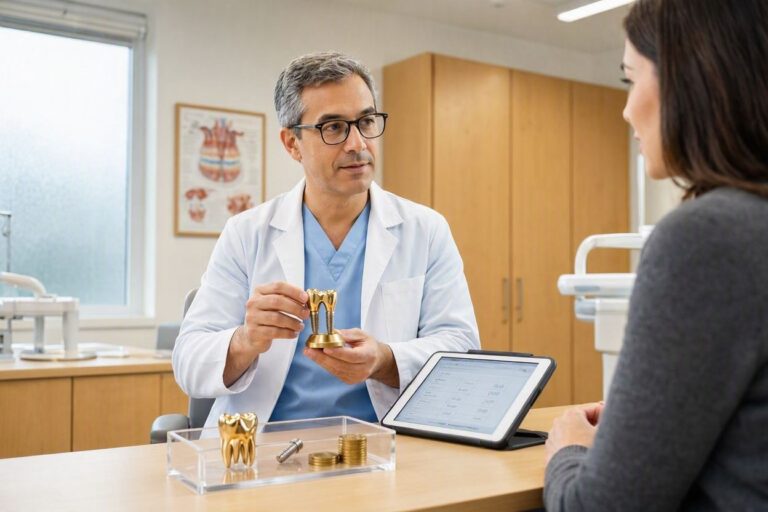
How Much Are Ceramic Dental Implants?
You have researched dental implants and encountered the standard titanium option. Then, in a forum, an advertisement, or a conversation with a holistic dentist, you hear about an alternative: ceramic dental implants. The promise is compelling—a metal-free, white, biocompatible replacement that appeals to patients with metal sensitivities, aesthetic concerns about gray titanium showing through the gum, or a philosophical preference for non-metallic materials. Your next question is immediate and practical. How much does this advanced, seemingly premium option actually cost?
The answer places ceramic implants firmly at the higher end of the implant pricing spectrum. A single ceramic dental implant, complete with the surgical placement, the ceramic abutment, and the final all-ceramic crown, typically ranges from $4,500 to $8,500 per tooth. This represents a premium of approximately 10% to 30% over a comparable titanium implant and crown performed by the same provider. The cost differential is driven by the higher price of the raw zirconia implant fixture, the specialized surgical and prosthetic components required, and the additional chair time and technique sensitivity associated with a material that is harder, more brittle, and less forgiving than titanium.
This guide provides a transparent, detailed breakdown of ceramic dental implant costs. We will explain the material science behind zirconia, the current generation of two-piece and one-piece implant designs, and why the laboratory and clinical handling costs differ from titanium. We will compare the lifetime value proposition, examining the advantages and limitations that justify or undermine the premium price. This is not a sales pitch for ceramic implants. It is an honest, comparative financial analysis for the patient who wants to understand exactly what they are paying for.
The Material: What Is a Ceramic Dental Implant?
When the dental industry says “ceramic implant,” it almost always means zirconia, specifically yttria-stabilized tetragonal zirconia polycrystal, or Y-TZP. This is not the ceramic of your grandmother’s decorative plates. It is a high-performance technical ceramic developed for demanding industrial and medical applications. Zirconia exhibits remarkable flexural strength, fracture toughness, and chemical inertness. It does not corrode in the oral environment. It does not release metal ions. It is naturally tooth-colored, eliminating the risk of dark gray show-through in patients with thin gum tissue.
The first generation of ceramic implants, introduced in the early 2000s, were one-piece designs. The implant and the abutment were milled from a single block of zirconia. This created a monolithic structure with no micro-gap between an implant and a separate abutment, a theoretical advantage for bacterial sealing. However, the one-piece design limited prosthetic flexibility. The implant had to be placed in a position that aligned perfectly with the planned crown contour. If the implant position was even slightly suboptimal, the restorative dentist had limited options to correct the angle. The implant could not be buried under the gum for a submerged healing protocol, which is often preferred for anterior aesthetic cases.
The current state-of-the-art is the two-piece ceramic implant. Like a titanium implant, it consists of a separate implant fixture and a separate abutment, joined by a screw. This design allows for a submerged healing protocol, greater restorative flexibility, and the ability to angle the abutment to compensate for implant positioning. The connection between the implant and abutment is typically a precisely milled friction-fit or a screw-retained interface. However, the two-piece design introduces a micro-gap between components, a site of potential bacterial colonization, and a joint where mechanical complications can occur. The zirconia screw itself is a point of vulnerability, as it lacks the ductility of a titanium screw and can fracture if over-torqued.
Zirconia vs. Titanium: The Material Cost Differential
The manufacturing cost of a zirconia implant fixture is significantly higher than that of a comparable titanium fixture. Titanium implants are produced on highly automated CNC Swiss lathes that mill the metal from rods in seconds. The tooling is standardized, the machining parameters are well-established, and the raw material is, relative to medical-grade zirconia, inexpensive.
A two-piece zirconia implant requires precision milling of a ceramic blank that is harder and more brittle than metal. The milling tools wear faster, the cutting speeds are slower, and the rejection rate for microscopic cracks or dimensional inaccuracies is higher. After milling, the zirconia undergoes a sintering process in a high-temperature furnace, where the material shrinks by approximately 20% as it densifies. This shrinkage must be precisely calculated in the digital design so that the final sintered implant matches the required dimensions. All of this adds manufacturing time, quality control expense, and ultimately a higher unit price that the implant manufacturer charges the dental practice.
A typical titanium implant fixture costs the dental practice between $150 and $350, depending on the brand, volume discounts, and the specific connection design. A comparable zirconia implant fixture costs the practice between $250 and $500. The surgeon marks up this cost to cover inventory, sterilization, and handling. The patient sees the difference reflected in a higher surgical line item.
The All-Inclusive Cost Breakdown
The cost of a ceramic implant, like a titanium implant, is not a single number but a composite of multiple treatment phases. Understanding each line item allows you to compare quotes from different providers and see where the ceramic premium is concentrated.
The diagnostic phase is identical for both materials and typically costs the same. You will pay for the initial consultation, the CBCT scan, and any intraoral digital scans or impressions. These diagnostic fees range from $250 to $600, regardless of the implant material chosen.
The surgical phase is where the ceramic premium first appears. The implant fixture itself costs the surgeon more. Additionally, the surgical placement of a zirconia implant requires a modified technique. Zirconia is more brittle than titanium. The surgeon must achieve higher primary stability through careful, often undersized, osteotomy preparation because the material does not tolerate micromotion during healing as forgivingly as titanium. The insertion torque must be controlled more precisely to avoid fracturing the implant body. These technical demands add chair time, and chair time is billable. The surgical fee for a ceramic implant placement typically ranges from $2,200 to $4,000, compared to $1,800 to $3,500 for a titanium implant from the same surgeon.
The Restorative Phase and Abutment Costs
The restorative phase introduces additional cost considerations specific to ceramics. The abutment, the connector between the implant and the crown, is also made of zirconia in an all-ceramic system. A custom-milled zirconia abutment, fabricated by a dental laboratory, costs the dentist between $200 and $400, and the patient fee ranges from $850 to $1,500. This is comparable to a custom titanium abutment, though some labs charge a premium for zirconia milling due to the same tool wear and sintering challenges.
The implant crown is the most visible component. To maintain the metal-free philosophy, the crown is typically made of layered zirconia, lithium disilicate, or a high-strength ceramic. A screw-retained all-ceramic crown on a ceramic abutment costs between $1,200 and $2,500. If the crown is cemented rather than screw-retained, the fee may be slightly lower, but retrievability is compromised.
Here is the composite cost table for a single ceramic dental implant compared to a standard titanium implant:
| Treatment Phase | Ceramic Implant Cost Range | Titanium Implant Cost Range |
|---|---|---|
| Diagnostic Workup (Consult, CBCT, Scans) | $250 – $600 | $250 – $600 |
| Surgical Placement (Fixture + Surgeon Fee) | $2,200 – $4,000 | $1,800 – $3,500 |
| Custom Abutment (Zirconia or Titanium) | $850 – $1,500 | $850 – $1,500 |
| Implant Crown (All-Ceramic) | $1,200 – $2,500 | $1,200 – $2,500 |
| Total All-Inclusive Fee | $4,500 – $8,600 | $4,100 – $8,100 |
💡 Observation on Pricing Overlap
Notice that the total cost ranges overlap significantly. A complex titanium case placed by an expensive specialist can cost more than a straightforward ceramic case placed by a less expensive provider. The material is only one variable in a multivariable pricing equation. Provider location, surgical complexity, and the need for bone grafting are often more significant cost drivers than the implant material itself.
The Advantages That Justify the Premium
The ceramic implant premium is not an arbitrary surcharge. It buys specific advantages that are clinically meaningful for certain patient populations. Understanding these advantages allows you to decide whether the premium is worth paying in your specific circumstances.
Aesthetic Superiority in Thin Tissue: This is the most cited advantage of ceramic implants. When the gum tissue is thin, a titanium implant can create a visible gray shadow at the gum line. This is particularly problematic in the anterior maxilla, the front upper jaw, where the smile line exposes the gum margin. A white zirconia implant eliminates this aesthetic risk. If your smile displays a high lip line and your gum tissue is thin or translucent, the ceramic premium is an investment in an undetectable restoration.
Metal Allergy and Sensitivity: Some patients report allergic reactions or sensitivities to titanium and other metals used in dental alloys. Documented titanium allergy is rare but real, confirmed by patch testing. More common are patient-reported subjective symptoms associated with metal implants, a phenomenon sometimes labeled as “multiple chemical sensitivity” or galvanic reactions when dissimilar metals are present in the mouth. For these patients, a metal-free alternative is not a preference; it is a medical necessity. Ceramic implants eliminate the variable of metal exposure entirely.
Corrosion Resistance and Ion Release: Titanium implants are considered biocompatible and corrosion-resistant, but they are not entirely inert. Studies have detected titanium ions and particles in the tissues surrounding implants and in distant organs. The clinical significance of this ion release is debated and the subject of ongoing research. For the overwhelming majority of patients, titanium ion release is clinically irrelevant. For a patient who is philosophically committed to the most inert possible restoration, or who has an autoimmune condition that raises concerns about any foreign body burden, ceramic offers a demonstrably lower chemical reactivity.
Plaque Affinity and Soft Tissue Response: Some studies suggest that zirconia surfaces accumulate less plaque biofilm than titanium surfaces. The biological basis involves the surface free energy and the protein adsorption characteristics of zirconia oxide. A cleaner surface correlates with healthier peri-implant soft tissue and a lower risk of peri-implantitis. The clinical significance of this difference remains a topic of debate, and diligent oral hygiene remains the dominant factor in long-term tissue health regardless of implant material.
The Limitations and Risks That Moderate the Value
The ceramic implant is not a universally superior product. It has specific material limitations that introduce risks not present with titanium. These risks factor into the lifetime cost equation. An implant that fails early or requires more frequent prosthetic maintenance erodes the value of the initial premium.
Brittleness and Fracture Risk: Zirconia is strong in compression but brittle in tension. Unlike titanium, which will bend before it breaks, zirconia fractures catastrophically when its limit is exceeded. Implant fractures, while rare in the current generation of well-designed two-piece systems, do occur. A fractured ceramic implant embedded in the jawbone is a clinical nightmare to remove, requiring trephination drills and often substantial bone loss. This complication is exceedingly rare with titanium, which either osseointegrates successfully or fails by mobility, rarely by fracture within the bone.
Screw Loosening and Prosthetic Complications: The zirconia abutment screw in a two-piece system is the weak link. Zirconia screws lack the elongation and plastic deformation properties of titanium screws. They must be torqued to a precise value with a calibrated torque wrench. Even then, screw loosening is reported more frequently in some ceramic implant systems than in established titanium connections. A loose screw requires a dental visit for retightening, which, if not covered under warranty, constitutes an ongoing maintenance cost. A fractured screw inside the implant body can render the entire implant unrestorable, requiring removal.
Limited Clinical Track Record: Titanium implants have over fifty years of clinical data demonstrating survival rates above 95% at ten years. Ceramic implants, particularly the current two-piece designs, have a much shorter and less voluminous evidence base. Early data is encouraging, with survival rates approaching those of titanium in carefully selected cases. But the thirty-year data that exists for titanium simply does not yet exist for ceramic. Choosing ceramic is choosing a technology with a shorter long-term report card.
Insurance and Financing for Ceramic Implants
The insurance landscape for ceramic implants is identical to that for titanium implants, with one added complication: some insurers may classify the ceramic option as an “upgrade” or “non-standard” material and reduce the allowed benefit accordingly. The dental insurance code for the implant fixture, D6010, does not distinguish between titanium and ceramic. However, the insurer’s contracted fee may be based on the assumption of a titanium fixture. If the ceramic fixture exceeds the insurer’s allowable fee for that code, the patient is responsible for the difference, even with an in-network provider.
You must ask the implant surgeon’s billing coordinator: “Does my insurance plan’s allowed fee for D6010 cover the cost of the ceramic implant fixture, or will I be billed the difference as a material upgrade?” A transparent practice will have encountered this question before and will provide a straightforward answer. If the ceramic implant is billed as a separate, non-covered service outside the D6010 code, it becomes fully out-of-pocket, while the abutment and crown may still be covered under the major restorative benefit.
Health Savings Accounts and Flexible Spending Accounts treat ceramic implants identically to titanium implants. Both are IRS-qualified medical expenses. You can use HSA or FSA funds to pay for the entire treatment, including the ceramic-specific premium. If you have a substantial HSA balance, the ceramic upgrade is effectively paid with pre-tax dollars, reducing the real cost by your marginal tax rate.
Conclusion
Ceramic dental implants cost between $4,500 and $8,600 for a complete single-tooth replacement, representing a premium of roughly 10% to 30% over equivalent titanium implants, driven by higher material manufacturing costs and more technique-sensitive surgical and prosthetic protocols. The premium buys demonstrable advantages in aesthetic translucency, metal-free biocompatibility, and potentially reduced plaque affinity, but it comes with a shorter long-term clinical track record and specific mechanical vulnerabilities. The decision is a personal calculus of aesthetic priority, material philosophy, and risk tolerance.
Frequently Asked Questions
Q: Can ceramic implants be used for full-mouth reconstruction?
A: Yes, ceramic implants can be used for full-arch restorations, including implant-supported fixed bridges like All-on-Four or All-on-Six concepts. The prosthetic challenges are greater due to the difficulty of achieving a passively fitting framework on multiple ceramic implants. The cost premium for a full-arch ceramic case over titanium is substantial, often $5,000 to $10,000 more, and few long-term studies exist on this specific application.
Q: Are ceramic implants approved by the FDA?
A: Yes, several zirconia dental implant systems have received FDA clearance. The most established is the Z-Systems ceramic implant, now owned by a larger dental corporation. Other manufacturers, including Straumann with its PURE ceramic implant, offer FDA-cleared two-piece ceramic systems. Always verify the specific implant brand and model your surgeon proposes and confirm its FDA clearance status.
Q: Do ceramic implants require special maintenance compared to titanium?
A: The daily maintenance is identical: brushing, flossing, and regular professional hygiene visits. However, because the prosthetic components are ceramic on ceramic, the risk of screw loosening may be slightly higher. Your dentist should check the abutment screw torque at your annual maintenance visits. Avoid using ultrasonic scalers with metal tips directly on the ceramic implant or abutment, as this can cause surface damage.
Q: If I have a titanium allergy, can a ceramic implant solve the problem?
A: If your allergy is specifically and solely to titanium, a ceramic implant is an excellent solution because it contains no titanium at any stage. However, the diagnosis of titanium allergy should be confirmed by a qualified allergist or dermatologist using standardized patch testing, not self-diagnosed based on vague symptoms. True titanium hypersensitivity is rare, and removing a well-integrated titanium implant based on an unconfirmed allergy may be an unnecessary expense and surgical risk.
Additional Resource:
For scientific literature on zirconia implant materials, visit the International Academy of Ceramic Implantology: https://www.iaoci.com/