How Painful Is a Single Dental Implant?
If you are scheduled for a single dental implant, the question dominating your thoughts is likely a very primal one: how much is this going to hurt? You may have heard stories, ranging from “it was nothing” to “it was the worst pain of my life.” The reality is predictable and, for the vast majority of patients, surprisingly manageable. This guide will provide a brutally honest, day-by-day walkthrough of the pain and discomfort associated with a single dental implant. We will cover the surgery itself, the critical first 48 hours, and the quiet healing phase that follows. This is your comprehensive, realistic guide to what you will actually feel, so you can prepare, manage your discomfort, and walk into your appointment with calm, accurate expectations.
The Surgery Itself: Why You Will Feel No Pain
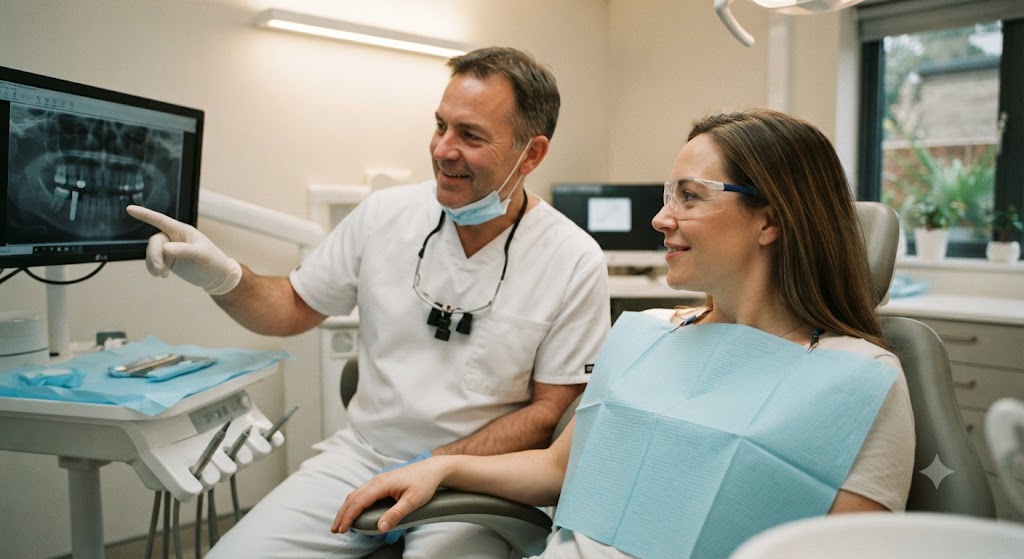
Let me be very direct. The placement of a single dental implant should be a pain-free surgical experience. You will feel strange sensations. You will feel intense pressure. You will hear sounds. You will feel vibration. You will not feel sharp, cutting pain. The entire procedure is performed under profound local anesthesia. Your oral surgeon or periodontist will administer a series of injections of a potent local anesthetic, typically articaine or lidocaine. They will test the site repeatedly by probing your gum. Only when you confirm a complete absence of sharp sensation will the surgery begin.
What you will feel is a deep, pushing, vibration-heavy pressure. This is the sensation of the surgical drills carefully creating a precise channel in your jawbone. It is a disconcerting feeling, but it is not painful. You will also hear the sounds of the drill, similar to a dental filling but with a slightly lower pitch. This is where sedation shines for the anxious patient. If you opt for oral or IV conscious sedation, you will be deeply relaxed and will have little to no memory of these sensations. The critical point is that if at any moment you feel a sharp zing of pain, you must alert the surgeon immediately by raising your hand. They will stop instantly and administer more local anesthetic. The surgery for a single implant is remarkably fast, often completed in 30 to 45 minutes from the first incision to the last suture. You will be shocked when they tell you it is done.
Hours 2-6 After Surgery: The Numbness and The First Ache
You will leave the dental office profoundly numb. Your lip, chin, tongue, and cheek will feel thick and wooden. The local anesthetic lasts for 2 to 4 hours. This is your window to get home, settle in, and take your first dose of pain medication. You must take the medication before the numbness completely wears off. This is the single most critical strategy for pain control. If you wait until you are in full-blown pain, you are chasing the pain and it will be much harder to control.
As the anesthetic slowly fades, a deep, throbbing ache will begin to build at the surgical site. It is not a sharp, stabbing pain. Patients describe it as feeling like a deep bruise in the jaw, or the persistent ache you feel a few days after a hard workout. It is a dull, constant, sore throb. For a single, straightforward implant with no major grafting, this initial pain is typically rated as a 2 or 3 out of 10 on a pain scale. It is annoying, not incapacitating. The prescription-strength ibuprofen (600mg to 800mg) that your surgeon has prescribed is the most effective medication for this type of inflammatory pain.
Day 1 to Day 3: The Peak of Discomfort
The post-operative discomfort will peak at around 24 to 72 hours after the surgery. You will wake up on the second morning feeling stiff and sore. Swelling will be at its maximum. Your cheek may look visibly puffy. Some patients develop a small bruise, a yellowish or purple discoloration on the skin over the jaw. This is a normal, harmless seepage of a small amount of blood into the tissues and is nothing to be alarmed about.
During this peak period, you manage the discomfort with a strict, scheduled regimen of anti-inflammatory medication. The most effective strategy is alternating ibuprofen and acetaminophen (Tylenol) every 3 to 4 hours, as prescribed. An ice pack is your best friend. Apply it to your cheek in 20-minute on, 20-minute off cycles. The cold constricts blood vessels, reduces swelling, and has a direct, local numbing effect. You will be on a diet of soft, cool foods. Yogurt, smoothies, protein shakes, and lukewarm soup are perfect. The key is to stay ahead of the pain. Take your medicine on schedule, even if you must set an alarm. By the end of day three, the sharp edge of the discomfort has passed, and the pain is transitioning into a localized soreness.
Day 4 to Day 7: Turning the Corner
By day four, you have turned a corner. The throbbing pain is gone, replaced by a dull, stiff soreness directly at the implant site. It hurts if you poke your cheek with your finger, but it does not hurt as a constant, gnawing presence. You will likely be off your prescription pain medication and managing any residual discomfort with over-the-counter ibuprofen as needed. The swelling begins to recede noticeably.
The stitches may start to feel a little irritating as the tissue heals, like a small, scratchy thread. This is normal. Do not poke at them with your tongue. You will begin to transition to slightly more textured soft foods, like scrambled eggs or mashed potatoes. The key milestone at the end of this week is that you are feeling significantly better, and your surgical site is no longer a central, consuming focus of your attention. If you have a desk job, you were likely able to return to work on day two or three. If you do heavy physical labor, you need to wait until the end of this week.
Week 2 to Osseointegration: The Pain-Free Phase
After the first 7 to 10 days, when the sutures are removed or have dissolved, the pain experience of a single dental implant is completely over. You will have zero pain. The gum tissue heals rapidly. The implant, now buried under your gum, enters a silent, biologically active phase called osseointegration. Your living bone cells are growing onto the microscopically roughened surface of the titanium implant. You have no sensation of this whatsoever. For the next three to six months, the implant site is a non-issue. The only potential for pain during this phase is if a rare, late infection develops, which would present as a sudden, painful swelling. This is an uncommon complication that requires an immediate call to your surgeon.
The Uncovery and Restoration: A Minor Event
Months later, when the implant is ready for a tooth, you return for a brief, minor procedure to uncover the top of the implant and place a healing abutment. This is a very minor event. It is done under local anesthesia. The surgeon makes a tiny incision to expose the implant cover screw, removes it, and screws in a small metal post that pokes through the gum. This procedure takes 10 minutes and causes minimal, if any, post-operative pain. It is akin to a mild gum irritation and resolves in a day. The final steps of taking impressions and cementing the crown are completely non-surgical and painless.
Conclusion
A single dental implant surgery is a painless procedure due to profound local anesthesia, leaving you with only a deep, non-painful sensation of pressure and vibration during the placement. The post-operative recovery involves a predictable, manageable peak of dull, aching discomfort in the first 48 to 72 hours, which is highly responsive to a scheduled regimen of high-dose ibuprofen and ice therapy. By the end of the first week, the pain has resolved into a localized soreness, and you then enter a completely pain-free, months-long osseointegration phase, making the overall experience far less painful than the fear that precedes it.
Frequently Asked Questions
Is a single implant more painful than a tooth extraction?
Most patients report that a single implant is significantly less painful than having a tooth extracted. An extraction is a traumatic removal. An implant is a controlled, gentle placement into a prepared site. The post-operative pain is typically milder and shorter in duration.
I’m terrified of dental pain. What is the best sedation option?
Intravenous (IV) conscious sedation is the most profound and effective form of anxiety and pain control for an awake patient. You will be deeply relaxed and will have complete or near-complete amnesia of the procedure. Combined with thorough local anesthesia, it guarantees a painless, stress-free experience.
Can I go back to work the next day?
For a straightforward single implant, most patients with a non-physical job return to work the day after surgery. You will have some mild swelling and soreness, but you should be fully functional. Have a soft lunch packed and continue your scheduled ibuprofen.
What if the pain is getting worse after day three?
This is a red flag and not normal. Pain that is increasing in intensity after day three, rather than subsiding, could indicate a dry socket (if an extraction was simultaneous), an infection, or a wound dehiscence. You must call your surgeon immediately for an evaluation.
How soon can I eat normally after a single implant?
You should stick to a soft diet for the first week. Avoid chewing on the implant side completely until the sutures are out and the gum is healed. After that, you can gradually resume a more normal diet, but you must protect the site from direct, hard chewing forces until the implant is fully integrated and the final crown is placed.
Additional Resource: Link
For more information on managing dental anxiety and understanding sedation options, a valuable resource for patients is the Dental Fear Central website. Visit Dental Fear Central