What Is the Purpose of Tiny Dental Implants?
You may have heard the term “mini dental implant” or “tiny dental implant” and wondered what these small-diameter devices are actually for. They seem like a lesser version of a standard implant, a compromise. The reality is that they are not a compromise; they are a distinct category of dental implant with a highly specific and valuable purpose. This guide will explore the true role of tiny dental implants in modern dentistry. We will define what they are, explain their primary clinical applications, particularly in stabilizing loose dentures, and clearly distinguish them from conventional implants. This is your in-depth resource for understanding exactly why a dentist might recommend a mini implant and how this small device can deliver a life-changing improvement in function and quality of life.
Defining a Tiny Dental Implant: What “Mini” Really Means
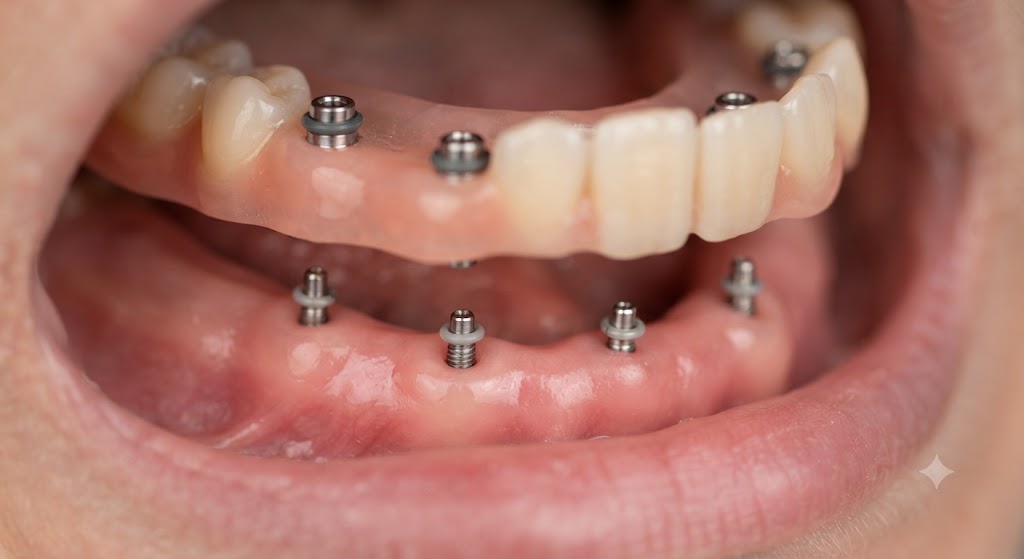
A tiny, or mini, dental implant is officially defined by its diameter. A standard conventional dental implant has a diameter of 3.5mm or greater. A mini dental implant is a solid, one-piece titanium alloy screw with a diameter of less than 3.0mm, most commonly ranging from 1.8mm to 2.9mm. This is a significantly narrower device. This small diameter is the defining feature and the source of its unique advantages and limitations. Unlike a standard two-piece implant, where the root-form body and the abutment are separate components joined by a screw, a mini implant is a single, solid piece. The top of the implant has a ball-shaped, square, or rubber O-ring retaining head that protrudes above the gum line. This head is designed to snap into a corresponding female attachment embedded in the base of a denture.
The surgical placement is fundamentally less invasive because the implant is so narrow. It is often placed directly through the gum tissue, like a small self-tapping screw, without making a large flap incision. This is why it is sometimes referred to as a “narrow-diameter implant” or a “small-diameter implant.” It is crucial to understand that mini implants are not simply cheap alternatives to standard implants for single-tooth replacement. Their optimal, evidence-based purpose is specific.
The Primary Purpose: Stabilizing a Loose Lower Denture
The single most common, successful, and life-changing purpose of tiny dental implants is to provide stability for a removable, full lower denture. This is the clinical application where mini implants truly excel. If you are a denture wearer, you know the misery of a loose, floating lower denture. The lower ridge of bone, once the teeth are gone, resorbs over time and becomes a flat, knife-edged shelf. There is no suction, no stable platform. The denture slides, lifts, and makes chewing difficult and speaking a constant worry.
The placement of just two to four mini implants in the front of the lower jaw transforms this situation. The small implants are placed in a single, short appointment. The corresponding O-ring housings are placed inside the underside of the existing or a new denture. When the patient puts the denture in, it snaps firmly and securely onto the mini implant heads. It is held in place. It does not move while eating or speaking. The patient can pull it out at night for cleaning, but during the day, it is a stable, functional, and confident restoration. This procedure is minimally invasive, often suitable for patients with significant bone loss who would require a major graft for standard implants, and is performed at a fraction of the cost of a fixed, full-arch bridge on standard implants. It is a transformative, accessible solution for the struggling denture patient.
Denture Retention for the Upper Jaw
Mini implants can also be used to retain an upper denture, but the design is often different. An upper denture gains substantial retention from the suction against the large, flat surface of the palate. The primary problem with an upper denture is the bulk and the triggering of the gag reflex from a plate that covers the entire roof of the mouth. By placing four to six mini implants, a horseshoe-shaped upper denture can be fabricated or modified. The mini implants snap into the denture and allow the dentist to significantly reduce or even eliminate the palatal coverage. The patient gains a more open, natural-feeling palate, the ability to taste food better, and a secure, non-floating denture. This is a distinct advantage over a conventional upper denture and dramatically improves patient comfort.
Temporary Anchorage in Orthodontics
Mini implants have a brilliant, off-label but widely accepted use in orthodontics. In this context, they are called Temporary Anchorage Devices, or TADs. An orthodontist wants to move a specific tooth in a very specific direction without moving any other teeth. This is difficult to achieve with conventional braces alone, as Newton’s third law—for every action, there is an equal and opposite reaction—applies. To pull one tooth back, you must push against another tooth, which often moves that tooth forward.
A TAD solves this problem. The orthodontist places a mini implant between the roots of teeth, into a small patch of jawbone, under local anesthesia. This mini implant becomes an immovable, fixed anchor. An elastic chain is attached from the TAD to the tooth that needs moving. The TAD provides an absolute, stationary anchorage point, allowing the orthodontist to move the target tooth efficiently, without any unwanted movement of the other teeth. Once the orthodontic movement is complete, the TAD is simply unscrewed and removed. It is a small, temporary screw that eliminates the need for headgear or complex, unesthetic elastic configurations.
Single Tooth Replacement: A Narrow Indication
This is a point of significant controversy and requires an honest, evidence-based perspective. Some dentists use mini implants to replace a single small tooth, particularly a lower incisor or a maxillary lateral incisor in a very narrow space where a standard-diameter implant would not fit. A standard implant requires at least 1.0mm of bone on either side of the implant and between it and an adjacent tooth root. If the space is congenitally narrow, a 1.8mm or 2.4mm mini implant may be the only surgical option for a fixed tooth replacement without orthodontic space opening.
The critical risk with this use is long-term mechanical fatigue fracture. A single tooth on a mini implant is subjected to all the lateral, torquing forces of chewing, and the mini implant’s narrow diameter creates a point of potential metal fatigue. The scientific literature reports a significantly higher fracture rate and a lower long-term survival rate for mini implants used for single-tooth replacement compared to standard implants. For this reason, the standard of care, whenever anatomically possible, is to orthodontically open enough space and place a standard-diameter implant. A mini implant for a single tooth is a compromise solution for a specific anatomical problem, and the patient must be fully informed of the mechanical risks.
The Advantages: Why Choose a Mini Implant Over a Standard Implant?
The advantages of a mini implant, in its correct clinical context, are clear. The surgery is truly minimally invasive. The implant is placed through the gum, often with no flap, no stitches, and minimal bleeding. The post-operative pain is minimal. The procedure is fast. Two to four mini implants can be placed in less than an hour. Because the implant is so narrow, it can often be placed in a ridge of bone that is too thin for a standard implant, without a bone graft. This makes it an accessible solution for the atrophied lower jaw. The cost is significantly lower. A mini-implant-retained overdenture is a fraction of the cost of a fixed, full-arch implant bridge. For the elderly, medically compromised, or financially limited patient with a loose lower denture, this is a profoundly beneficial solution that improves nutrition, social confidence, and quality of life.
The Limitations: What a Mini Implant Cannot Do
A mini implant cannot and should not be used as a direct substitute for a standard implant in a standard case. It is not the right tool for replacing a molar, a tooth that absorbs the highest forces in the mouth. It cannot support a heavy, fixed bridge. It is not designed to be a permanent, single-tooth anchor in an area of high force. The O-ring attachments that retain the denture are consumable and will wear out over time, requiring periodic replacement, which is a routine, quick in-office procedure. The patient must understand that the mini implant overdenture is a removable prosthesis that is now remarkably stable, not a fixed, non-removable set of teeth.
Conclusion
The purpose of tiny dental implants is primarily to provide a minimally invasive, affordable, and life-changing solution for stabilizing a loose, uncomfortable lower denture, snapping it securely into place on a few small-diameter implants and dramatically restoring a patient’s ability to chew and speak with confidence. They also serve as powerful temporary anchorage devices in orthodontics, enabling precise tooth movement without unwanted side effects. While they can be used as a compromise solution for replacing a single small tooth in an extremely narrow space, their true, evidence-based strength is in retention and anchorage, not in bearing heavy, long-term, single-tooth chewing forces.
Frequently Asked Questions
How long do mini dental implants last?
When used for denture retention, mini implants have a high survival rate, with studies showing survival rates above 90% at five to ten years. Their longevity depends on patient health, bone quality, and meticulous oral hygiene. The O-ring attachments wear out and are replaced every 1-2 years.
Can I sleep with my mini implant denture?
No. The denture is removable. You must take it out at night. The gum tissue and the implants need a rest period without the constant contact and pressure of the denture. You clean the denture and brush the implant heads gently with a soft toothbrush.
Are mini implants painful to place?
The procedure is minimally invasive and is performed under local anesthesia. You will feel pressure but no pain. Post-operative discomfort is typically very mild, often requiring only over-the-counter pain relievers for a day or two.
Can mini implants be used to support a fixed bridge that I don’t take out?
No. Mini implants are almost always designed for removable overdentures. They are not designed to bear the constant, non-removable load of a fixed bridge. A fixed bridge requires the larger diameter and the two-piece structural connection of standard implants.
I was told I don’t have enough bone for implants. Will mini implants work for me?
Very possibly, especially in the lower jaw. Because mini implants are so narrow, they can often be placed in a thin ridge of bone that would be insufficient for a standard-diameter implant. Your surgeon will assess this with a CT scan. This is the core value proposition of mini implants in atrophied jaws.
Additional Resource: Link
For more detailed information on mini dental implants as a denture stabilization solution, you can explore the patient resources provided by the International Congress of Oral Implantologists. Visit the ICOI Patient Page