Implant Screw Fell Off: Causes & Solutions
The moment is unsettling. You are eating, brushing your teeth, or simply running your tongue over your implant crown, and you feel something move. A tiny, hard piece of metal is in your mouth, or the crown itself is suddenly loose, wobbling on its base. The implant screw, the internal connector that holds the visible tooth to the titanium root buried in your bone, has loosened or, in the worst case, fractured. Your heart sinks. The fear is immediate: has my implant failed? In the vast majority of cases, the answer is no. The implant fixture, the part in the bone, is perfectly healthy. The failure is in the mechanical connection, and this is a manageable, solvable problem. This guide is a calm, clear, sequential manual for exactly what to do when your implant screw falls off or your crown loosens. It explains the precise causes of abutment screw loosening and fracture, the immediate steps you must take to protect the implant, and the professional solutions your dentist will employ to restore your tooth, often in a single, straightforward appointment.
The Anatomy of the Problem: What Exactly Came Off?
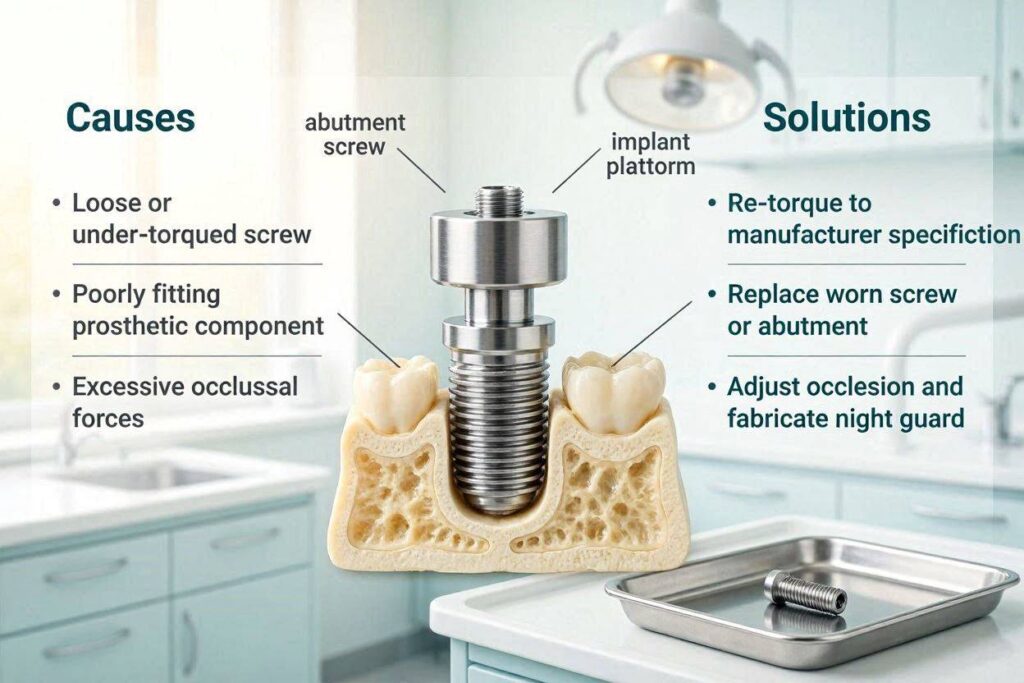
Your understanding of what happened determines the urgency of your response. The dental implant is a three-part system. The implant fixture is the screw-shaped titanium post deep in the bone. The abutment is the connector piece that is screwed into the fixture. The crown is the visible tooth, cemented or screwed onto the abutment.
When a patient says “my implant screw fell off,” one of three things has occurred:
- The Abutment Screw Loosened: This is the most common scenario. The tiny, internal titanium or gold-plated screw that clamps the abutment to the fixture has unscrewed itself. The abutment and the crown, as a single unit, feel loose and may even lift out of the implant. You may feel the loose components in your mouth. This is a mechanical, not a biological, failure.
- The Crown Came Loose (Cement Failure): The crown was cemented onto the abutment. The cement bond has failed, and the crown has come off. The abutment is still firmly screwed into the implant. You will see the metal abutment post still attached in your mouth when you remove the loose crown.
- The Abutment Screw Fractured: A much more serious, but rarer, event. The internal screw has snapped. The broken fragment remains deep inside the threaded channel of the implant fixture. The abutment and crown are loose or have come out, but you cannot simply screw them back in. This requires a skilled retrieval.
The Immediate Steps: What You Must Do Right Now
Your actions in the first few minutes are critical to preventing damage to the underlying implant and ensuring the most straightforward repair.
Step 1: Do Not Panic. Retrieve the Components. Calmly remove the loose crown, abutment, or screw fragment from your mouth. Do not swallow it. Place all the retrieved pieces in a small, clean, secure container—a small jar, a contact lens case, or a zip-lock bag. Bring this container to your dentist.
Step 2: Inspect the Implant Site in Your Mouth. Look in the mirror. You will see a metal post (the abutment) still attached, or you will see a small hole in the gum with a metal platform at the bottom (the top of the implant fixture). This is the implant body. It should be clean, non-bleeding, and not painful.
Step 3: Protect the Implant Immediately. If the abutment and crown are completely out and the implant fixture’s internal connection is exposed, you must protect it. The open screw channel is a direct route for bacteria, food debris, and saliva to enter the implant and the surrounding bone. If you have access to a pharmacy, obtain some sterile cotton pellets or a small piece of clean gauze. Roll it into a tiny ball and gently place it over the implant hole. Do not pack it tightly. The goal is to cover the opening. You can also place a small amount of dental wax or even sugar-free chewing gum over the hole as a temporary seal. Then, call your dentist immediately.
Step 4: Do Not Attempt to Glue It Back Yourself. Under no circumstances should you use super glue, household adhesive, or any other glue to try and reattach the crown or abutment. This will irreversibly damage the implant’s internal connection and the prosthetic components, transforming a simple screw tightening into a complex, costly, and possibly destructive salvage procedure.
Step 5: Do Not Chew on That Side. The exposed implant fixture is stable in the bone but is not designed to bear direct chewing force without the protective abutment and crown. Chewing on a bare implant can damage the internal threads or overload the bone.
The Dental Visit: Professional Diagnosis and Repair
Your dentist will see you for an emergency appointment. The diagnosis and repair follow a logical, step-by-step protocol.
Diagnosis
The dentist will examine the retrieved components and the implant site. A small periapical X-ray is taken to assess the implant fixture, the bone level, and to see if there is a retained screw fragment in the channel. The dentist will visually inspect the abutment screw. Is it intact and simply unscrewed, or is it fractured? The distinction is everything.
The Simple Solution: Re-Tightening a Loose Abutment Screw
If the screw is intact, the solution is straightforward. The dentist will clean and disinfect the internal connection of the implant with chlorhexidine. They will inspect the abutment and the crown for any damage. The abutment is re-seated into the implant. Using a calibrated torque wrench, the dentist tightens the abutment screw to the precise manufacturer-specified torque, typically 25-35 Ncm. This torque is critical. The screw is a precision fastener that acts as a spring. It must be stretched to its exact design tension to clamp the components together and resist loosening. The screw access hole is sealed with sterile PTFE tape and a small composite filling. The entire procedure takes 15 to 20 minutes. It is often done without anesthesia.
The Complex Solution: Retrieving a Fractured Abutment Screw
If the screw has fractured, a small piece remains deep in the implant’s threaded shaft. This is a technically delicate procedure. The dentist will use a surgical microscope or high-magnification loupes. They will attempt to engage the broken fragment with a specialized ultrasonic instrument or a specific screw retrieval kit. The fragment is gently, patiently vibrated and rotated out. This preserves the implant’s internal threads. Once the fragment is removed and the implant channel is inspected and cleaned, a new abutment screw and abutment can be placed and torqued. If the broken fragment cannot be removed, the implant is compromised. The screw channel threads may be stripped and irreparable. In this worst-case scenario, the implant fixture may need to be surgically removed and replaced in the future.
The Root Causes of Screw Loosening and Fracture
Understanding why the screw loosened is the key to preventing a recurrence.
- Inadequate Torque at Placement: The most common cause. If the screw was not torqued to the manufacturer’s specification at the initial delivery, the joint was preload-deficient. It was never fully tight.
- Excessive Occlusal Forces (Bruxism/Grinding): A heavy bite, grinding, or clenching generates lateral forces that far exceed the screw’s fatigue limit. The screw stretches, loses preload, and loosens. This is the primary functional cause.
- Poorly Fitting Restoration: If the crown does not fit passively onto the abutment or the abutment does not seat perfectly into the implant, there is a gap. Any micro-movement under load will focus stress on the screw.
- Screw Material Fatigue: Over many years of cyclic loading, the metal of the screw can simply fatigue and fracture. This is a long-term mechanical wear process, analogous to a metal part failing in an engine.
- Lack of a Protective Occlusal Guard: A patient with a known grinding habit who does not wear a custom-fitted night guard is at dramatically higher risk of screw loosening and fracture.
Prevention: The Long-Term Solution
Once the screw has been re-tightened or replaced, the focus shifts to prevention. Your dentist will meticulously check and adjust the bite. There must be no heavy contacts or lateral interferences on the implant crown. A slight, light occlusal contact in maximum intercuspation, with immediate disclusion in lateral movements, is the protective occlusal scheme. If you have any signs of bruxism—worn teeth, morning jaw soreness, scalloped tongue—your dentist will strongly recommend a custom-fitted, hard, full-coverage occlusal guard to be worn every night. This guard is an insurance policy for your implant mechanics. You must also maintain excellent oral hygiene, as peri-implant inflammation can contribute to the overall loss of tissue support.
Conclusion
When an implant screw falls off, the loose crown and abutment must be immediately retrieved, the exposed implant fixture sealed with a clean cotton pellet, and an emergency dental appointment scheduled to determine if the abutment screw has simply loosened, which requires a simple 15-minute re-torquing, or has fractured, requiring a skilled retrieval procedure. The root cause is almost always mechanical—inadequate initial torque, excessive bite forces, or bruxism—and the long-term prevention is a precisely adjusted bite and a protective night guard. This is a manageable, solvable mechanical event, not a failure of the implant itself.
Frequently Asked Questions
Is a loose implant screw an emergency?
It is not a life-threatening emergency, but it is an urgent dental situation. You should see your dentist within 24 to 48 hours. The exposed internal connection is vulnerable to bacterial contamination and debris impaction. Delaying can make the repair more difficult.
Can I just screw the implant crown back on myself?
No. You do not have the sterile environment, the knowledge of the correct torque specification, or the ability to verify the internal fit. An untrained attempt to screw it back in can cross-thread the screw, strip the implant’s internal threads, or leave it undertorqued, guaranteeing another failure. This is a professional procedure.
Will the dentist need to replace the entire implant?
In the vast majority of cases of a loose screw, absolutely not. The implant fixture in the bone is healthy and fully integrated. The repair is only to the prosthetic screw and possibly the abutment and crown. If the internal threads of the implant are stripped or a broken screw fragment cannot be retrieved, the implant itself may be compromised, but this is a rare outcome.
How can I tell if my implant screw is getting loose?
The early warning signs are subtle. You may feel a slight clicking, a rocking sensation, or a very fine vibration when you bite down on the implant tooth. You may notice a small, unexplained change in the fit of the crown. If you feel anything unusual, see your dentist immediately for a simple, preventive screw torque check.
Additional Resource:
For further information on the long-term maintenance and mechanical aspects of implant restorations, visit the patient resources page of the American College of Prosthodontists at www.gotoapro.org.
Disclaimer: This article provides general guidance for a common mechanical complication. Your specific implant system, restoration design, and individual situation require a professional clinical evaluation. Always consult your implant dentist immediately if you experience any looseness in your implant restoration.