What Are My Sedation Options for a Root Canal?
It starts with a slight twinge when you drink something cold. Then, it becomes a dull, persistent ache that simply refuses to fade. You finally visit the dentist, hoping for a small filling, but instead, you hear the two words that strike more fear than almost anything else in medicine: root canal.
If your heart rate just increased simply reading those words, take a deep breath. You are not alone. Millions of people experience dental anxiety, and a root canal is often the pinnacle of that fear. However, the reality of modern dentistry has changed dramatically. The procedure, which saves your natural tooth rather than removing it, is not the painful ordeal of old stereotypes. In fact, the entire goal of modern endodontics is to relieve your pain, not cause it.
But knowing the clinical facts does not always calm the racing heart or the sweaty palms. This is precisely where sedation dentistry bridges the gap. The question you need answered is not just “Do I need a root canal?” but rather, “What are my sedation options for a root canal?” Choosing the right sedation transforms a potentially traumatic experience into a boring, relaxed, and even sleepy appointment. This comprehensive guide will walk you through every realistic option available, from the mildest form of relaxation to completely sleeping through the treatment, so you can make the best decision for your comfort.
Understanding the Real Need for Sedation During a Root Canal
Before diving into the specific medications, it is important to understand why sedation pairs perfectly with this particular procedure. A root canal involves cleaning infected tissue from deep inside the tooth. The anatomy of the tooth contains tiny canals that require precision and time. You do not just need numbness; you need to be physically still and emotionally calm for an extended period.
The Biological Barrier: Local Anesthetics vs. Inflammation
Local anesthesia, the numbing shot, is a marvel of modern science. It blocks the pain signals from the nerve. However, it does not address the psychological fear of needles, the sound of the drill, or the sensation of vibration. Furthermore, in the presence of severe infection and inflammation—the “hot tooth”—the local tissue chemistry changes. The pH drops, and the anesthetic molecules struggle to work effectively. It can sometimes feel like the tooth simply will not go numb.
Here is where sedation creates a success loop. Sedation calms the central nervous system. This lowers your metabolism and reduces the acidity in the inflamed tissue, allowing the local anesthetic to perform its job flawlessly. The fear of “not getting numb” is often the greatest driver of anxiety. Sedation guarantees that the numbing process happens while you simply do not care.
The Mind-Body Connection
Dental anxiety is a visceral, physical reaction. The sound of instruments can trigger a surge of adrenaline that accelerates your heart rate. Flinching, a protective reflex, can compromise the precision of the doctor. Sedation breaks this cycle. It dulls the amygdala, the brain’s fear center, preventing that chemical cascade of stress. This is not about being “weak” or having a low pain tolerance. It is a medically recognized strategy to facilitate necessary healthcare.
Defining the Continuum of Consciousness
Sedation is not a simple on-or-off switch. It exists on a spectrum defined by the American Society of Anesthesiologists. Understanding these levels helps you gauge exactly “What are my sedation options for a root canal?” without confusion.
Minimal Sedation (Anxiolysis)
You are awake, relaxed, but fully responsive. You can answer questions and breathe independently. Reaction times may be slightly impaired, but all protective reflexes remain intact. You may feel a warm, floating sensation but remember the appointment.
Moderate Sedation (Conscious Sedation)
Often called twilight sleep. You are deeply relaxed. You may slur your words, feel heavy, and likely forget large portions of the procedure. You respond purposefully to verbal commands or light touch. Your breathing remains stable without assistance. This is the sweet spot for many patients.
Deep Sedation
You are on the edge of consciousness. You cannot respond easily to stimulation and may require help maintaining your airway. You will remember almost nothing. This is a medically induced state very close to general anesthesia.
General Anesthesia
You are completely unconscious. Your protective reflexes stop. You require a breathing tube or advanced airway management. This state is typically reserved for hospital settings or surgical centers.
Exploring Your Paths to Comfort: The Main Options
When you ask your endodontist, “What are my sedation options for a root canal?”, they will likely outline a tiered approach. We will break down each tier based on the delivery method and intensity, allowing you to match your anxiety level to the technique.
Oral Sedation: The Magic Pill Approach
Oral sedation remains the most common intermediate option between nitrous oxide and intravenous sedation. It is needle-free, making it instantly appealing to those with a fear of injections. The concept is simple: you take a prescribed pill before your appointment.
The Medications at a Glance
The landscape of oral sedatives has evolved. While Valium (diazepam) was the historic standard, modern dentistry favors shorter-acting, more targeted drugs.
Benzodiazepines: The Gold Standard
This class of drugs triggers the release of GABA, an inhibitory neurotransmitter that turns down the volume of nerve activity in your brain.
- Triazolam (Halcion): This is the workhorse of pill sedation. It is potent, kicks in rapidly (about 30 to 60 minutes), and has a short half-life. It also has a mild amnesic effect—a gift for those who want to forget the sounds of the instruments entirely. Doctors usually prescribe a dose the night before to ensure a restful sleep, with a second dose scheduled one hour before the appointment.
- Lorazepam (Ativan) and Diazepam (Valium): These are longer-acting drugs. Doctors often use them for more complex, lengthy procedures or for patients with extreme anxiety who need calming that extends well beyond the appointment’s end. The longer half-life means you will require a dedicated driver not just for safety, but because you likely will remain groggy for several hours.
- Hydroxyzine: This is an antihistamine with strong anti-anxiety effects. It is an excellent alternative for patients with a history of substance abuse because it has zero habit-forming potential. It lacks the amnesic effect but provides substantial relaxation.
The Dosage Protocol: Fixed vs. Titration
This is a critical safety distinction. Unlike an IV, where the doctor can slowly drip medicine until you hit the ideal level, a pill is a fixed dose. Once you swallow it, you lock in the effect. Some providers offer incremental oral sedation, where you take a small dose in the office, wait, and take another if the effect is insufficient. However, the peak effect remains difficult to predict precisely due to your metabolism.
Who is this for?
Oral sedation suits the patient who feels anxious walking through the door, dreads the feeling of IV placement, and needs more than laughing gas but does not necessarily need to be “asleep.” It manages moderate to high anxiety effectively.
Inhalation Sedation: Laughing Gas and the Art of Control
Nitrous oxide has survived over 150 years of medical history for a simple reason: it works beautifully with a massive safety margin. If you are looking for a fleeting, gentle calm that allows you to drive yourself home, this is the option.
The Mechanics of the Experience
A small mask rests over your nose. Within minutes, a sweet, faintly pleasant smell signals the entry of a mixture of nitrous oxide and oxygen. Your limbs feel heavy and warm. You may notice a floating sensation or a disconnection from the sharp, clinical edges of the room. Sounds fade into the background.
The genius of nitrous oxide is its rapid titratability. The dentist controls the percentage in real time. If the procedure enters a noisy phase, they can ramp it from 30% to 50%. The moment the sensitive work concludes, they flush the system with 100% oxygen.
The Metaphor of the Radio Dial
Think of your anxiety as a loud radio static playing in your head. Local anesthetic alone numbs the tooth, but the radio plays on. Nitrous oxide acts like a volume knob. You simply turn down the static. You hear the music of your own breathing instead of the drill. Then, you turn the knob back up, and the drug exits your lungs, unmetabolized, within five minutes.
The Unique Role of Oxygen
Unlike pills that depress the entire system, nitrous oxide mixes with at least 30% oxygen—more than you breathe in ambient air. This makes it the only sedation method that is actively oxygenating your blood during the root canal. For patients with cardiovascular concerns or those who simply hate the “hangover” feeling, this clean exit strategy is unbeatable.
Intravenous (IV) Sedation: The Deep Twilight
When the thought of sitting in the chair creates a visceral panic, even the thought of staying awake is too much. This is the realm of IV sedation, often marketed as “twilight sleep.”
Bypassing the Digestive Lottery
Pills must survive the acid of your stomach and the first pass of your liver. A percentage of the drug gets destroyed before it reaches your brain. IV sedation delivers medication directly into the bloodstream with 100% bioavailability. The onset is measured in seconds, not minutes.
The Amnesic Cocoon
The primary drug used in IV sedation is often Midazolam, a benzodiazepine with an extremely powerful short-term memory erasure effect. You will not simply not care during the procedure; you will create no conscious memory of the file passing up the canal. This is called anterograde amnesia. Patients often open their eyes at the end, look at the doctor, and ask with genuine surprise, “When are we starting?”
The Safety Profile: A Vital Distinction
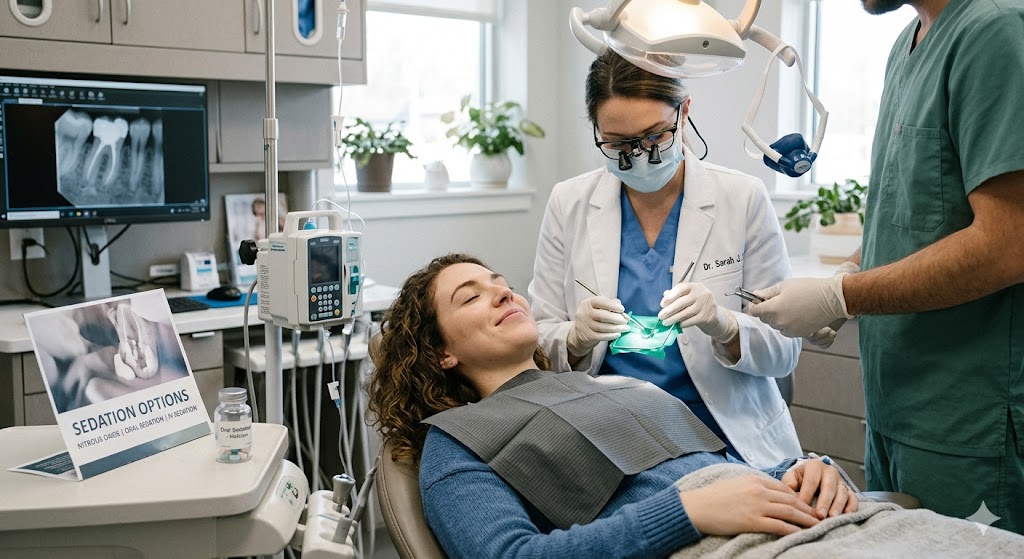
This level of care requires a team with advanced training. At least two operators should be present: the endodontist performing the root canal and a dedicated registered nurse or auxiliary monitoring your vitals. The monitors track blood pressure, pulse oximetry (oxygen levels in your blood), and heart rhythm continuously.
Vital Safety Note: IV sedation can drift you into a deeper plane than intended. You need a provider who can rescue you from a deeper level of sedation. The classic phrase is “If you can rescue them, you can sedate them.” Always verify that your endodontist or the visiting anesthesiologist holds a permit for deep sedation or general anesthesia, not just minimal oral sedation.
General Anesthesia: Full Unconsciousness in the Right Setting
It is crucial to distinguish between deep IV sedation and true general anesthesia. In a fully anesthetized state, your airway reflexes fail. An endotracheal tube secures your breathing.
When a Root Canal Justifies This Level
This is rarely the first line for a standard molar root canal in an adult. However, it becomes the ethical standard for specific populations:
- Patients with severe special needs (autism, dementia, extreme uncontrollable movement disorders) who cannot cooperate for even a second.
- Young children requiring pulpal therapy (a “baby root canal”) who cannot comprehend the need to stay still.
- Complex physical obstructions where airway protection is medically mandated.
In these scenarios, a dental anesthesiologist brings a mobile surgical suite to a specialized dental office or the treatment occurs in a hospital operating room.
Complementary Techniques: The Non-Chemical Toolbox
No discussion answering “What are my sedation options for a root canal?” is complete without the behavioral and digital tools that amplify chemical sedation.
The Psychology of The Wand
A significant portion of the trauma surrounding root canals centers on the “palatal injection.” Traditional syringes rely on high pressure to force fluid into dense tissue. The computer-controlled local anesthetic delivery system, often branded as “The Wand,” drips the fluid ahead of the needle tip, creating a pathway of numbness. It eliminates the burning, pressure sensation. Pairing The Wand with nitrous oxide creates a nearly perception-free onset of numbness.
Digital Sensory Submersion
Domestic audiovisual technology has revolutionized the chair. Active noise-canceling headphones (Bose or Sony variants) can erase the specific high-frequency whine of the endodontic rotary file. Placing a virtual reality headset that plays a slow-motion underwater landscape shifts the brain’s sensory bandwidth away from auditory fear triggers toward visual calm.
Pre-Operative Pharmacology Anxiety
A root canal infection often hurts worse at night, preventing sleep. Suffering through three sleepless nights before an appointment primes the nervous system for hysteria. A short-term, low-dose corticosteroid pack (like a Medrol Dosepak) prescribed a day or two before the procedure can dramatically reduce periapical inflammation, making it easier to anesthetize and reducing the need for heavy sedatives.
A Detailed Comparative Analysis of Sedation Modalities
To decide, you need a direct, side-by-side comparative view. The table below distills the nuances into actionable data points.
| Feature | Nitrous Oxide (Laughing Gas) | Oral Conscious Sedation (Pill) | IV Twilight Sedation | General Anesthesia |
|---|---|---|---|---|
| Anxiety Level Treated | Mild to Moderate | Moderate to High | High to Severe | Severe/Non-cooperative |
| Route of Delivery | Inhalation via nasal mask | Swallowed tablet | Direct vein injection | Inhaled gas & IV drugs |
| Onset of Action | 3 to 5 minutes | 30 to 90 minutes | Instant (seconds) | Instant |
| Memory of Procedure | You remember everything | Fuzzy fragments likely | Complete amnesia likely | Complete amnesia |
| Ability to Drive Home | Yes, immediately after | No, requires escort | No, requires escort | No, requires escort |
| Depth Monitoring | You control slight volume | Fixed dose, variable effect | Continuous vital monitoring | Full airway support |
| Reversal Agent | 100% Oxygen flush | Flumazenil rarely used | Flumazenil available | Full life support |
| Relative Cost (Scale 1-4) | 1 ($) | 2 ($$) | 3 ($$$) | 4 ($$$$) |
Breaking Down the Cost Factor
Cost often impacts the decision. Insurance typically classifies sedation as a convenience for standard care, though coding a medical necessity (like panic disorder) can change coverage.
Nitrous Oxide: Billed in 15-minute increments. A 90-minute root canal might add $100 to $150 to the total bill. This is often the most accessible option.
Oral Sedation: The fee usually covers the consultation and the medication. Expect to pay a flat fee ranging from $200 to $500, independent of the root canal’s technical fee.
IV Sedation: This involves the skills of a dedicated sedationist. The first hour frequently costs between $500 and $700, with subsequent 15-minute blocks adding $100 to $150 each. Given that a molar root canal takes roughly 90 minutes, $800 is a realistic estimate.
Navigating the Pre-Sedation Phase: The Checklist
The experience of sedation begins the night before. Your preparation determines the clinical outcome. A doctor cannot sedate a dehydrated, caffeinated patient safely.
The Fasting Rule (NPO Guidelines)
The “nil per os” (nothing by mouth) rule is the cornerstone of safety. The primary risk is aspiration—stomach contents entering the lungs while you are sedated.
- For Oral Sedation: Light sedation may only require a light fasting period, but often, providers mandate no solid food for 6 hours and no clear liquids for 2 hours prior.
- For IV Sedation: This is absolute. A sip of water with a necessary cardiac pill might be allowed, but a full stomach cancels the case. Being hungry is a small price for safety.
The Wardrobe Matters
Wear a short-sleeved shirt or a loose-fitting top. The blood pressure cuff cycles constantly. A tight sleeve rolling up the arm causes discomfort. Leave the contacts out; sedated eyes blink less frequently, and corneal drying occurs. Avoid heavy makeup; the doctor reads your skin color for oxygenation clues.
The Escort Protocol
A responsible adult must not just drop you off. They must check you in and remain on the premises or immediately reachable. Verbal consent for discharge is meaningless if you are under the influence of midazolam. You may feel stone-cold sober, but your motor reflexes are legally impaired.
The Step-by-Step Timeline: What Actually Happens in the Chair
If you understand the process, the fear of the unknown dissipates. Here is what a fully sedated root canal timeline looks like.
The Pre-Op Bay (T-45 Minutes):
If you chose oral sedation, you took your Halcion in the parking lot. Now you feel a heavy, drowsy calm. The assistant greets you with a quiet voice, dims the lights, and places a warm blanket over you. They place the monitoring probes—a clip on the finger (pulse oximeter), a cuff on the arm, and maybe stickers on the chest.
The Induction (T-15 Minutes):
For IV patients, the tourniquet goes on. Topical numbing spray freezes the skin so the tiny butterfly needle feels like nothing more than a gentle push. The moment the plunger compresses the midazolam, the room softens. The harsh ceiling light becomes a warm halo.
The Numbing (T-5 Minutes):
This is the critical crossover. The endodontist waits for your sedation to peak. They gently lift the lip and place a small amount of topical gel. You are so detached that you might feel the pressure but interpret it as a distant touch. Then, the local anesthetic injection occurs. Because your brain is bathed in GABA inhibitors, you do not register the sting. You do not flinch.
The Procedure (T-0 to T-60 Minutes):
You breathe on your own. Your eyes are likely closed. The team works with the efficiency of a pit crew, not because they rush, but because they do not need to manage an anxious patient. The rubber dam is placed to isolate the tooth. Drilling is just a vibration. The endodontist cleans the canals with microscopic precision. You are in a state of passive, sleepy peace.
The Reboot (T-70 Minutes):
The instruments come out. The sedation level is lightened. If on nitrous, you breathe pure oxygen. The doctor calls your name. You open your eyes, feeling like you just had the deepest nap of your life. The rubber dam is gone. The tooth is saved.
Detailed Risk Profiles and How Top Clinics Mitigate Them
No medical procedure is without risk, but the art of safe sedation lies in anticipating predictable complications. You should know these to ask the right questions.
Airway Obstruction: The “Snoring” Sign
As you drift into sedation, the muscles in your jaw and tongue relax. This soft tissue can fall backward, partially blocking the throat. It sounds like loud snoring. A skilled team does not ignore it; they reposition the jaw with a gentle “jaw thrust” maneuver. The monitor alarm is set to sound if the oxygen saturation dips below a safe threshold (typically 95%).
The IV Infiltration
Occasionally, the IV catheter pokes through the back of the vein, pushing fluid into the surrounding tissue. It causes a localized swelling. This is not dangerous, but it burns slightly. A good assistant checks the IV line flow constantly before pushing a full bolus of sedative.
The Paradoxical Reaction
In less than 1% of the population, benzodiazepines cause the opposite effect: agitation, crying, and combativeness instead of sleep. This is more common in the very young or very old. There is no way to predict it, but a team trained in advanced sedation knows how to restrain and protect you from self-harm while the drug metabolizes or they add rescue medication.
Addressing the Anatomical Challenges: The Special Cases
Your anatomy dictates your sedation needs. Not all root canals are equal.
The “Hot Tooth” Mandibular Molar
The lower back teeth sit in dense, cortical bone. When inflamed, the anesthetic bath surrounding the nerve often fails. This is the scenario where deep IV sedation shines. The doctor can inject anesthetic directly into the nerve bundle via a painless block because you are already sedated, stopping the pain-spasm cycle.
The Gag Reflex Warrior
A root canal requires a rubber dam—a sheet of latex that isolates the tooth. For patients with an uncontrollable gag reflex, even numbing fails because the dam triggers spasms. Oral and IV benzodiazepines are powerful anti-emetics and muscle relaxants. The sedation does not just calm your mind; it calms the trigeminal nerve circuits that cause gagging.
Pediatric Root Canals (Pulpotomies)
Kids do not understand “keep your hands still.” Movement is the enemy of microscopic surgery. While nitrous oxide is useful for cooperative but worried teens, a child who needs a pulpotomy on a primary molar often requires a general anesthetic drip to ensure absolute stillness and safety, preventing a file separation accident.
The Technology Synergy: Sedation Enables Better Outcomes
Consider the relationship between sedation and technical quality. A calm patient allows the endodontist to use the highest standard of magnification. If you are squirming, the doctor works faster to relieve your distress. If you are sedated, the doctor works slower, more meticulously, and with greater magnification.
You enable 3D cleaning technologies, like GentleWave or laser-assisted irrigation, which work best on a still target. Thus, sedation is not just a comfort luxury; it is a gateway to minimally invasive, maximally effective microsurgery.
The Art of the Recovery Room: What Follows the Procedure
The experience does not end when the file exits the tooth. The post-operative phase dictates your overall perception of the treatment.
The Immediate Fog
If you underwent IV sedation, you will be moved to a recovery room or allowed to rest in the chair. The lights remain dim. You might cry, laugh, or feel an overwhelming sense of relief. This is the limbic system rebooting. The staff knows not to take anything you say seriously during this phase. Emotional lability is a normal side effect of midazolam wearing off.
The Step-Down Discharge
You will only be released to your escort when you can stand steadily and walk unassisted. For oral sedation, this might be possible within 10 minutes of the procedure ending. For IV sedation, plan on a 30- to 45-minute recovery period in the office. The “Aldrete Score”—a scale measuring activity, respiration, circulation, consciousness, and color—objectively guides the team. You do not leave until you score high enough.
The Second Wave of Pain
The local anesthetic will last for 3 to 5 hours post-operatively. You must take your prescribed ibuprofen or analgesic before the numbness wears off. A common mistake is waiting for pain to return. Pre-emptive pain control prevents the inflammatory cascade from waking up.
Nutrition and Hydration
A milkshake or smoothie is the perfect post-sedation meal. It provides calories, cools the periapical inflammation, and requires no chewing force on the freshly treated tooth. Avoid hot liquids while your lips and tongue remain numb to prevent accidental burns.
The Comprehensive FAQ: Honest Answers to Hard Questions
To ensure no stone is left unturned in your search for comfort, here are the most pressing questions patients ask when researching sedation methods.
Does sedation replace the need for local anesthetic?
Absolutely not. The sedative keeps your brain calm. The local anesthetic keeps the nerve’s pain signals silent. You always receive a full numbing injection. The sedation just makes the injection itself comfortable.
I have sleep apnea. Can I still be sedated?
Yes, but your CPAP therapy history matters. Patients with moderate to severe obstructive sleep apnea are more prone to airway collapse under sedation. Endodontists trained in advanced techniques will often request you bring your CPAP mask. During recovery, the team may apply it to keep your airway splinted open. Full general anesthesia with a secure endotracheal tube is sometimes safer than the uncontrolled airway of twilight sleep for extreme OSA cases.
Why did I wake up crying?
Propofol and benzodiazepines have a disinhibitory effect. You are not sad. Crying is a very common “emergence phenomenon.” Some patients wake up singing. Others cry. It is a neurological reaction, not a reflection of trauma.
How do I know if my dentist is qualified to sedate me?
Ask them directly: “What level of sedation permit do you hold?” A general dentist with an “oral conscious sedation” permit should not venture into deep IV territory. For deep sedation, you want a dental anesthesiologist (who completed a 3-year residency) or a certified registered nurse anesthetist (CRNA) working under the dentist’s supervision.
Which sedation leaves me “awake” but truly carefree?
This is the precise description of oral conscious sedation. You remain conscious, able to follow instructions like “turn your head,” but the emotional edge is completely removed. You simply do not care that you are at the dentist.
Long-Term Psychological Benefit: Breaking the Phobia Cycle
The unsung benefit of full-coverage sedation during a root canal is the breaking of the avoidance cycle. Patients with dental phobia avoid checkups. A small cavity that needed a filling becomes a large infection needing a root canal. The root canal is traumatic, fueling the phobia.
Sedation shatters this cycle. You attend the appointment. You remember nothing traumatic. You return for the crown delivery without dread. Over time, your brain re-learns that dental visits are safe. Sometimes, just two deep sedations are enough to cure a lifelong phobia, allowing a transition to mild nitrous oxide for future cleanings. This is a permanent investment in your future health.
Pharmacogenomics: Why One Pill Fails and Another Works
You might have a friend who raves about Halcion, yet when you took it, you felt absolutely nothing. Are you immune to sedation? No. You are likely a genetic outlier.
The CYP3A4 Enzyme Highway
Your liver breaks down midazolam and triazolam using a pathway called CYP3A4. Some people are ultra-rapid metabolizers—the liver clears the drug so fast it never reaches the brain’s receptors. Others are poor metabolizers—a tiny dose creates a deep, prolonged stupor.
Redheads and Resistance
The MC1R gene, responsible for red hair, also modulates pain pathways. Studies consistently show that natural redheads are resistant to local anesthetics and often require 20% more sedation. If you are a redhead, you are not being dramatic; your physiology literally processes these drugs differently. Inform your provider about your hair color history—it is a valid clinical data point.
The Medication Interaction Web: Be Honest in Your History
Your endodontist needs to know every substance entering your body. A common herbal supplement can derail a safe sedation.
St. John’s Wort: This induces the liver to hyper-metabolize sedatives, drastically shortening the drug’s lifespan. Your pill may wear off mid-procedure.
Grapefruit Juice: A single glass inhibits CYP3A4, causing the sedative to accumulate to dangerously high, deep levels from a standard dose.
Cannabis (THC): Chronic cannabis users have altered baseline heart rates and airway reactivity. Propofol doses often need to be significantly increased to overcome tolerance. Do not hide this; the anesthetist needs to know it to avoid awareness under sedation.
A Final Checklist Before You Book
Do not just call and ask for a price. Interview the office with these specific criteria to ensure you receive safe care for your root canal sedation.
- Credential Check: Is the sedation provider a DDS with a deep sedation permit, a Dental Anesthesiologist (DDS, MS), or a CRNA?
- Monitoring Equipment: Ask, “Do you use capnography?” This device measures the carbon dioxide in your exhaled breath. It catches an obstructed airway 15 seconds faster than a pulse oximeter. It is the absolute gold standard for safety.
- Emergency Readiness: Ask, “What emergency protocols are in place if the sedation deepens too much?” The answer should include specific reversal agents (Flumazenil, Naloxone) and airway kits visible in the room.
- The Day-Before Connection: A doctor who calls you the night before to review fasting and anxiety levels is demonstrating a high-touch, safety-first culture.
Conclusion
Sedation for a root canal is not a luxury; it is the bridge that allows you to cross from infection and fear to health and calm. You have options ranging from the gentle, self-controlled sigh of laughing gas to the profound, dreamless amnesia of intravenous twilight sleep. The right choice depends on your level of anxiety, your anatomy, and your medical history, all balanced within a safety framework that modern, well-equipped clinics can expertly provide. By understanding exactly what these procedures entail, you transform from a passive, terrified patient into an informed advocate for your own comfort, ensuring you receive the essential treatment you need without the emotional trauma you do not.
Additional Resources
The American Association of Endodontists Patient Resource Center
Link: https://www.aae.org/patients/
This official resource provides unsponsored, evidence-based information on root canal safety, pain management, and finding a certified endodontist near you.
Frequently Asked Questions
Is sedation during a root canal safe for elderly patients?
Yes, with modifications. Elderly patients often require lower doses due to slower metabolism. The team may focus on nitrous oxide rather than heavy IV drugs to minimize the risk of post-operative delirium. A pre-operative medical clearance from a primary care physician is standard practice.
Can I take my regular anxiety medication on the day of sedation?
You must discuss this specifically with the endodontist. Some maintenance SSRIs are safe to take with a sip of water. However, combining a daily prescription sedative (like Xanax or Klonopin) with the procedure’s sedation protocol can lead to dangerous over-sedation and respiratory depression. The doctor may instruct you to skip the morning dose.
How long will the sedation effect last after I leave the office?
For nitrous oxide, the effect vanishes within 5 minutes. For oral sedation, coordination and judgment remain impaired for at least 8 hours, though you may feel a pleasant drowsiness for the rest of the day. Do not make legal decisions, use heavy machinery, or post on social media during this window.
My tooth is infected; will the sedation still work?
Yes. In fact, sedation works best for infected teeth. By calming your central nervous system, the sedative lowers the inflammatory mediators in the bloodstream, creating a chemical environment where the local numbing agent can finally take hold. This breaks the frustrating “hot tooth” cycle where a patient struggles to get numb.
Will I feel any pain during the root canal with sedation?
Sedation combined with local anesthetic aims for zero pain. The sedative ensures you do not care about the sensation, while the local block ensures the nerve signal never fires. You may sense pressure or vibration, which the sedative translates into a distant, dream-like awareness, but a sharp, acute pain breakthrough indicates a need for more local anesthetic and is immediately addressed.