Single Tooth Implant Procedure
Losing a tooth can feel frustrating. Maybe it happened during a meal. Perhaps it was a long-term battle with decay. Whatever the reason, you now face a choice: leave the gap, get a bridge, or consider a single tooth implant.
Dental implants sound intimidating. The words “surgery” and “screw” do not help. But the truth is far less scary. Every day, thousands of people complete this procedure and go back to eating apples, smiling freely, and forgetting they ever lost a tooth.
This guide walks you through the single tooth implant procedure with clear language and honest details. You will learn what happens before, during, and after surgery. You will see tables comparing implants to bridges. You will read real recovery timelines. And you will finish knowing exactly what to expect.
Important note: This article is for general educational purposes. Every mouth is different. Always consult a licensed dentist or oral surgeon for personal medical advice.
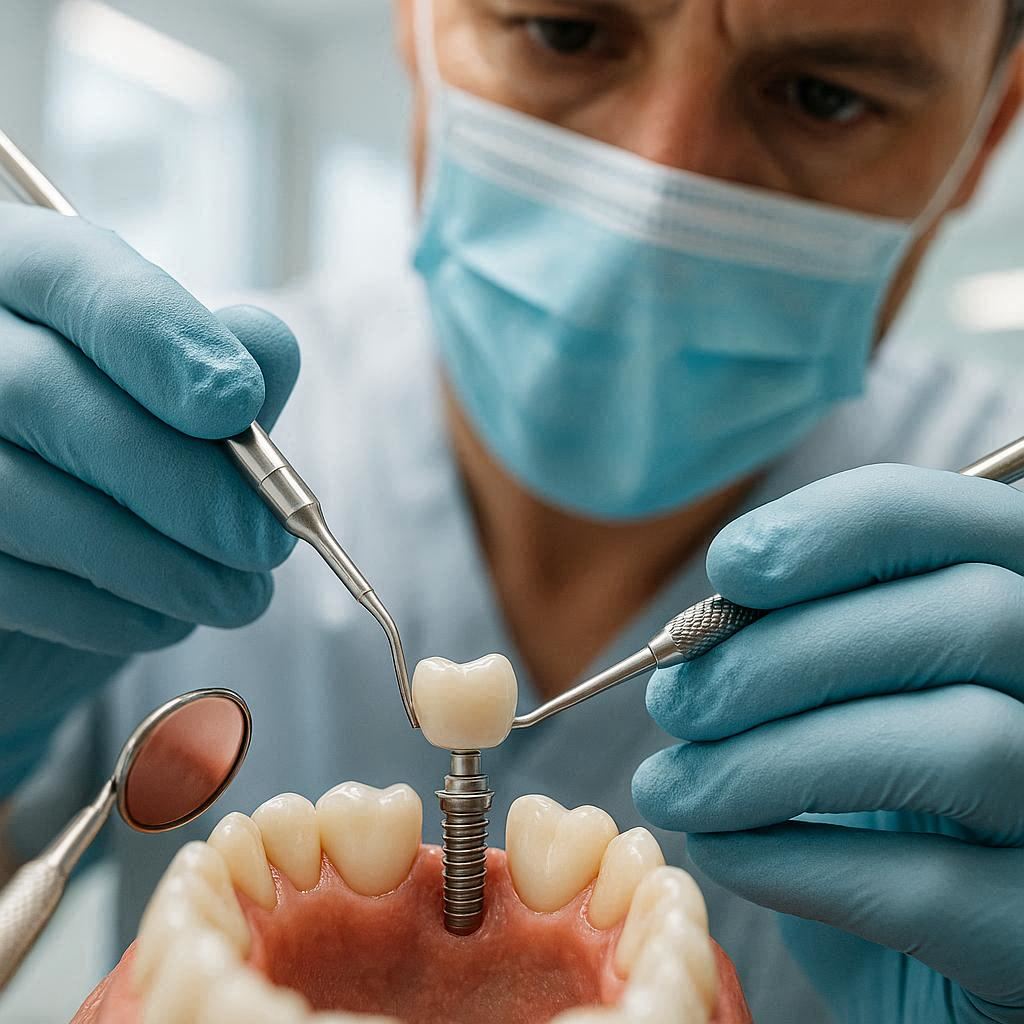
What Is a Single Tooth Implant? A Simple Explanation
A single tooth implant replaces both the root and the crown of a missing tooth. Unlike a bridge, which shaves down healthy teeth, an implant stands alone.
The implant itself is a small titanium post. A dentist places this post into your jawbone. Over time, your bone grows around the titanium. This process is called osseointegration. It sounds complicated, but it simply means the implant becomes part of you.
Once the implant is stable, the dentist attaches an abutment (a connector piece) and finally a dental crown. The crown looks, feels, and functions like a natural tooth.
Three main parts of a single tooth implant:
- The implant post: Titanium screw placed in the jawbone.
- The abutment: Connector that joins the post to the crown.
- The crown: Artificial tooth custom-made to match your other teeth.
A single tooth implant does not affect neighboring teeth. You can floss normally. You brush it like a regular tooth. And with good care, it can last thirty years or more.
Who Is a Good Candidate for a Single Tooth Implant?
Not everyone can get an implant right away. Dentists look for a few key things before saying yes.
Ideal Candidate Checklist
| Criterion | Why It Matters |
|---|---|
| One missing tooth | The procedure is designed for a single gap. |
| Healthy gums | Gum disease can cause implant failure. |
| Enough jawbone density | The implant needs solid bone to hold it. |
| Non-smoker (or willing to quit) | Smoking slows healing and increases failure risk. |
| Good general health | Conditions like uncontrolled diabetes may interfere. |
| Realistic expectations | Implants feel natural but require healing time. |
If you lack bone density, do not lose hope. A bone graft can build up the area. This adds another step to the process, but it makes implants possible for most people.
Young people under eighteen are usually not good candidates. Their jaws are still growing. An implant placed too early could end up in the wrong position.
Note: Dentists almost never refuse a patient solely because of age. Many healthy adults in their seventies and eighties receive implants successfully.
The Complete Single Tooth Implant Procedure: Step by Step
The entire journey from first consultation to final crown takes several months. That is normal. Rushing an implant often leads to problems. Patience gives you a tooth that can last a lifetime.
Let me break down each phase.
Step 1: Initial Consultation and Treatment Planning
Your first visit is all about information. The dentist examines your mouth, takes X-rays, and often orders a 3D scan called a CBCT. This scan shows bone volume, nerve positions, and sinus locations.
The dentist will ask about your medical history. Be honest. Conditions like heart disease, osteoporosis, or autoimmune disorders can affect implant success. Medications like blood thinners or bisphosphonates also matter.
During this visit, you will receive a treatment plan. It includes:
- Number of appointments
- Estimated timeline
- Total cost breakdown
- Any preparatory procedures (like tooth extraction or bone graft)
Take this plan home. Read it slowly. Ask questions about anything unclear.
Step 2: Preparatory Procedures (If Needed)
Sometimes the missing tooth area is not ready for an immediate implant. Common preparations include:
Tooth extraction: If you still have a damaged tooth, the dentist removes it first. In some cases, they place the implant immediately after extraction. This is called an immediate implant. Not everyone qualifies.
Bone graft: If your jawbone is too thin or soft, a graft builds it up. The dentist takes bone from another area (or uses synthetic material) and adds it to the site. Healing from a bone graft takes four to six months before implant placement.
Sinus lift: For upper back teeth, the sinus cavity may be too close. A sinus lift raises the sinus floor to make room for bone.
These steps add time but dramatically improve success rates. Do not skip them if your dentist recommends them.
Step 3: Placing the Implant Post (Surgery Day)
Surgery day arrives. Most people feel nervous beforehand. That is completely normal. But here is what actually happens.
You receive local anesthesia. The same kind used for a filling. You will be awake but feel no pain. For anxious patients, sedation options exist (oral medication, nitrous oxide, or IV sedation).
The dentist makes a small incision in your gum to expose the bone. Then they drill a precise hole using special surgical guides. This is not like drilling a wall. The process is slow, careful, and controlled.
The titanium post goes into the hole. The dentist screws it into place with a torque wrench. Then they place a healing cap or a cover screw over it. Finally, they stitch the gum closed over or around the implant.
How long does surgery take? A single tooth implant placement takes about 30 to 60 minutes. Adding sedation or bone grafting extends the time.
Most patients report pressure but no sharp pain. You will hear drills and feel vibrations. That is the strangest part.
Step 4: Osseointegration – The Healing Phase
After surgery, the real magic begins. Your bone grows around the titanium surface. This process, osseointegration, takes three to six months.
During this time, you wear a temporary restoration if needed. For front teeth, the dentist might give you a temporary partial denture or a bonded plastic tooth. For back teeth, many people simply live with the gap.
What happens during osseointegration:
- You cannot put pressure on the implant.
- You eat soft foods on the opposite side.
- You maintain excellent oral hygiene around the area.
- You attend follow-up visits for X-rays.
This phase tests your patience. But remember: every week of healing makes your implant stronger.
Step 5: Abutment Placement (Minor Second Surgery)
Once the implant is fully integrated, you return for a short appointment. The dentist uncovers the implant by making a tiny incision (if it was buried) or simply removing the healing cap.
Then they attach the abutment. This is a small metal or zirconia piece that sticks out above the gumline. It acts as the foundation for your crown.
The dentist takes impressions (digital or physical) of the abutment and your other teeth. These impressions go to a dental lab. A technician uses them to craft your custom crown.
A healing cap goes back over the abutment. Your gums need about two weeks to shape themselves around the abutment before the final crown arrives.
This appointment lasts about 20 to 40 minutes. You receive local anesthesia again, but the discomfort is minimal.
Step 6: Final Crown Placement
The moment you have been waiting for. Your custom crown is ready.
The dentist removes the healing cap and checks the abutment. They try the crown on your implant. They check the fit, the bite, and the color. Adjustments happen in real-time.
Once everything is perfect, they cement or screw the crown onto the abutment. A screw-retained crown is easier to repair later. A cemented crown looks slightly more natural. Both are excellent options.
The dentist polishes the crown. You look in the mirror. And there it is: a tooth that belongs to you again.
You leave the office with care instructions and a follow-up appointment in six months.
Single Tooth Implant vs. Dental Bridge: An Honest Comparison
Many people wonder whether an implant or a bridge is better. The answer depends on your situation. Here is a realistic table to help you decide.
| Feature | Single Tooth Implant | Traditional Dental Bridge |
|---|---|---|
| Affects healthy teeth | No | Yes (shaves down adjacent teeth) |
| Bone preservation | Prevents bone loss | Does not stop bone loss |
| Longevity | 20–30+ years | 7–15 years |
| Initial cost | Higher (3,000–6,000) | Lower (2,000–4,000) |
| Insurance coverage | Often partial | Often more complete |
| Procedure time | 4–8 months | 2–3 weeks |
| Cleaning | Floss normally | Requires special floss threaders |
| Repair difficulty | Relatively easy (crown unscrews) | Entire bridge often replaced |
| Risk of decay | None (titanium does not decay) | Abutment teeth can decay under crowns |
A quote from a real patient (name changed for privacy):
“I got a bridge for my first missing tooth. Ten years later, one of the anchor teeth rotted underneath. I had to replace the whole thing and get an implant anyway. I wish I had just done the implant first.” — David, 52
Bridges work well for people who cannot have implants due to bone loss or medical conditions. But if you are a candidate, an implant is almost always the better long-term investment.
Single Tooth Implant Recovery Timeline: What to Expect Week by Week
Recovery varies from person to person. But most people follow a similar pattern. Here is a realistic week-by-week breakdown.
Day of Surgery (Day 0)
- What you feel: Numbness for 3–5 hours. Then mild throbbing as anesthesia wears off.
- What to do: Bite on gauze for 30–60 minutes. Rest. Apply ice packs to your cheek (15 minutes on, 15 off).
- What to eat: Cold soft foods (yogurt, smoothies, pudding). Nothing hot.
- Pain level: 2–4 out of 10.
Days 1–3 (The Swelling Phase)
- What you feel: Swelling peaks around day two. Some bruising on the cheek or chin. Minor bleeding is normal.
- What to do: Continue ice packs for first 24 hours, then switch to warm compresses. Take prescribed or OTC pain relievers. Sleep with head elevated.
- What to eat: Soft, lukewarm foods (mashed potatoes, scrambled eggs, soup).
- Pain level: 3–5 out of 10.
Days 4–7 (Turning the Corner)
- What you feel: Swelling goes down. Stitches may start dissolving (if non-resorbable, removal at day 10–14). You feel more like yourself.
- What to do: Begin gentle salt water rinses (no swishing – just move your head). Resume light activities. No exercise.
- What to eat: Semi-soft foods (pasta, soft bread, cooked vegetables).
- Pain level: 1–2 out of 10.
Weeks 2–4 (Back to Normal Life)
- What you feel: Almost no discomfort. Gum tissue heals around the implant site. You may forget the implant is there.
- What to do: Return to work and normal daily routines. Avoid chewing directly on the implant area. Brush gently.
- What to eat: Most foods except very hard, sticky, or crunchy items (nuts, hard candy, bagels).
- Pain level: 0–1 out of 10.
Months 2–6 (Osseointegration)
- What you feel: Nothing. The implant is quietly fusing with your bone.
- What to do: Continue good oral hygiene. Attend all follow-up X-ray appointments.
- What to eat: Normal diet. Just avoid putting extreme pressure on the implant.
- Pain level: 0.
Important: Pain that worsens after the first week is not normal. Neither is swelling that returns after disappearing. Call your dentist immediately if you experience either.
Cost of a Single Tooth Implant Procedure: A Realistic Breakdown
Let us talk money. Implants are not cheap. But neither is replacing a bridge every ten years.
Here is what goes into the total cost:
| Component | Typical Cost Range (USD) |
|---|---|
| Consultation and X-rays | 150–500 |
| CBCT 3D scan | 200–600 |
| Tooth extraction (if needed) | 200–600 |
| Bone graft (if needed) | 300–1,500 |
| Implant post placement | 1,500–3,000 |
| Abutment | 300–600 |
| Custom crown | 1,000–2,500 |
| Total without insurance | 3,000–3,000–6,500 |
Additional costs that may apply:
- Sedation (nitrous oxide: 100–300, oral sedation: 200–500, IV sedation: 500–1,000)
- Sinus lift (1,500–3,000)
- Temporary restoration (200–600)
Does Insurance Cover Single Tooth Implants?
Dental insurance is improving, but most plans still treat implants as a “major service.” Typical coverage is 50% after a waiting period and annual maximums (often 1,000–1,500 per year).
Medical insurance sometimes covers part of the implant if the tooth loss resulted from an accident or a medical condition (like a cyst or tumor). Always ask your dentist to file both dental and medical claims.
Payment Options to Consider
- Dental discount plans: Reduce costs by 10–30% for a yearly membership fee.
- CareCredit or other medical credit cards: Interest-free if paid within a promotional period.
- In-house membership plans: Some dental offices offer monthly plans with reduced implant fees.
- Dental schools: A single tooth implant at a university clinic may cost 40–60% less. Students work under supervision. Appointments take longer, but quality is excellent.
Risks and Complications: An Honest Discussion
No surgical procedure is risk-free. Good dentists have very high success rates (over 95% for single tooth implants). But problems can happen.
Common (But Usually Manageable) Issues
| Complication | Likelihood | What Happens |
|---|---|---|
| Post-op pain and swelling | Almost everyone | Resolves with ice, rest, and medication |
| Minor bleeding | Common | Stops with pressure and time |
| Infection at implant site | 5–10% | Antibiotics or minor drainage procedure |
| Nerve injury (numbness) | Less than 1% | Usually temporary; rare permanent cases |
| Implant failure (no integration) | 2–5% | Replacement or alternative treatment |
Less Common but Serious
- Implant fracture: Extremely rare with modern titanium.
- Sinus perforation: For upper teeth. Usually heals on its own or requires small repair.
- Allergic reaction: Very rare. Titanium allergies exist but are uncommon.
Habits That Increase Failure Risk
- Smoking: Smokers have failure rates 2–3 times higher than non-smokers.
- Poor oral hygiene: Plaque buildup leads to peri-implantitis (bone loss around implant).
- Grinding or clenching (bruxism): Extra force can loosen or fracture implants.
- Uncontrolled diabetes: High blood sugar impairs healing.
Note: Peri-implantitis is the leading cause of late implant failure (after the crown is placed). It is similar to gum disease but around an implant. Regular cleanings and good home care prevent it.
Real Patient Questions About Single Tooth Implants
Here are the most common questions people ask during consultations.
“Will it hurt?”
The procedure itself does not hurt because of local anesthesia. Afterward, most people describe the discomfort as a dull ache, similar to a tooth extraction. Over-the-counter ibuprofen manages it for most patients.
“How long does the whole process take?”
From start to finish: 4 to 8 months. About 50% of that time is waiting for bone to heal. Shortcuts exist (immediate loading), but they carry higher risks.
“Can I get an implant years after losing a tooth?”
Yes. But the longer you wait, the more bone loss occurs. You may need a bone graft first. The procedure is still very possible.
“Will people notice it?”
No. Modern crowns are made from zirconia or layered porcelain. They match the color, translucency, and shape of your natural teeth. Even dentists sometimes struggle to tell which tooth is the implant.
“How do I clean a single tooth implant?”
Floss around it normally. Use a soft toothbrush. Some patients use a water flosser or interproximal brushes. Avoid metal scrapers. Your regular dental hygienist will know how to clean it professionally.
“What if the crown breaks?”
Crowns can chip or crack like natural teeth. But because the crown is separate from the implant post, the dentist simply removes the old crown and makes a new one. No surgery required.
Daily Life With a Single Tooth Implant: What Really Changes?
After the crown is placed, your life returns to normal. But let me share what actually improves.
Eating: You forget you ever had a gap. Biting into an apple, tearing meat off a bone, enjoying sticky caramels – all possible. No special tools needed.
Smiling: No more hiding your mouth. No more gap showing when you laugh. The crown looks so natural that even close friends may not notice.
Cleaning: You brush and floss like normal. That is it. No special soaks, no adhesives, no removal at night.
Traveling: No worries about losing a partial denture. No forgetting to pack a retainer. Your implant stays with you.
Dental visits: Your hygienist cleans around the implant just like a natural tooth. They use plastic instruments instead of metal. That is the only difference.
How to Choose a Dentist for Your Single Tooth Implant
Not all dentists place implants. Some refer to specialists. Here is who does what.
Types of Providers
| Provider | Pros | Cons |
|---|---|---|
| General dentist (with implant training) | Convenient, one location for everything | May handle complex cases less often |
| Oral surgeon | Expert in bone and nerve anatomy | Usually does not place crowns (refers back) |
| Periodontist | Gum and bone specialist | Higher cost |
| Prosthodontist | Expert in crowns and aesthetics | May not place implant post themselves |
Questions to ask before choosing a provider:
- How many single tooth implants have you placed in the last year?
- What is your success rate?
- Do you use 3D guided surgery?
- Who places the crown – you or another dentist?
- What is your policy for failed implants (free replacement or not)?
Red Flags to Watch For
- A dentist promising a full implant in one visit (except very specific cases)
- Prices that seem too good to be true ($1,500 total for everything)
- No CBCT scan before surgery (X-rays alone are not enough)
- Unwillingness to show before-and-after photos of their work
Single Tooth Implant Procedure: Before and After Photos (Descriptions)
While this article cannot display actual images, here is what you would see in a typical case study:
Before: A healthy adult in their 40s missing tooth #19 (lower left first molar). The gap shows adjacent teeth leaning slightly into the space. The X-ray reveals moderate bone loss in the area.
Immediately after implant placement: A small titanium post visible in the bone. The gum is sutured around it. Some redness but no dramatic changes.
Three months later (osseointegration): The X-ray shows bone growing tightly against the implant threads. No gaps or dark lines visible.
After final crown: A porcelain molar that matches the color, contour, and texture of the neighboring teeth. The crown emerges naturally from the gumline. The patient smiles widely.
The difference is not just cosmetic. Patients report better chewing ability, improved speech (no whistling through a gap), and higher confidence.
Long-Term Care for Your Single Tooth Implant
An implant can last 30 years or more. But it needs maintenance. Here is your long-term care checklist.
Daily Habits
- Brush twice a day with a soft or extra-soft toothbrush.
- Floss once a day. Use regular floss or a water flosser.
- Avoid chewing ice, hard candy, or non-food objects.
- If you grind your teeth at night, wear a nightguard. Grinding is the #1 threat to implant crowns.
Professional Maintenance
- See your hygienist every six months (or more often if recommended).
- Get annual X-rays to check bone levels around the implant.
- Tell your hygienist you have an implant. They will use plastic scalers instead of metal.
Signs Something Is Wrong
- Bleeding around the implant when flossing
- A bad taste or smell from the area
- The crown feels loose
- You see the gum receding around the abutment
If you notice any of these, call your dentist promptly. Early intervention saves implants.
What About Immediate Implants? (Same-Day Teeth)
You may have seen advertisements for “teeth in a day.” Immediate implants do exist, but they are not for everyone.
What is an immediate implant? The dentist extracts the damaged tooth and places the implant post in the same appointment. Sometimes they even attach a temporary crown right away.
Who qualifies?
- Healthy gums with no active infection
- Excellent bone quality and quantity
- No gum disease
- Non-smoker
- Front tooth replacement (less chewing force)
Success rate: Slightly lower than delayed implants (about 90–95% vs. 95–98%). The risk is higher because the bone has not had time to fill the extraction socket.
For most people, waiting 4–6 weeks after extraction before placing the implant gives the best results. Do not let marketing pressure you into rushing.
Conclusion: Three Key Takeaways
The single tooth implant procedure takes several months and costs more upfront than a bridge, but it preserves your jawbone and neighboring teeth while offering decades of worry-free function. Most patients describe the process as less painful than expected and life-changing in terms of confidence and eating ability. Choose an experienced provider, follow the healing guidelines strictly, and you can reasonably expect your implant to serve you well for thirty years or more.
Frequently Asked Questions (FAQ)
1. Can a single tooth implant fail years later?
Yes, but it is uncommon. Late failures usually come from peri-implantitis (bone infection around the implant) or excessive force from teeth grinding. Regular dental checkups prevent most late failures.
2. How much does a single tooth implant cost with insurance?
After insurance pays 50% of covered services, you might pay 1,500to3,500 out of pocket. But coverage varies wildly. Always get a pre-treatment estimate.
3. Is a single tooth implant painful to get?
No. The procedure uses local anesthesia, so you feel pressure but not pain. Post-surgery discomfort is typically mild to moderate and manageable with OTC pain relievers.
4. How long does a single tooth implant last?
With proper care, 20–30 years is common. Some patients keep their implants for 40+ years. The crown may need replacement after 10–15 years, but the titanium post often lasts a lifetime.
5. Can I get a single tooth implant if I have bone loss?
Yes, but you will likely need a bone graft first. A graft adds 3–6 months to the process but makes implant placement possible in most cases.
6. What can I eat after a single tooth implant?
First week: cold and lukewarm soft foods (yogurt, smoothies, soup, mashed potatoes). Weeks 2–4: semi-soft foods (pasta, scrambled eggs, soft bread). After one month: most normal foods except extremely hard items. After osseointegration (3–6 months): anything.
7. Will my insurance cover a single tooth implant?
Many dental plans cover 50% of the implant post and crown after a waiting period. Some cover nothing. Check your plan’s “major services” section. Medical insurance may cover implants from accidents or medical conditions.
8. Can a single tooth implant be done in one day?
In very specific cases, yes (immediate loading). But most dentists prefer to wait 3–6 months for osseointegration to lower the risk of failure. Same-day implants are not recommended for molars or for smokers.
9. What is the success rate of single tooth implants?
Over 95% for lower jaw and 93–95% for upper jaw. Success rates drop for smokers (80–85%) and people with uncontrolled diabetes or severe grinding.
10. Do I need a bone graft for a single tooth implant?
Only if your jawbone is too thin (less than 1.5mm around the planned implant site). Your dentist will measure this with a CBCT scan. About 40–50% of implant patients need some form of grafting.
Additional Resource
For the most up-to-date clinical guidelines and patient education materials on dental implants, visit the American Academy of Implant Dentistry (AAID) patient information page:
👉 https://www.aaid.com/patients/ (open in a new tab)
This resource includes a “Find an Implant Dentist” tool, downloadable patient guides, and answers to clinical questions written by board-certified implant surgeons.
Disclaimer
This article is for informational purposes only and does not constitute medical advice. Dental implant procedures vary based on individual anatomy, health status, and provider experience. The information presented here is a general guide. Always seek the advice of a licensed dentist or oral surgeon with any questions regarding your specific condition. Never disregard professional medical advice because of something you have read in this article. The author and publisher are not liable for any outcomes resulting from the use of this information.