What Materials Are Used to Make Tiny Dental Implants?
When a tiny dental implant is placed in your jaw, it becomes a permanent part of your body. The material it is made from is not a trivial choice; it is a sophisticated biomedical engineering decision that determines the implant’s strength, its biocompatibility, and its long-term success. You have a right to know exactly what that tiny screw in your mouth is composed of. This guide will provide a detailed, scientific yet accessible explanation of the materials used to manufacture mini dental implants. We will explore the dominance of titanium alloy, the specific grades used, the critical role of surface technology, and the emerging use of ceramic materials. This is your comprehensive resource on the biomaterials science that makes mini implants a safe, predictable medical device.
The Gold Standard: Titanium Alloy (Ti-6Al-4V)
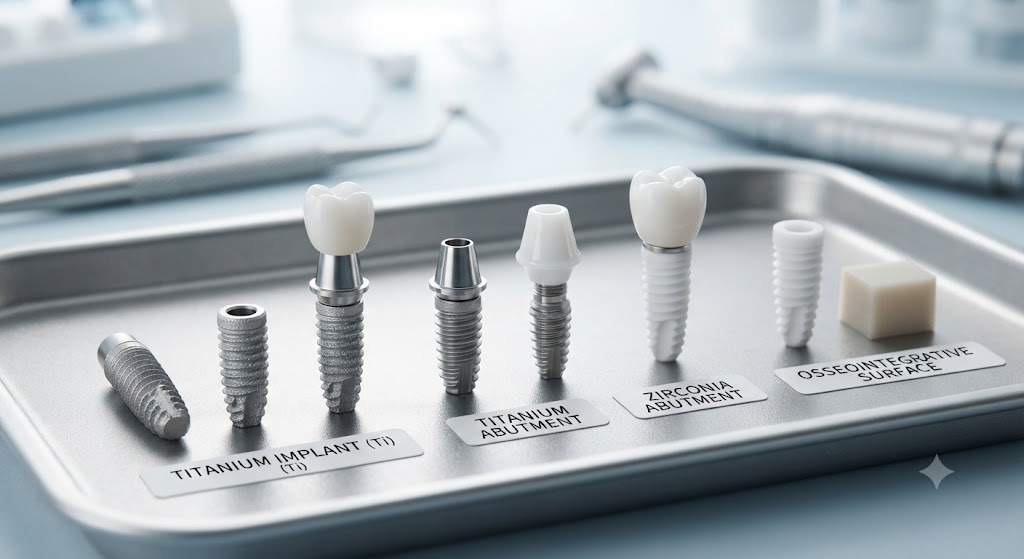
The overwhelming majority of mini dental implants are fabricated from a specific titanium alloy called Ti-6Al-4V, which stands for Titanium-6% Aluminum-4% Vanadium. This is not commercially pure titanium. It is an engineered alloy that is widely used in orthopedic prostheses, such as hip and knee replacements, as well as dental implants. The addition of aluminum and vanadium to the titanium matrix dramatically increases the mechanical strength and fatigue resistance of the material. This is critically important for a mini implant. Because the implant has such a small diameter, it must be made of an extraordinarily strong material to withstand the bending and torsional forces it will experience in the mouth without fracturing. The tensile strength of Ti-6Al-4V is significantly higher than that of pure titanium, making it the material of choice for load-bearing mini implants.
This alloy is rigorously regulated. The American Society for Testing and Materials (ASTM) sets the precise chemical and mechanical property specifications for surgical implant-grade Ti-6Al-4V. The ASTM F136 specification is the standard for wrought titanium alloy for surgical implant applications. A legitimate manufacturer of mini dental implants will source only ASTM F136-compliant alloy from a certified mill. This traceability and material certification is the foundation of the implant’s safety. It guarantees the alloy’s composition, its freedom from contaminants, and its mechanical properties.
Biocompatibility and Osseointegration: Why Titanium?
The reason titanium, and its alloys, are the dominant biomaterial in implant dentistry is its unique and unparalleled relationship with living bone. Titanium is profoundly biocompatible. The human immune system does not recognize it as a foreign invader. It does not trigger a chronic inflammatory or allergic foreign-body reaction. The surface of the titanium alloy spontaneously forms a thin, dense, and stable layer of titanium dioxide upon contact with air. This oxide layer is the key to the magic of osseointegration.
When the titanium implant is surgically placed into a precisely prepared channel in the jawbone, the body’s healing response is not to wall it off with a fibrous scar capsule, as it would with most other foreign materials. Instead, the fibrin and proteins in the healing blood clot adhere to the titanium dioxide surface. Osteoblasts, the bone-forming cells, migrate to this protein-coated surface. They begin to lay down new bone matrix directly onto the oxide layer. Over the months of healing, this new bone mineralizes and matures, forming an intimate, structural, and functional connection with the implant surface. This is osseointegration. The implant is not just sitting in bone; it is biologically fused to it. This allows the mini implant to transmit the forces of chewing from the denture into the jawbone, providing the stimulation that preserves bone.
The Critical Role of Surface Topography
The surface of a modern mini implant is not smooth. The microscopic topography of the implant surface is a primary determinant of the speed and strength of osseointegration. A smooth, machined surface is slow to integrate and achieves a weaker bone-implant contact. To maximize the surface area and create an ideal scaffold for bone cell attachment, manufacturers modify the implant surface. The most common and well-researched technique is sandblasting with a biocompatible media, such as alumina or resorbable calcium phosphate, followed by acid etching with a strong acid mixture. This process removes any surface contaminants and creates a complex, three-dimensional, micro-rough landscape of pits and craters on a scale of microns. This dramatically increases the total surface area available for bone cell attachment. A mini implant with this micro-roughened surface will achieve a significantly stronger and faster osseointegration, which is essential given its small diameter and reduced initial bone contact.
The Emerging Alternative: Ceramic (Zirconia) Mini Implants
An alternative material that is gaining traction in implant dentistry is zirconium dioxide, or zirconia. It is a high-performance white ceramic. The desire for a metal-free, tooth-colored implant is driven by patient preference and specific clinical situations. The primary advantage of a zirconia mini implant is its aesthetic color. It is white. In a patient with thin, translucent gum tissue, a gray titanium implant can sometimes create a dark, visible shadow through the gum, which is aesthetically unacceptable. A white zirconia implant eliminates this risk.
Zirconia is also profoundly biocompatible and exhibits very low bacterial plaque adhesion, which may be beneficial for long-term gum health. However, zirconia is a ceramic and has a fundamentally different material property profile than titanium alloy. It is very strong in compression but more brittle and has lower flexural strength. The risk of a catastrophic, sudden fracture under a bending load is a concern, especially for a small-diameter mini implant. The manufacturing process for a zirconia implant is different, and the one-piece design is more common. Zirconia mini implants are a valid, high-quality option for a specific patient with a documented metal sensitivity or a high aesthetic demand in the visible zone, but the clinical long-term data for mini zirconia implants is less voluminous than for the titanium alloy standard.
What About Metal Allergies?
True, immunologically confirmed allergy to titanium alloy is exceptionally rare. It is so rare that definitive prevalence numbers are difficult to establish. However, some patients report a constellation of symptoms they associate with metal sensitivity. If you have a history of severe skin reactions to metal jewelry and are concerned, a referral to an allergist or dermatologist for a specific titanium and metal allergy patch test can be performed. If a genuine diagnosis of a titanium allergy is made, a zirconia mini implant is the direct, metal-free alternative. It is a legitimate reason to choose a ceramic implant.
The Danger of Non-Certified, Clone Implant Materials
A stark warning must be given. The market is flooded with cheap, non-branded mini implant systems. These are often labeled simply as “titanium.” The material they are actually made from is unknown. They may be machined from an uncertified, lower-grade alloy of unknown origin and composition. The trace elements and contaminants within the alloy can cause a severe foreign body reaction, lead to corrosion in the body, and result in catastrophic early implant failure and bone loss. The surface treatment may be absent or rudimentary, leading to a failure to integrate. The mechanical properties may be dangerously low, leading to a fracture during placement or in function. A legitimate mini implant, from an established manufacturer like 3M ESPE (MDI), Intra-Lock, or Sterngold, comes with material traceability, an ASTM certification, and decades of clinical documentation. A generic, low-cost implant from an online marketplace does not. You are placing a permanent medical device into your body. The material’s certification is not a luxury; it is a non-negotiable safety requirement.
Conclusion
The vast majority of tiny dental implants are made from the high-strength, biocompatible titanium alloy Ti-6Al-4V, which conforms to the strict ASTM F136 surgical implant standard, chosen for its superior fatigue resistance in narrow diameters and its unique ability to fuse directly to living bone through osseointegration. The success of this fusion is dramatically enhanced by a micro-roughened surface created through advanced sandblasting and acid-etching protocols. For the rare patient with a proven metal allergy or a critical aesthetic need, metal-free zirconia ceramic mini implants provide a valid, tooth-colored alternative, though with a different long-term mechanical profile.
Frequently Asked Questions
What does ASTM F136 mean on my implant package?
It is the material certification number. It guarantees that the titanium alloy rod from which your mini implant was machined has been tested and certified by an accredited laboratory to meet the exacting chemical composition and mechanical strength requirements for permanent surgical implantation in the human body.
Is a mini implant magnetic? Will it set off airport security?
No. Titanium alloy and zirconia are non-ferromagnetic materials. They are completely non-magnetic. A dental implant will not trigger a metal detector at an airport security checkpoint.
Can I have an MRI with mini dental implants?
Yes, absolutely. Titanium and zirconia are non-magnetic and are MRI-safe. The implant will not move or heat up in the MRI machine. It may, however, cause a slight artifact or distortion in the image of the area immediately around the implant.
Are the O-ring housings in my denture also made of titanium?
The O-ring attachment housing that is embedded in your denture is typically made of a different metal, often a stainless steel alloy or a titanium alloy, with a rubber O-ring inside. The implant head is titanium, and the housing is a compatible, durable metal.
Do mini implants use the same grade of titanium as standard implants?
Many standard implants are also made from Ti-6Al-4V alloy, particularly those designed for high-strength applications. Some standard implants are made from commercially pure (CP) titanium, Grade 4, which is softer. The choice of alloy for a mini implant is even more critical due to the narrow diameter.
Additional Resource: Link
For a scientific overview of dental implant biomaterials, you can explore the educational resources of the Academy of Osseointegration. Visit the Academy of Osseointegration