What Is The Sensation Of Dental Implants?
The decision to get a dental implant is a significant one. You are replacing a part of your body with a medical device. It is natural to wonder: “What will it feel like?” Will it feel like a foreign object? Will I constantly be aware of it? Will it feel like my old tooth?
The answer is overwhelmingly positive. The goal of a dental implant is to replicate the feel and function of a natural tooth. In most cases, once the healing process is complete, patients report that they cannot tell the difference between their implant and their natural teeth.
This guide will explore the sensations associated with dental implants, from the moment of placement to the long-term feel. We will address the differences between the healing phase and the final restoration, and we will explain why implants feel the way they do.
The Missing Sensation: The Periodontal Ligament
To understand how an implant feels, you must understand a key difference in its anatomy compared to a natural tooth.
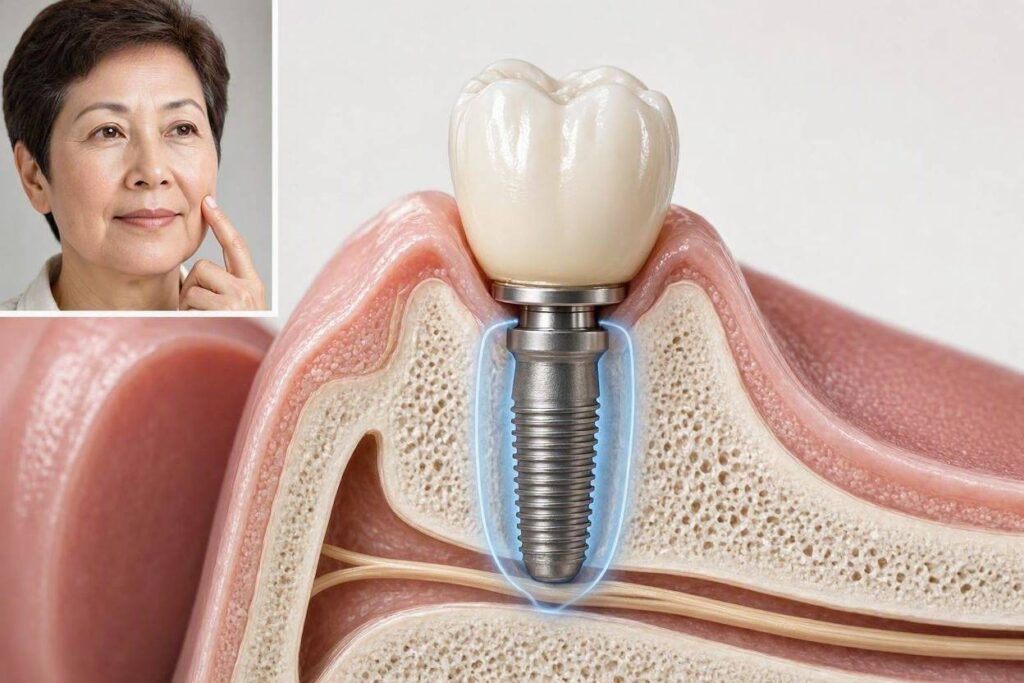
A natural tooth is not directly fused to your jawbone. It is held in place by a network of tiny fibers called the periodontal ligament (PDL) . This ligament acts as a shock absorber. It cushions the tooth against the forces of chewing. It also contains nerve endings that provide proprioception—the ability to sense pressure and fine movement.
A dental implant is different. It is fused directly to the bone (osseointegration). There is no periodontal ligament. This is a crucial distinction that affects sensation.
- Natural Tooth: You can feel the pressure of chewing very precisely. You can tell if you are biting on a hard seed or a soft piece of bread. The PDL sends these signals to your brain.
- Dental Implant: Your sense of pressure is different. Because there is no ligament, the feedback is less precise. You may not be able to detect very fine differences in texture or pressure. You still feel the pressure because the force is transmitted to the bone, but it is a slightly different, less “springy” sensation.
Will this bother you? For the vast majority of patients, the answer is no. The difference is subtle. You will still be able to chew perfectly well. You just might not be able to feel the exact texture of a grain of sand in your food the way you would with a natural tooth.
The Healing Phase: What Does It Feel Like in the Beginning?
The first few weeks after implant surgery are not representative of the final feel. There will be normal post-surgical sensations.
- Soreness and Swelling: This is normal and expected. It is the body’s inflammatory response to the surgery.
- Pressure: You may be aware of the presence of the implant under the gum. It may feel “full” or “tight” in that area.
- Tingling or Numbness: Some patients experience temporary tingling or numbness in the lip, chin, or gums if a nerve was disturbed during surgery. This usually resolves over a few weeks.
During this phase, the implant is not loaded (no chewing force is applied). You will be eating soft foods and avoiding the area. The sensation at this stage is dominated by healing, not function.
The Restoration Phase: The Magic Moment
Several months later, when the crown is placed on the implant, the sensation changes dramatically.
This is the moment when the implant truly becomes a tooth. The custom-made crown fills the gap, completes your smile, and restores your bite.
- The First Few Days: The new crown may feel a bit “tight” or “full.” Your tongue will probably play with it. The adjacent teeth may feel some pressure. This is simply because the space has been filled after being empty for so long.
- The Adaptation Period: Within a week or two, your brain adapts. The “foreign object” feeling disappears. The implant becomes integrated into your oral awareness.
The Long-Term Feel: It Becomes a Part of You
This is the most common answer to the question “What does an implant feel like?”
It feels like nothing. It feels like a normal tooth.
Once you have adapted, you will likely forget the implant is even there. It does not move. It does not cause pain. It just sits there, doing its job. When you eat, you chew on it. When you smile, you see it.
Patients who have lived with a missing tooth or a failing tooth report that the implant feels incredible. The feeling of stability and solidity is a relief.
The Temperature Sensation
One difference you might notice is temperature. The implant crown (the visible part) is made of porcelain or zirconia. It will feel hot or cold just like a natural tooth because it is in contact with the oral environment. However, the titanium post inside the bone does not have nerve endings, so you will not feel temperature changes in the bone the way you would with a natural tooth root.
Comparing the Feel: Implant vs. Denture
This comparison highlights the superiority of the implant.
- A Denture: Feels bulky. It moves. It can rub and cause sores. You are constantly aware of it. It covers your palate or rests on your gums. The sensation is one of a foreign object in your mouth.
- An Implant: Feels fixed. It is streamlined. It does not move. It is not a foreign object; it is a replacement.
The “Clicking” or “Movement” Warning Sign
The one sensation you should never feel with a dental implant is movement. A healthy, integrated implant is completely solid. If you feel it clicking, wiggling, or shifting, this is a sign of a problem (as discussed in a previous article). It means the crown is loose or the implant itself is failing. Contact your dentist immediately.
Conclusion
The ultimate goal of a dental implant is to be so natural that you forget it is there. While the implant lacks the precise sensory feedback of the periodontal ligament, this difference is imperceptible to most patients in daily life. After the initial healing phase, a successful implant simply feels like a strong, stable, natural tooth. It feels like a part of you.
Frequently Asked Questions (FAQ)
Q: Will I be able to feel my dental implant when I eat?
A: Yes, you will feel pressure when you chew. However, you will not have the same fine-tuned sensitivity as a natural tooth because there is no periodontal ligament. You will be able to chew normally, but you might not detect very fine textures.
Q: Does a dental implant feel different from a natural tooth?
A: In the long term, most patients say it feels very similar. The main difference is the lack of the “shock absorber” ligament. The implant feels more rigid and solid compared to a natural tooth, which has a tiny amount of natural give.
Q: Will my tongue keep playing with the implant crown?
A: Yes, especially in the first few days. Your tongue is very sensitive to changes in your mouth. It will explore the new crown. This habit usually stops within a few weeks as your brain adjusts.
Q: Can I feel the screw in a dental implant?
A: No. The screw is buried deep within the crown, the abutment, and the implant fixture. It is not exposed to the oral environment. You cannot feel it.
Q: Will the implant feel cold in the winter?
A: The crown will respond to temperature changes in your mouth, just like a natural tooth. If you drink cold water, you will feel the cold on the crown. The titanium post in the bone does not transmit temperature sensation to the bone itself.
Additional Resource:
For a patient’s perspective on life with dental implants, you can explore testimonials and educational content from the American Academy of Implant Dentistry (AAID): https://www.aaid.com/