How Long Do Dental Crowns Last On Implants?
A dental implant is a two-part system. The implant fixture—the titanium post in your bone—is designed to last a lifetime. But the crown—the visible, tooth-shaped part that sits on top—is a different story. It is a prosthetic device subject to wear and tear, just like any other dental restoration.
When you invest in a dental implant, you are making a long-term commitment to your oral health. A natural question is: “How long will the crown last before I need to replace it?”
The answer is reassuring. An implant crown is a highly durable restoration. With proper care, it can last for many years, often decades. This guide will explore the factors that influence the lifespan of an implant crown, the materials used, and what you can do to maximize its longevity.
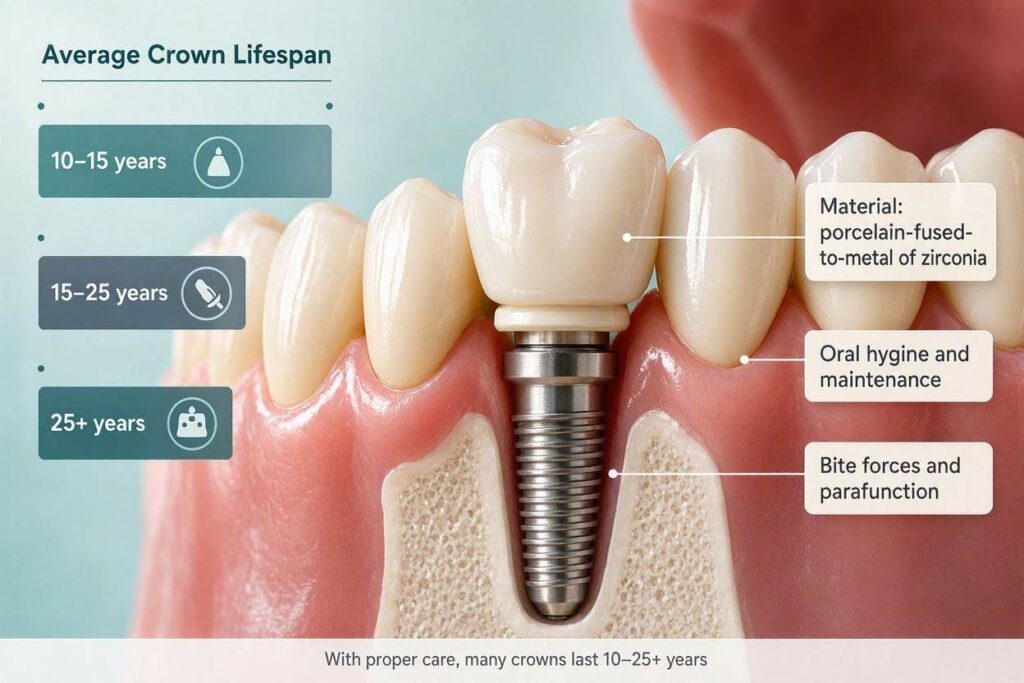
The Short Answer: 10 to 15 Years (or Much Longer)
The average lifespan of a dental crown on an implant is commonly cited as 10 to 15 years. However, this is a conservative estimate. Many implant crowns last for 20, 25, or even 30 years or more.
The wide range exists because the lifespan is heavily dependent on several variables, most of which are under the patient’s control.
The implant fixture itself has a very high success rate (over 95%). The crown is the component that is more likely to fail or need replacement. The good news is that replacing a worn-out crown is a simple, non-surgical procedure. The implant stays put, and a new crown is simply screwed or cemented onto the existing abutment.
The Factors That Influence Crown Longevity
Several key factors determine whether your crown will last 10 years or 30 years.
1. The Material of the Crown
The choice of material has a major impact on durability.
- Porcelain-Fused-to-Metal (PFM): These crowns are strong but can chip. The porcelain layer can fracture off the metal base under heavy force.
- Zirconia: This is a very strong, monolithic ceramic. It is highly resistant to chipping and cracking. It is an excellent choice for back teeth and for patients who grind.
- E-max (Lithium Disilicate): This is a very aesthetic ceramic, ideal for front teeth. It is strong, but not quite as tough as zirconia for heavy chewing forces on molars.
- Gold: As discussed earlier, gold is the most durable and wear-resistant material. It will not chip or crack.
2. The Location in the Mouth
Crowns on back molars are subjected to much greater chewing forces than crowns on front teeth. A molar crown must withstand hundreds of pounds of pressure per square inch. Consequently, crowns on molars tend to wear out faster than those on incisors.
3. Parafunctional Habits (Grinding and Clenching)
This is a major factor. Bruxism (teeth grinding) and clenching put immense stress on the crown and the implant. This can lead to:
- Chipping or fracture of the porcelain.
- Loosening of the screw that holds the crown in place.
- Failure of the implant itself.
If you grind your teeth, you must wear a nightguard. This is a custom-made appliance that you wear while you sleep. It absorbs the forces of grinding, protecting both your implant crown and your natural teeth.
4. Oral Hygiene
While the crown itself cannot get a cavity, the area around it is vulnerable. If plaque builds up around the crown, it can cause inflammation of the gums (mucositis) and eventually bone loss (peri-implantitis). If the bone supporting the implant is lost, the implant can fail, and the crown will be lost with it. Excellent home care and regular professional cleanings are essential.
5. The Skill of the Dentist and Lab
The quality of the fit and the bite is crucial. If the crown does not fit perfectly, or if the bite is “high” (causing excessive force on that tooth), the risk of failure increases. A well-made crown by a skilled team will last longer.
The Most Common Reasons for Crown Replacement
What actually goes wrong that necessitates a new crown?
1. Aesthetic Concerns
The crown may look fine, but the gums around it may have receded over time. This can expose the metal margin of a PFM crown (showing a dark line) or the abutment. The patient may choose to replace the crown for aesthetic reasons.
2. Wear and Tear
Over a decade or two, the porcelain can wear down, losing its natural luster and texture. The biting surface may flatten out.
3. Chipping or Fracture
A piece of the porcelain chips off. If the chip is small, it might be repairable with a composite bonding material. If the fracture is large, the crown must be replaced.
4. Screw Loosening
In screw-retained crowns, the screw can sometimes loosen over time. This is usually a quick fix (tightening the screw), but if it happens repeatedly, the crown may need to be replaced.
5. Implant Failure
This is the worst-case scenario. If the implant itself fails due to infection or bone loss, the crown is lost along with it.
How to Protect Your Investment
Your implant crown is a valuable asset. Here is how to protect it:
- Brush and floss meticulously. Pay special attention to the area where the crown meets the gum.
- See your dentist every 6 months for a checkup and cleaning. This allows them to monitor the health of the implant and the condition of the crown.
- Wear a nightguard if you grind or clench.
- Avoid using your teeth as tools. Do not open bottles or packages with your implant crown.
- Do not chew on ice or hard candies.
The Cost of Replacing a Crown
If your crown does need to be replaced, the cost is significantly less than the cost of the original implant (which included surgery). You are only paying for the new crown and possibly a new abutment.
- Cost of a replacement crown: Typically ranges from $1,000 to $2,500, depending on the material and the dentist.
Conclusion
A dental crown on an implant is a durable, long-lasting restoration. While the average lifespan is 10-15 years, many patients enjoy their crowns for decades. The key to longevity lies in the quality of the materials, the skill of the dental team, and, most importantly, your commitment to oral hygiene and protecting the crown from excessive forces.
Frequently Asked Questions (FAQ)
Q: Do I need to replace the implant when the crown wears out?
A: No. The implant fixture is separate from the crown. If the crown fails, it can usually be replaced without removing the implant. The implant remains in the bone, and a new crown is attached to it.
Q: Can a crown on an implant get a cavity?
A: No. The crown is made of porcelain or ceramic, which is not susceptible to decay. However, the gums and bone around the crown are vulnerable to infection, which can lead to implant failure.
Q: Is a zirconia crown stronger than a porcelain crown?
A: Yes. Zirconia is an incredibly strong material. It is less likely to chip or fracture than traditional porcelain-fused-to-metal. This makes it an excellent choice for back teeth.
Q: How do I clean under an implant crown?
A: You use floss to clean around the base of the crown, just like a natural tooth. Many dentists recommend using a water flosser (like a Waterpik) or interdental brushes to effectively clean the area where the crown meets the gum.
Q: Will my dental insurance cover a replacement crown?
A: Most dental insurance plans will cover a replacement crown if the original is a certain age (usually 5 years old or older). The coverage is usually 50% of the cost, subject to your annual maximum. Check your policy details.
Additional Resource:
To learn more about the longevity of different dental materials, you can visit the American Dental Association’s patient education website: https://www.mouthhealthy.org/