Are There Screwless Dental Implants?
The term “screwless dental implant” sounds like a contradiction. After all, the image most people have of a dental implant is a titanium screw being twisted into the jawbone. For some patients, the idea of a screw is the biggest barrier to getting treatment. They worry about the hardware, the mechanical parts, and the possibility of things loosening over time.
If you have been searching for a “screwless” option, you are likely looking for something simpler, more holistic, or less “mechanical.” But is such a thing real?
The answer is complicated. While you cannot eliminate the threaded implant post that anchors into the bone, you can eliminate the visible screw that holds the crown in place. The confusion lies in the terminology. This guide will clarify exactly what “screwless” means in modern implant dentistry and what options are available to you.
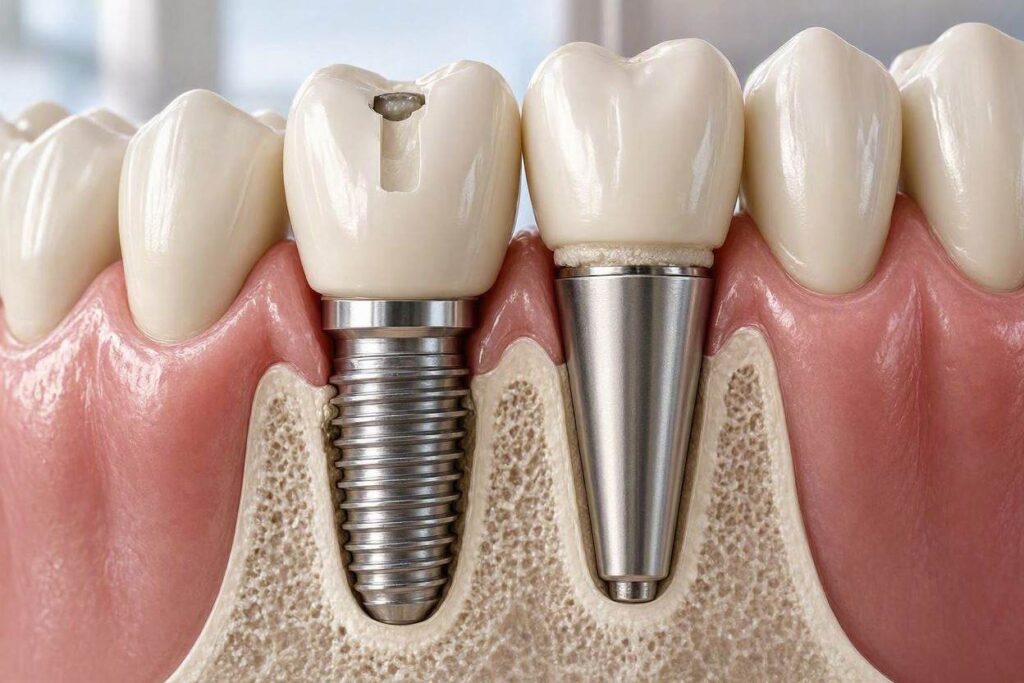
Defining “Screwless”: The Two Screws in an Implant System
To understand why “screwless” is a confusing term, you need to know that a standard dental implant system has two distinct “screws” involved.
- The Implant Fixture (The Big Screw in the Bone): This is the titanium post. It has threads on the outside that grip the bone. It is placed during surgery.
- The Abutment Screw (The Tiny Screw in the Crown): This is a very small screw that connects the abutment (connector) to the implant fixture, or the crown to the abutment. It is usually accessed through a small hole in the biting surface of the crown.
When a patient asks for a “screwless” implant, they usually mean one of two things:
- “I don’t want the big screw in my bone.” (Usually impossible, except with alternative treatments like bridges).
- “I don’t want the tiny screw holding my tooth in place.” (Definitely possible with a cement-retained crown).
Option 1: The “Screwless” Crown (Cement-Retained Restorations)
If your goal is to have a tooth that looks perfect with no screw access hole, you want a cement-retained implant crown.
How it works:
Instead of using a screw to hold the crown onto the abutment, the dentist uses dental cement. This is very similar to how a traditional crown is placed on a natural tooth.
The Difference from Screw-Retained Crowns:
| Feature | Screw-Retained Crown | Cement-Retained Crown (“Screwless” tooth) |
|---|---|---|
| Attachment | A small titanium screw holds the crown. | Dental cement holds the crown. |
| Visible Hole | Yes, a small hole on the biting surface is filled with composite. | No hole. The crown is solid porcelain. |
| Aesthetics | Good, but the filling can stain over time. | Excellent. Seamless and natural. |
| Retrievability | Easy. The dentist can unscrew it for repair. | Difficult. The crown often has to be cut off. |
Why choose Cement-Retained?
Many patients and dentists prefer cement-retained crowns for the front teeth because the aesthetics are superior. There is no risk of a dark shadow from the screw hole. The crown looks like a solid, natural tooth.
The Risk:
If the dentist is not meticulous about removing excess cement from under the gum line, the leftover cement can cause inflammation and bone loss (peri-implantitis). This is a technical challenge, but a skilled dentist handles it routinely.
Option 2: The “One-Piece” Implant (No Abutment Screw)
There is another level of “screwless” that addresses the abutment screw (the tiny connector). In a standard two-piece implant system, the implant post is placed, and then an abutment is screwed into it later.
A one-piece implant eliminates this separate component. The implant post and the abutment are manufactured as a single solid piece of titanium.
How it works:
The surgeon places the one-piece implant. The top of the implant (the abutment part) sticks out through the gum immediately. Once it heals, the crown is cemented directly onto this exposed post.
The Advantages:
- No Abutment Screw: There is no tiny screw to come loose or break. This is a mechanical weak point that is eliminated.
- Simpler Design: Fewer parts mean fewer potential failures.
The Disadvantages:
- Healing Risk: Because the post sticks out of the gum during healing, the patient must be extremely careful not to bite on it or disturb it.
- Less Versatile: If the implant is placed at a bad angle, the dentist cannot change the abutment to fix the alignment. The crown has to be cemented at whatever angle the implant went in.
This is the closest you can get to a truly “screwless” mechanical system (only the big fixture screw remains).
Option 3: The “Blade” or “Basket” Implants (The Obsolete Screwless)
If you dig into the history of dentistry, you will find true “screwless” implants. These were used in the 1970s and 1980s before modern threaded implants were perfected.
- Blade Implants: A flat, thin piece of metal with holes in it. It was tapped into a groove cut in the bone.
- Subperiosteal Implants: A metal framework that sat on top of the bone, under the gum.
Why they are obsolete:
These implants had catastrophic failure rates. They did not integrate with the bone well, they caused infections, and they destroyed bone tissue. You will not find a reputable modern dentist who uses these. If you see an advertisement for a “screwless blade implant,” run.
Option 4: The “Ceramic” (Zirconia) Implant
Sometimes, when a patient asks for “screwless,” they are actually asking for “metal-free.” They don’t mind the threads, but they don’t want titanium in their body.
Zirconia implants are ceramic. They are white. They still have threads (they are a “screw” in the bone), but they are often marketed as “holistic” or “metal-free.”
Are they screwless?
No. They are still threaded.
The Advantage:
If you have a metal allergy or sensitivity, or if you want a completely white implant post, zirconia is the solution. It offers excellent aesthetics and biocompatibility.
Why the Threads (The Screw) Are Necessary
It is worth explaining why the “screw” in the bone is non-negotiable.
Dental implants rely on primary stability. This means the implant must be tight and immobile immediately after it is placed in the bone. If it moves even a tiny bit during the first few weeks of healing, the bone will not fuse to it (osseointegration will fail).
Threads are the best way to achieve primary stability. They cut into the bone and anchor the implant firmly. Think of a wood screw versus a nail. You can pull a nail out of wood relatively easily, but a screw holds tight.
Without threads, the implant would fail. The “screw” is a feature, not a flaw.
Which “Screwless” Option Is Right for You?
- If you want a perfect smile with no visible hole: Ask for a cement-retained crown.
- If you want fewer mechanical parts: Ask about one-piece implants.
- If you want no metal in your body: Ask about zirconia implants.
If you want an implant with no threaded fixture at all, you are looking for a miracle that doesn’t exist in modern medicine. The threads are the secret to the implant’s strength and longevity.
Conclusion
While you cannot get a dental implant without the threaded post in the bone, you can get a “screwless” restoration. A cement-retained crown has no visible screw hole, providing a seamless, natural appearance. One-piece implants eliminate the tiny abutment screw, reducing mechanical complexity. For those avoiding metal, zirconia implants offer a white, ceramic alternative. The “screw” in the bone is essential for stability and success, but the visible and mechanical screws can be minimized or eliminated.
Frequently Asked Questions (FAQ)
1. Is a cement-retained implant crown as strong as a screw-retained one?
Yes. The cement used is very strong. The bond between the crown and the abutment is more than sufficient to withstand chewing forces. The main difference is retrievability; a screw-retained crown is easier to remove if repairs are needed.
2. Can a screw-retained crown be converted to a cemented one?
Yes, sometimes. If you have a screw-retained crown that you are unhappy with (perhaps the access hole is visible or staining), a dentist can sometimes remove the screw, fill the internal hole, and cement the crown instead. However, this depends on the specific implant system and the shape of the abutment.
3. Why do most dentists use screw-retained crowns now?
Dentistry has moved toward screw-retained crowns because they are easier to remove. If the porcelain chips or the gum needs treatment, the dentist can simply unscrew the crown without damaging it. They also eliminate the risk of cement-induced gum disease. However, for front teeth where aesthetics are paramount, many dentists still prefer cement.
4. Are one-piece implants cheaper?
Sometimes, yes. Because they have fewer components, the lab fees and parts costs might be slightly lower. However, the surgical skill required to place them perfectly is high. The cost often ends up being similar to a standard implant.
5. Is a zirconia implant “screwless”?
No. Zirconia implants are threaded. However, they are “metal-free.” If your primary concern is avoiding metal, zirconia is the solution. If your concern is avoiding the physical shape of a screw, you are out of luck, as all modern implants use threads to stabilize the bone.