What is a Dental Mini Implant?
The frustration of a loose lower denture is a daily, private struggle. It shifts during a meal, clicks during a conversation, and can make a person feel decades older than they are. The standard solution, a set of conventional dental implants, requires a jawbone of sufficient width and height, and the budget for a significant surgical investment. But a parallel technology exists, one that is slimmer, quicker, and designed specifically for those who have been told their bone is too far gone. This is the dental mini implant. It is not simply a smaller version of a standard implant. It is a distinct device with a different engineering philosophy, a different surgical approach, and a specific, highly successful primary purpose: to turn a removable, unstable denture into a secure, snap-in appliance. This guide provides a complete, technically precise definition of the mini dental implant, explains exactly how it differs from its larger counterpart, details the rapid, gentle placement procedure, and clarifies the clinical situations where it is the ideal tool.
The Anatomical and Engineering Definition
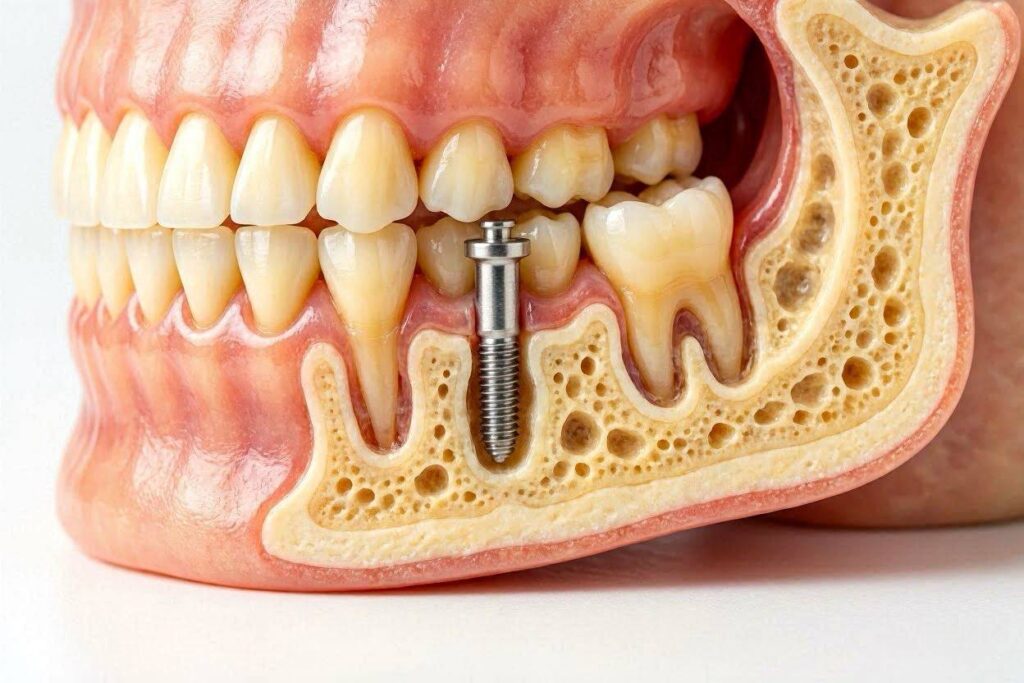
A dental mini implant, commonly abbreviated as MDI, is a titanium alloy post with a diameter of less than 3.0 millimeters. The most established systems feature implants with diameters of 1.8mm, 2.1mm, or 2.4mm. To visualize this, a standard wooden toothpick is about 2.0mm wide. This is the scale of the device. The critical engineering difference is the one-piece, monolithic design. A conventional dental implant consists of a separate implant fixture and a separate abutment that is screwed into it at a later date. An MDI is a single, solid unit. The implant body, the threaded portion that enters the bone, and the prosthetic head, the ball-shaped or square attachment that protrudes above the gum, are machined from one continuous piece of titanium alloy.
This one-piece design has profound implications. It eliminates the micro-gap between an implant and its abutment, a site where bacteria can colonize. It also means the prosthetic head is visible in the mouth from the moment of placement. The threads of an MDI are aggressive, self-tapping, and deeply cut. They are designed to compress the bone laterally as the implant is screwed in, achieving a high degree of primary stability, the mechanical grip that holds the implant absolutely still, even in bone that is dense but very narrow. The metal is typically a Ti-6Al-4V alloy, the same biocompatible, high-strength titanium alloy used in standard implants and orthopedic joint replacements.
The Primary Purpose: A Denture Stabilization Anchor
It is a fundamental error to view a mini implant as a direct substitute for a standard implant in every situation. The standard implant is designed to be a stand-alone, load-bearing unit, capable of withstanding the intense, focused chewing forces on a single molar. A mini implant is designed to be a retaining device. Its primary, and most clinically successful, application is the stabilization of a removable full or partial denture. When a patient bites down on a denture supported by four or six mini implants, the chewing force is distributed across a wide area—the entire denture base and the underlying gum tissue. The mini implants provide grip, retention, and lateral stability. They prevent the denture from floating, tipping, or dislodging. They share the load with the soft tissue. This is why their narrow diameter is mechanically viable in this application. Using a single mini implant to support a stand-alone molar crown, where it would be forced to bear the entire concentrated load of a powerful bite, subjects it to bending fatigue and a significant risk of fracture. A skilled clinician understands this distinction. The MDI is a supreme denture anchor.
The Direct Comparison: Mini Implant vs. Standard Implant
The clinical choice between these two technologies is a decision tree based on bone volume, budget, and the desired prosthetic outcome.
Dimensional and Structural Contrast
A standard implant typically ranges from 3.5mm to 6.0mm in diameter and requires a minimum of 1mm of healthy bone on all sides, demanding a total bone width of at least 5.5mm to 6.0mm. The MDI, at 1.8mm to 2.4mm, can be successfully placed in a ridge of bone as narrow as 3.0mm. The standard implant is a two-piece system, which provides prosthetic versatility—if the crown chips, it can be replaced without disturbing the integrated implant. The MDI is a one-piece system. Its prosthetic ball or square head is fixed. If this head is damaged, the entire implant must be removed.
Surgical and Biological Differences
The placement of a standard implant is a formal surgical procedure, requiring a full-thickness flap, where the gum is incised and folded back, the bone is drilled, and the implant is placed, followed by sutures. The healing is submerged, and the implant is left undisturbed for three to six months. The MDI placement is a minimally invasive, often flapless procedure. A small tissue punch removes a tiny circle of gum, a narrow pilot drill creates a starter channel, and the MDI is screwed through the gum directly into the bone. There are typically no incisions and no stitches. The post-operative discomfort is dramatically less. Standard implants are designed for delayed loading, allowing the biological process of osseointegration to complete before forces are applied. MDIs can often be loaded immediately, with the denture being modified and snapped onto the implants on the same day. This is a profound quality-of-life difference.
| Feature | Dental Mini Implant (MDI) | Standard Dental Implant |
|---|---|---|
| Diameter | 1.8 – 2.4 mm | 3.5 – 6.0 mm |
| Design | One-piece (monolithic) | Two-piece (fixture + abutment) |
| Primary Function | Denture stabilization & retention | Independent tooth root replacement |
| Minimum Bone Width | Approx. 3 mm | Approx. 6 mm |
| Surgical Approach | Minimally invasive, flapless, no sutures | Surgical flap elevation & sutures |
| Typical Loading | Immediate (same day) | Delayed (3-6 months) |
| Post-Op Discomfort | Mild, short duration | Moderate, longer duration |
The MDI Procedure: A Walkthrough
The patient arrives with a loose, well-constructed denture. A 3D CBCT scan has confirmed a narrow but adequate ridge of bone in the anterior (front) zone of the jaw, between the mental foramina where the nerves exit. This is the safe zone. The dentist marks four positions on the gum. Local anesthesia is administered.
A tissue punch, a tiny circular blade, is used to remove a 2-millimeter disc of gum tissue at each site. No scalpel incision is made. A very narrow pilot drill, under copious chilled saline irrigation, is used to create a starter channel to a precisely controlled depth. The MDI, removed from its sterile packaging, is placed into a hand driver or a torque-controlled surgical motor. The dentist screws the implant into the bone. The threads advance, compressing the bone. The final insertion torque is monitored. A value of 35 Ncm or higher is the desired goal, confirming excellent primary stability.
The procedure for four implants takes 30 to 45 minutes. With the implants in place, the dentist now modifies the denture. Small housings containing nylon O-rings are picked up into the underside of the denture using a cold-cure acrylic resin, directly in the patient’s mouth. The denture is then seated over the ball-shaped heads of the implants. The O-rings engage with a satisfying snap. The patient bites down, and the denture is securely locked in place. It can be removed by the patient for cleaning, but it will not move during speech or a careful meal.
The O-Ring Maintenance Reality
The nylon O-ring is the mechanical heart of the retention system. It is a consumable, wear-and-tear component. Over time, typically every 12 to 24 months, the O-ring loses its elasticity and the denture begins to feel less retentive. Replacing the O-rings is a trivial, five-minute, in-office procedure that does not involve the implants. The denture housings are cleaned, and new O-rings are inserted. This is the only routine maintenance cost associated with an MDI-retained denture. The patient must also clean gently but thoroughly around the ball attachments with a soft toothbrush and use a water flosser to irrigate the gum cuff.
The Candidacy Profile
The ideal MDI candidate is a long-term denture wearer, typically in the lower jaw, who has suffered the gradual, inevitable bone resorption that leaves a thin, knife-edged ridge. A conventional implant is impossible without a complex, costly, and lengthy bone grafting procedure. The patient is often older, on a fixed income, and cannot afford a full standard implant reconstruction. The MDI offers a life-changing upgrade to their quality of life at a fraction of the cost and with a surgery that is gentle enough for a medically stable older adult. Heavy smokers, patients with uncontrolled diabetes, or those with severe grinding habits are poor candidates due to impaired healing and excessive force.
Conclusion
A dental mini implant is an ultra-thin, one-piece titanium post, less than 3mm in diameter, engineered primarily as a minimally invasive anchor to securely stabilize a loose removable denture. It differs from a standard implant in its monolithic design, its suitability for very narrow bone ridges, its flapless surgical placement with minimal discomfort, and its ability to immediately secure a denture with a snap-in O-ring system. It is the transformative, affordable solution for patients who have been told they lack the bone for traditional implants.
Frequently Asked Questions
Can a mini implant be used to replace a single missing tooth?
In very limited scenarios, such as a small lower incisor with low biting forces or a congenitally narrow space, a mini implant can support a single crown. However, it is mechanically high-risk for molars and is not the standard of care for single-tooth replacement. A standard-diameter implant is vastly superior for this purpose.
How long do mini dental implants last?
With proper placement, good oral hygiene, and regular O-ring maintenance, mini dental implants can provide decades of reliable service. The most common mechanical complication is a fractured implant neck due to metal fatigue, which is often a result of excessive force or a poor bite alignment, or the natural wear of the O-rings, which is easily addressed.
Is the mini implant procedure painful?
The procedure is remarkably gentle. The flapless, no-stitch technique means post-operative pain is typically mild and manageable with an over-the-counter analgesic for a day. Most patients report far less discomfort than they anticipated.
Can my existing denture be converted to fit mini implants?
In most cases, yes. If your existing denture is well-made, has a sound acrylic base, and fits your mouth correctly, a dentist can retrofit it with the necessary housings and O-rings on the same day the implants are placed. If the denture is old, worn, or poorly fitting, a new denture must be fabricated.
Additional Resource:
For further patient education on mini dental implant technology, visit the resource center of the American Academy of Implant Dentistry at www.aaid.com.
Disclaimer: This article provides a comprehensive educational overview of mini dental implants. A personal consultation and a 3D radiographic examination by a qualified implant dentist are required to determine if you are a candidate for this specific treatment.