Can You Get Gold Dental Implants?
Gold has been used in dentistry for centuries. Gold fillings and crowns have a long history of durability and biocompatibility. When it comes to dental implants, many patients wonder if gold is an option. The idea of a gold dental implant sounds luxurious and durable, but is it actually possible?
This guide explores the reality of gold dental implants. You will learn about the materials used in dental implants, whether gold implants exist, alternatives that incorporate gold, and the costs involved.
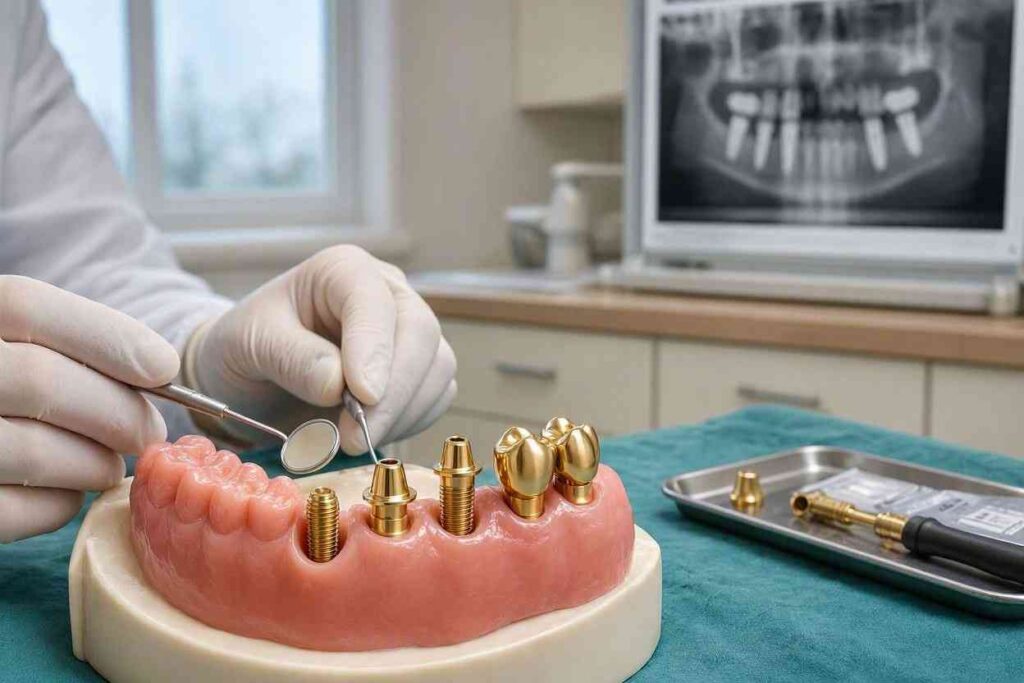
Understanding Dental Implant Materials
To understand whether gold dental implants are possible, it helps to know what dental implants are made of and why.
Titanium Implants
The vast majority of dental implants are made from titanium or titanium alloys. Titanium is the material of choice because it has a unique ability to fuse with bone. This process, called osseointegration, is essential for implant success. The bone cells attach directly to the titanium surface, creating a strong and stable foundation.
Titanium is also lightweight, strong, and resistant to corrosion. It has been used in medical implants for over 50 years with excellent results.
Zirconia Implants
Zirconia implants are a metal-free alternative. They are made from zirconium dioxide, a ceramic material. Zirconia is white, which some patients prefer for aesthetic reasons. It also integrates well with bone and is suitable for patients with metal sensitivities.
Zirconia implants are newer than titanium but have shown promising results in clinical studies.
Why Not Gold?
Gold is a noble metal that is highly resistant to corrosion and biocompatible. However, gold is too soft to serve as a dental implant. Pure gold would bend and deform under the forces of chewing. Even gold alloys are not strong enough to withstand the demands placed on a dental implant.
Additionally, gold does not osseointegrate the way titanium does. Bone cells do not attach to gold surfaces as readily. Without osseointegration, the implant would not be stable.
Do Gold Dental Implants Exist?
The short answer is no. True gold dental implants, where the implant post itself is made of gold, do not exist. Gold is not a suitable material for the implant fixture that is placed in the jawbone.
However, gold can be used in other parts of the implant restoration. This is where the confusion often arises.
Gold Abutments
The abutment is the connector piece that attaches to the implant post and supports the crown. Abutments can be made from various materials, including titanium, zirconia, and gold.
Gold abutments are available and are used in some cases. They are typically made from a gold alloy that is strong enough for this purpose. Gold abutments are less common than titanium or zirconia abutments, but they are a legitimate option.
Gold Crowns on Implants
The visible part of the implant restoration is the crown. Crowns can be made from porcelain, zirconia, or metal alloys including gold.
A gold crown on a dental implant is entirely possible. The implant post is titanium, but the crown placed on top can be made of gold. Gold crowns are extremely durable and have been used in dentistry for decades.
Some patients choose gold crowns on implants for their durability, especially on back teeth where chewing forces are greatest. Others choose gold for aesthetic reasons, as a visible statement of luxury.
Gold-Plated Components
Some implant components may be gold-plated for aesthetic or functional reasons. However, gold plating is not the same as a solid gold implant. The underlying material is still titanium or another suitable metal.
Cost of Gold Dental Implants
While true gold implants do not exist, you can get a titanium implant with gold components. Here is what that might cost.
Standard Implant with Porcelain Crown
A standard titanium implant with a porcelain crown costs between $3,000 and $5,000 per tooth. This is the most common type of implant restoration.
Titanium Implant with Gold Abutment and Gold Crown
If you choose a gold abutment and gold crown on a titanium implant, the cost increases. A gold abutment adds $200 to $500 compared to a standard titanium abutment. A gold crown costs between $1,000 and $2,500 depending on the amount of gold used.
The total cost for a titanium implant with gold abutment and gold crown ranges from $4,500 to $8,000 per tooth.
Full Gold Restoration
For a complete gold restoration, including a gold abutment and a full gold crown, the cost ranges from $5,000 to $10,000 per tooth. The price depends on the current market price of gold and the complexity of the case.
Cost Comparison Table for Implant Options
Here is a quick reference table comparing different implant restoration options.
| Implant Type | Abutment Material | Crown Material | Cost per Tooth |
|---|---|---|---|
| Standard Implant | Titanium | Porcelain | $3,000 – $5,000 |
| Aesthetic Implant | Zirconia | Zirconia | $3,500 – $6,000 |
| Gold Accent Implant | Gold | Porcelain fused to gold | $4,500 – $7,000 |
| Full Gold Restoration | Gold | Full gold | $5,000 – $10,000 |
Why Choose Gold Components?
Even though true gold implants do not exist, there are reasons why some patients and dentists prefer gold components.
Durability
Gold is extremely durable and resistant to wear. Gold crowns can last 20 years or more with proper care. They do not chip or crack the way porcelain can.
Biocompatibility
Gold is highly biocompatible. It does not cause allergic reactions in most people. Patients with sensitivities to other metals may tolerate gold well.
Gentle on Opposing Teeth
Gold is softer than porcelain, which means it is gentler on the opposing teeth. Porcelain crowns can wear down natural teeth over time. Gold does not cause this type of wear.
Aesthetics
Some patients simply prefer the look of gold. Gold teeth have been a status symbol in some cultures for decades. A gold crown on an implant can be a personal style choice.
Alternatives to Gold Dental Implants
If you are interested in gold but concerned about cost or other factors, consider these alternatives.
Porcelain Fused to Gold Crowns
A porcelain fused to metal crown has a metal base covered with porcelain. The metal base can be gold alloy. This gives you the durability of gold with the aesthetics of porcelain. The cost is lower than a full gold crown.
Gold-Colored Zirconia
Some zirconia crowns can be tinted to have a gold appearance. This gives you the look of gold without the cost of actual gold. However, the durability and properties are those of zirconia, not gold.
Gold Fillings and Inlays
If you have natural teeth that need restoration, gold fillings and inlays are available. These are made from gold alloy and are extremely durable. They are a good option for back teeth.
Important Notes for Patients
- True gold dental implants do not exist. The implant post is always made of titanium or zirconia.
- Gold can be used for the abutment and crown components of an implant restoration.
- Gold crowns on implants are extremely durable and can last decades.
- The cost of gold restorations depends on the current market price of gold.
- Gold is biocompatible and suitable for patients with metal sensitivities.
- Discuss your preferences with your dentist to determine the best options for your case.
Frequently Asked Questions
Can you get a solid gold dental implant?
No, solid gold dental implants do not exist. Gold is too soft to serve as an implant post. Implant posts are made of titanium or zirconia.
Can you get a gold crown on a dental implant?
Yes, you can get a gold crown on a dental implant. The implant post is titanium, and the crown placed on top can be made of gold alloy.
How much does a gold dental implant cost?
A titanium implant with a gold abutment and gold crown costs between $4,500 and $10,000 per tooth. The price depends on the amount of gold used and current gold prices.
Are gold crowns on implants safe?
Yes, gold crowns on implants are safe. Gold is biocompatible and has been used in dentistry for centuries. Gold crowns are durable and long-lasting.
Why are gold crowns so expensive?
Gold crowns are expensive because gold is a precious metal. The cost of the crown depends on the amount of gold used and the current market price of gold.
Do gold crowns last longer than porcelain crowns?
Gold crowns are extremely durable and can last 20 years or more. Porcelain crowns may chip or crack over time. Gold is more resistant to wear and fracture.
Can I be allergic to gold dental components?
Gold allergy is extremely rare. Gold is one of the most biocompatible metals. Most patients tolerate gold restorations without any problems.
Is gold better than porcelain for implant crowns?
Gold and porcelain each have advantages. Gold is more durable and gentler on opposing teeth. Porcelain offers better aesthetics. The best choice depends on the location of the implant and your personal preferences.
Conclusion
True gold dental implants do not exist because gold is too soft to serve as an implant post. However, you can get a titanium implant with gold components, including a gold abutment and gold crown. Gold restorations are durable, biocompatible, and long-lasting. The cost ranges from $4,500 to $10,000 per tooth depending on the amount of gold used. If you are interested in gold dental components, discuss your options with your dentist.
Additional Resource
For more information on dental implant options and finding a qualified implant dentist, visit the American Academy of Implant Dentistry at www.aaid.com. This professional organization offers patient education resources and a directory of credentialed implant dentists.