What Are The FAQs For Dental Implants?
Dental implants represent the most significant advancement in tooth replacement in modern dentistry. They are surgically placed titanium or zirconia posts that replace missing tooth roots and support crowns, bridges, or dentures. Patients considering or living with dental implants have a consistent set of questions. This guide compiles and answers the most frequently asked questions about dental implants with depth, accuracy, and honesty. It serves as a comprehensive reference for anyone navigating the implant journey, from initial consideration to long-term maintenance.
The Basics: What, Who, and Why
What exactly is a dental implant?
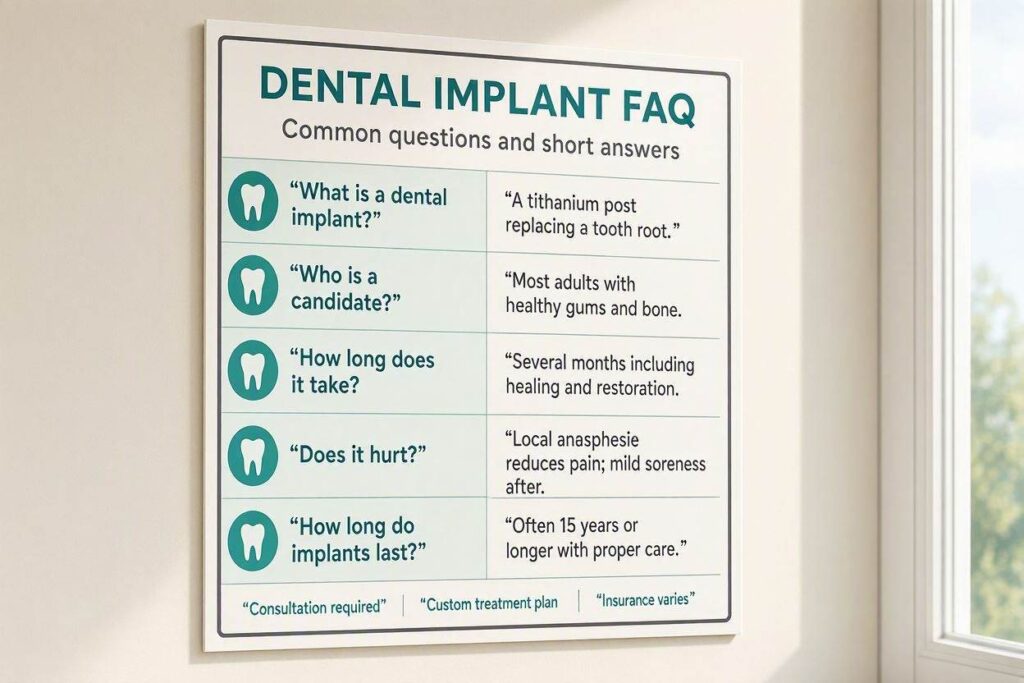
A dental implant is an artificial tooth root. It is a small, threaded post, most commonly made of commercially pure titanium or a titanium alloy, that is surgically placed into the jawbone. Over a healing period of three to six months, the bone cells grow directly onto the implant surface in a process called osseointegration. Once integrated, the implant provides a stable foundation for a prosthetic tooth. The visible replacement tooth—a crown, a bridge, or a denture attachment—is secured to the implant.
Am I a candidate for dental implants?
Most healthy adults with one or more missing teeth are candidates for dental implants. The essential requirements are adequate bone volume and density in the jaw to support the implant, healthy oral soft tissues free of active periodontal disease, and a medical status that permits elective oral surgery. There is no upper age limit. An 85-year-old in good health can successfully receive implants.
Factors that complicate candidacy include heavy smoking, uncontrolled diabetes, active chemotherapy or radiation therapy to the jaws, and long-term use of certain medications such as intravenous bisphosphonates. These are not absolute contraindications in every case but require careful evaluation by the implant surgeon in coordination with the patient’s physician.
Why choose an implant over a bridge or denture?
Dental implants offer distinct advantages. An implant replaces a single tooth without involving the adjacent healthy teeth. A conventional fixed bridge requires the adjacent teeth to be ground down to support the bridge. An implant preserves the jawbone. When a tooth is lost, the alveolar bone that supported it begins to resorb. The implant transmits chewing forces to the bone, maintaining its density and volume. A bridge or denture does not preserve bone.
An implant-supported restoration is fixed and non-removable. It functions and feels like a natural tooth. A removable partial denture or complete denture rests on the gum tissue, can move during function, and requires removal for cleaning. Implants provide superior chewing efficiency, speech clarity, and psychological comfort.
How long do dental implants last?
Dental implants have published long-term survival rates of over 95% over ten years and can last a lifetime. The implant body, made of biocompatible titanium or zirconia, does not decay and is highly resistant to corrosion. The implant crown, like any dental crown, has a finite service life of 10 to 15 years on average and may require replacement due to wear, fracture, or aesthetic changes. The longevity of the implant depends overwhelmingly on the patient’s long-term maintenance and risk factor control.
The Procedure: Pain, Time, and Steps
Is the implant surgery painful?
The implant placement surgery itself is not painful. It is performed under local anesthesia, which completely numbs the surgical site. Many patients also receive sedation—nitrous oxide, oral conscious sedation, or intravenous sedation—for anxiety control. During the procedure, the patient feels pressure and vibration but no sharp pain.
Postoperative discomfort is typically mild to moderate, peaking at 24 to 48 hours. It is managed effectively with over-the-counter analgesics such as ibuprofen or acetaminophen, or with a short course of prescribed pain medication. Most patients return to normal activities the day after surgery.
How long does the entire implant process take?
The complete timeline from implant placement to final crown delivery is three to six months for a straightforward case without bone grafting. The implant is placed and allowed to heal undisturbed for three to six months. After osseointegration is confirmed, the final impression is taken, and the crown is fabricated and delivered over two to four weeks.
If a tooth requires extraction before implant placement, the total timeline extends. Immediate placement on the day of extraction shortens the process. Delayed placement after socket healing adds three to six months. If significant bone grafting is required, the grafting heals for three to nine months before implant placement, extending the total timeline to nine to fifteen months.
Do I need bone grafting?
If the jawbone at the implant site is insufficient in width, height, or density, a bone graft is necessary. Bone resorption after tooth loss is a natural, progressive process. A cone beam computed tomography (CBCT) scan precisely measures the available bone. The surgeon will determine whether grafting is required. Minor grafting can often be performed at the same time as implant placement. Major grafting, such as a block bone graft or a lateral window sinus lift, requires a separate surgical procedure and a dedicated healing period.
What is the success rate of dental implants?
Dental implants are the most successful tooth replacement option. In healthy patients, the survival rate of single implants in the anterior mandible exceeds 97% over ten years. Implants in the posterior maxilla, where bone is less dense and the sinus limits available height, have a slightly lower survival rate, around 93% to 95%. Success depends on surgical precision, patient health, and long-term maintenance. Smoking, uncontrolled diabetes, and poor oral hygiene are the most significant modifiable risk factors for failure.
The Different Types of Implant Restorations
How many implants do I need?
The number of implants depends on the restoration type. A single missing tooth requires one implant. A short span of missing teeth, such as three or four adjacent teeth, can be replaced with two implants supporting a fixed bridge. A completely edentulous arch can be restored with as few as four implants (All-on-4) supporting a fixed full-arch bridge, or with two to four implants supporting a removable snap-on overdenture. More implants generally provide greater stability, load distribution, and long-term security.
What is an All-on-4?
The All-on-4 treatment concept uses four implants in a single arch to support a fixed, screw-retained full-arch bridge. The two posterior implants are angled, often at 30 to 45 degrees, to maximize the use of available bone and avoid anatomical structures like the maxillary sinus and the inferior alveolar nerve. The bridge is attached on the same day as surgery in many cases. The All-on-4 concept is a well-researched and predictable option for the edentulous arch, particularly in the mandible.
Can I have teeth on the same day as implant surgery?
Yes, in selected cases. Immediate implant placement with an immediate provisional crown can provide a visible tooth on the day of extraction and implant placement. Full-arch immediate loading—the All-on-4 or Teeth in a Day protocol—provides a fixed provisional bridge on the day of surgery. These same-day teeth are provisional restorations, not the final prostheses. They are worn during the osseointegration healing period of four to six months, after which the definitive, custom-fabricated bridge is delivered.
Costs, Insurance, and Financing
How much does a single dental implant cost?
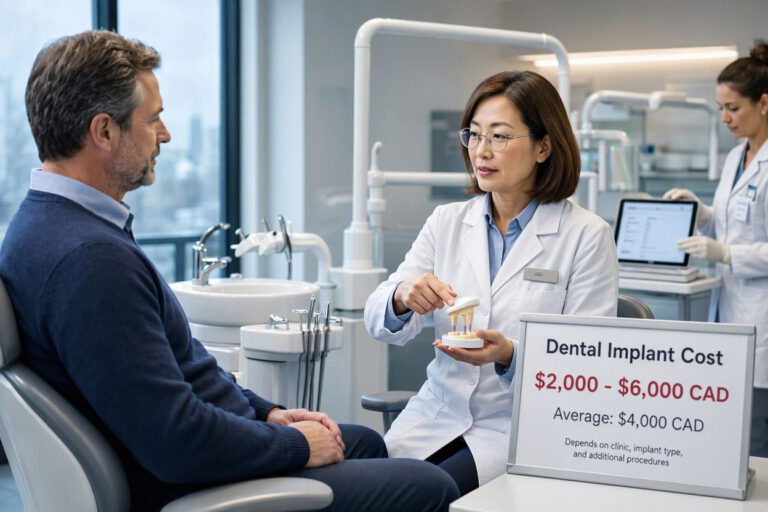
The all-inclusive cash cost of a single dental implant, including the surgical placement, the abutment, and the implant crown, ranges from approximately $3,500 to $6,000 in the United States. The fee varies by geographic location, the type of implant system used, the need for bone grafting, and the expertise of the provider. A full breakdown is provided in the dedicated cost guides earlier in this series.
Does dental insurance cover implants?
Dental insurance coverage for implants is increasing but remains inconsistent. PPO plans that cover implants typically classify them as a major service, subject to 50% coinsurance and the annual maximum, usually $1,500 to $2,000. The plan pays a portion of the allowed amount, and the patient pays the remainder. Many individual plans exclude implants or impose a 12-month waiting period. Employer-sponsored plans are more likely to offer implant coverage. You must verify your specific plan’s benefits.
What if I cannot afford dental implants?
Multiple pathways to reduced-cost implant care exist. Dental schools and residency programs offer implants at 40% to 60% below private practice fees. Federally Qualified Health Centers provide sliding fee scales based on income. Dental tourism to Mexico, Costa Rica, or other countries can reduce costs by 50% to 70%. Third-party financing through CareCredit and similar lenders divides the total fee into manageable monthly payments. These options are detailed in earlier guides in this series.
Living With Implants: Maintenance and Longevity
How do I clean my dental implants?
Implants require a dedicated daily cleaning protocol. A soft-bristled electric or manual toothbrush cleans the visible crown surfaces. An interdental brush is the essential tool for cleaning the critical implant-crown-gum interface, where peri-implantitis begins. Shred-resistant PTFE floss and a water flosser with a non-metal tip provide additional plaque disruption. Professional maintenance with a hygienist every three to six months, using non-metal instruments, is non-negotiable. This topic is exhaustively covered in the dedicated cleaning guide.
Can I get an MRI with dental implants?
Yes. Dental implants are made of titanium or zirconia, which are non-ferromagnetic or weakly paramagnetic materials. They do not pose a safety risk during MRI scans. The implant may create a localized artifact—a distortion or dark area—on the MRI image, which can obscure the view of adjacent structures. The patient should inform the MRI technologist of the presence of dental implants, but the scan can proceed safely.
Can dental implants get cavities?
No. Implant crowns are made of porcelain, zirconia, or composite resin, none of which can decay. The implant body is made of titanium or zirconia, which cannot decay. However, the implant is susceptible to peri-implantitis, a bacterial infection that destroys the supporting bone, analogous to periodontitis around natural teeth. Implants do not get cavities, but they are not immune to disease. The prevention of peri-implantitis through biofilm control is the primary maintenance goal.
What if my implant fails?
Implant failure is uncommon but recognized. Early failure occurs within weeks of placement and is due to failed osseointegration. Late failure occurs years later due to peri-implantitis or biomechanical overload. A failed implant is removed using the techniques described in the dedicated removal guide. After a healing period and often a bone graft, a new implant can be placed. The vast majority of failed implant sites can be successfully re-treated.
The Consultation Process
What should I ask my implant dentist at the consultation?
The essential questions cover training, experience, planning, and communication. Ask about the dentist’s specific implant training and credentials, the number of similar cases they have completed, the type of implant system they use, whether they use CBCT-guided planning, who will perform the surgical and restorative phases, the expected total timeline, the all-inclusive cost, and the complication and failure management policy. A written treatment plan with ADA codes and fees should be provided. A thorough, unrushed consultation that welcomes your questions is a positive indicator.
Conclusion
Dental implants are the most durable, functional, and bone-preserving tooth replacement option, with success rates exceeding 95% and the potential to last a lifetime with proper care. The procedure involves a surgical phase under local anesthesia with manageable postoperative discomfort, a healing period of three to six months for osseointegration, and a restorative phase that delivers a custom crown, bridge, or denture. Long-term success depends entirely on meticulous daily biofilm control, regular professional maintenance, and the management of personal risk factors like smoking and uncontrolled diabetes, making the patient an active partner in the implant’s longevity.
Frequently Asked Questions
What is the minimum age for dental implants?
Dental implants are contraindicated in growing children and adolescents. The jaw must be skeletally mature. For females, this is typically age 15 to 17. For males, age 17 to 21. Cephalometric X-rays taken at least six months apart confirm that growth has ceased. Placing an implant in a growing jaw results in infraocclusion as the adjacent natural teeth continue to erupt.
Can I smoke and have dental implants?
Smoking significantly increases the risk of implant failure and peri-implantitis. Smokers have a failure rate approximately two to three times higher than non-smokers. The vasoconstrictive and immunosuppressive effects of nicotine impair wound healing and osseointegration. Many implant surgeons require a smoking cessation period before and after surgery. Quitting smoking is the most impactful risk-reduction step a patient can take.
Is there a warranty on dental implants?
Many implant manufacturers offer a limited lifetime warranty that covers the cost of a replacement implant if the fixture fractures. The warranty typically does not cover the surgical fee for removal and replacement, the bone grafting, or the prosthetic components. Some dental practices offer their own restoration warranty covering abutment screw loosening or crown defects for a defined period. Warranty terms vary. Ask for the written warranty documentation.
Can I have an MRI if I have a dental implant?
Yes, dental implants are MRI-compatible. They are made of non-ferromagnetic materials and do not pose a safety risk. Inform the MRI technologist that you have dental implants.
Additional Resource
The American Academy of Implant Dentistry maintains a comprehensive patient education section at aaid.com. The site includes an “Understanding Dental Implants” guide, a searchable directory of AAID-credentialed implant dentists, and detailed explanations of implant procedures, risks, and maintenance. This is an authoritative starting point for anyone beginning their implant research.